China visa or visa-free transit: which one do you need?
Unilateral visa-free (50 countries), 240-hour transit, regional visa-free, 27 treaty countries. These four do not stack or clash — take the one that fits you.
Do not book an embassy appointment yet. China now runs four parallel visa-free routes, and a lot of people turn out not to need a visa at all. Work down the list first; apply only if none of them fits.
1. Four routes — take the one that fits
Broadly, China grants unilateral visa-free entry to countries it has no mutual agreement with, and applies the agreement where one exists. The two lines are deliberately kept apart. Unilateral visa-free (50 countries), visa-free transit (240 hours), regional visa-free (Hainan and others) and the mutual exemption agreements (27 countries, ordinary passports) do not stack and do not clash — you take whichever one you qualify for. If you already qualify for unilateral visa-free, the entries for your country in the agreement table mostly cover diplomatic and service passports anyway, which has little to do with a tourist on an ordinary passport.
| Route | Who it covers | Length of stay | Key conditions |
|---|---|---|---|
| Unilateral visa-free | ordinary passports of 50 countries | 30 days | business, tourism, visiting family and friends, exchanges, transit; no onward ticket required |
| Visa-free transit (240 hours) | ordinary passports of 57 countries | 10 days | must be heading to a third country or region, with an onward ticket with the date and seat confirmed, entering through one of 65 designated ports |
| Visa-free transit (24 hours) | every country | 24 hours | do not leave the port’s restricted area; leaving requires a temporary entry permit first |
| Regional visa-free | Hainan 61 countries, cruise groups, ASEAN groups, groups transferring in from Hong Kong and Macao | 6–30 days | limited to defined areas, and some require travelling with a group |
| Mutual visa exemption agreements | ordinary passports of 27 countries | normally within 30 days | as set out in the agreement |
For every one of these policies, the permitted stay is counted from 00:00 on the day after you enter.
2. How to work out which one is yours
- Check the 50-country unilateral visa-free list first. If you are on it, this is by far the easiest route: 30 days, no onward ticket required, and tourism, business and family visits all qualify. The list is in the entry rules, section 2.
- Not on the list? Check whether your trip is actually “transit”. If your next leg flies to a different country or region, and you are a citizen of one of the 57 countries holding an ordinary passport and an onward ticket with the date and seat confirmed, use 240-hour visa-free transit. Note that returning to the country you came from does not count as transit.
- Only connecting at the airport, not going out. That is the 24-hour route, which applies to every country. See can I leave the airport on a China layover.
- Only going to Hainan, or joining a cruise group, an ASEAN tour group, or a tour group transferring into Guangdong or Hainan from Hong Kong or Macao. Look at regional visa-free, in the entry rules, section 4.
- None of the above? Then check the agreements. 27 countries have mutual visa exemption for ordinary passports; see the entry rules, section 8.
One more thing worth repeating: even if you qualify for visa-free transit, work, study and news reporting still require prior approval and the appropriate visa. You cannot enter visa-free and do those.
3. None of them fits: applying for a visa
If none of the visa-free policies above covers you, you need a visa. Start at the China Consular Service Network, or the site of your local Chinese embassy or consulate, and read the policy and requirements there.
Pick the visa category that matches your main purpose for coming — an L visa for tourism, an M visa for business, and so on. The process runs: fill in the application form online at consular.mfa.gov.cn/VISA/ → assemble the documents on the checklist published by the Chinese embassy or consulate covering your area → submit the passport and give fingerprints.
The full table of visa categories (C, D, F, G, J1, J2, L, M, Q1, Q2, R, S1, S2, X1, X2, Z) and the documents each one needs is in the entry rules, section 7.
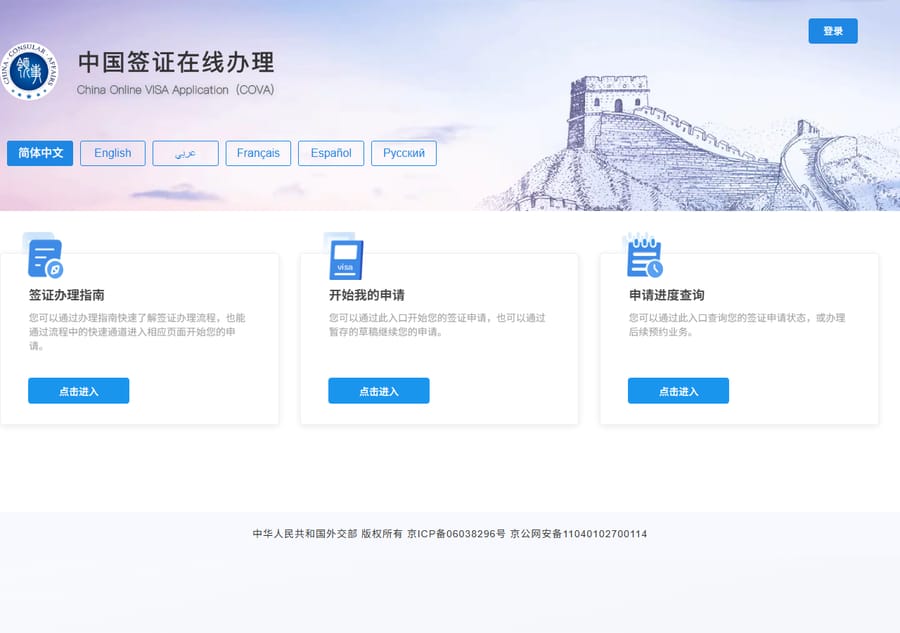
From here you can fill in the form, book an appointment, and check how your application is progressing. The top right of the page switches between English, French, Spanish, Russian and Arabic.
4. Two things to do whichever route you take
- Verify it on the official site. The entry rules that apply to your passport are whatever the National Immigration Administration site says that day. No other website is trustworthy.
- Fill in the arrival card online before takeoff. It is free, and the only official channels are the site s.nia.gov.cn/ArrivalCardFillingPC/, the “移民局 12367” app, and the WeChat mini program of the same name. Details in China visa-free transit: how to confirm it before you fly.
Sources
Questions visitors ask
- Can visa-free entry, visa-free transit and treaty exemptions be combined?
- They do not stack, and they do not clash. Unilateral visa-free (50 countries), visa-free transit (240 hours), regional visa-free (Hainan and others) and the mutual exemption agreements (27 countries, ordinary passports) are four parallel routes. Take whichever one you qualify for.
- I am already on the 50-country visa-free list. Do I still need to satisfy the transit conditions?
- No. Unilateral visa-free gives you 30 days and asks for no onward ticket to a third country or region, which is far looser than visa-free transit. Just enter visa-free.
- When do I actually have to apply for a visa?
- When none of the four visa-free routes fits you, or when your purpose is work, study, or news reporting. Those need prior approval and the right visa even during a visa-free transit stay.
- Where do I start a visa application?
- Read the requirements on the China Consular Service Network at cs.mfa.gov.cn, or on the site of your local Chinese embassy or consulate. Then use the China Online Visa Application system at consular.mfa.gov.cn/VISA/ to fill in the form, book an appointment and track progress.