What to Wear in China by Month & City: Packing Matrix
China spans several climate zones, so never pack for a generic 'Asian summer' or 'Chinese winter.' Start with three year-round basics—quick-dry base tops, a packable windproof shell, and grippy walking shoes—then use the month-by-city table below to add the right mid-layer for your exact stops.
China is extremely wide and extremely long, so at any given moment the temperature is different everywhere. In the same week, Heilongjiang in the north is frozen while Guangdong in the south is still in T-shirts. Pack by month and city, not for “China”.
The two classic packing mistakes are bringing only cotton T-shirts for an “Asian summer” and freezing in northern autumn wind or 18°C metro cars, or hauling a heavy wool coat into humid southern hills where you sweat through your shirt in ten minutes. Pack by specific city and month, not by national averages.
A three-piece base that works everywhere
Before checking the weather for individual cities, put these three items in your bag. They solve more daily problems than five extra outfits:
- Quick-dry base shirts you can wash in a hotel sink: in humid southern summers and rainy seasons, heavy cotton stays damp for 48 hours.
- A packable hooded windproof and water-resistant shell: blocks windy train platforms, sudden autumn showers, and aggressive air conditioning while taking up no space in a daypack.
- Broken-in walking shoes with real tread: polished mall stone, wet metro stairs, and historic courtyards are slick when wet. Leave smooth-soled dress shoes and brand-new white sneakers at home.
Those three are the base. Do not decide the rest from memory. Check the forecast and the temperature for your destination before you go — once a week out, and again the day before — and let that decide how many mid-layers to pack. The two tables below are for exactly that: the first gives long-term average temperatures and typical weather so you know what season that month really is, and the second translates it into outfits.
First, the temperature and the weather
These are long-term average daytime highs and overnight lows, with the weather that month is known for. Use them to judge what weight of clothing to bring, and check an actual forecast before you fly — a 10°C swing inside one week is normal in Chinese spring and autumn.
| Month | Beijing | Shanghai / Hangzhou | Xi’an | Chengdu / Chongqing | Guangzhou / Shenzhen |
|---|---|---|---|---|---|
| Jan | 2 / −8 °C · clear, cold, dry | 8 / 1 °C · damp cold, drizzle | 5 / −4 °C · dry cold | 10 / 4 °C · grey, damp, chilly | 19 / 11 °C · mild and dry |
| Feb | 5 / −6 °C · clear and cold | 10 / 3 °C · damp cold | 9 / −1 °C · dry cold | 13 / 6 °C · grey and chilly | 20 / 13 °C · “return of the south wind”, condensation everywhere |
| Mar | 12 / 0 °C · windy, occasional dust | 15 / 6 °C · warming, rainy | 15 / 4 °C · warming, windy | 18 / 10 °C · warming | 23 / 16 °C · humid and foggy |
| Apr | 20 / 7 °C · warm, windy | 21 / 12 °C · pleasant, rainy | 21 / 9 °C · pleasant | 24 / 15 °C · warm | 27 / 20 °C · muggy, rainy |
| May | 26 / 13 °C · dry heat | 26 / 17 °C · warm, rainy | 27 / 14 °C · dry heat | 28 / 19 °C · warm | 30 / 23 °C · rainy season begins |
| Jun | 30 / 18 °C · humid, thunderstorms | 28 / 21 °C · plum rains, days of drizzle | 32 / 19 °C · hot | 30 / 22 °C · muggy, rainy | 32 / 25 °C · heaviest rain of the year |
| Jul | 31 / 22 °C · hottest and wettest | 33 / 25 °C · sauna heat | 33 / 22 °C · very hot | 32 / 24 °C · fierce heat (Chongqing often above 35 °C) | 33 / 26 °C · fierce heat, typhoon season |
| Aug | 30 / 21 °C · humid, thunderstorms | 33 / 25 °C · fierce heat, typhoon season | 31 / 21 °C · very hot | 33 / 24 °C · the peak (Chongqing often above 38 °C) | 33 / 26 °C · fierce heat, typhoon season |
| Sep | 26 / 15 °C · crisp and clear | 28 / 21 °C · muggy, cooling | 25 / 16 °C · long autumn rains | 27 / 20 °C · overcast, rainy | 32 / 25 °C · still hot, still typhoons |
| Oct | 19 / 8 °C · sunny and cool | 23 / 15 °C · clear and dry, the best month | 20 / 10 °C · cool, rainy | 22 / 16 °C · cool, grey, rainy | 29 / 21 °C · drying out |
| Nov | 10 / 0 °C · winter arrives fast, hard north wind | 17 / 9 °C · noticeably cooler | 13 / 3 °C · turning cold | 17 / 11 °C · grey and chilly, little sun | 25 / 17 °C · the nicest month of the year |
| Dec | 4 / −6 °C · dry cold, heated indoors | 11 / 3 °C · damp cold, unheated indoors | 6 / −2 °C · dry cold | 11 / 6 °C · chilly, almost no sun | 21 / 12 °C · mild and dry |
Remember one dividing line: north of the Qinling–Huaihe line, buildings have municipal heating; south of it, they do not. That is why 5 °C in Shanghai, Hangzhou, Chengdu or Chongqing often feels worse than −5 °C in Beijing — it is cold outside, cold inside, and damp.
Then, what to wear
This table turns those temperatures into outfits you can walk out the door in:
| Month | Beijing | Shanghai / Hangzhou | Xi’an | Chengdu / Chongqing | Guangzhou / Shenzhen |
|---|---|---|---|---|---|
| Dec–Feb | Heavy down coat + thermal base layers + hat & gloves (freezing outside, heated indoors) | Packable down coat + fleece mid-layer (damp cold, no central heating indoors) | Heavy down jacket + windproof trousers (bitter wind on the city wall) | Light down or insulated jacket + sweater (rarely freezes, but damp and grey) | Light jacket + hoodie over a T-shirt (mild days, occasional cool fronts) |
| Mar–Apr | Windproof jacket + light sweater (big day-night swings, dry wind) | Water-resistant shell + long-sleeve shirt or knit (spring rain, cool evenings) | Trench or light jacket + long-sleeve tee (warm sun at noon, fast evening chill) | Light jacket + breathable long sleeve (warms up early; carry a compact umbrella) | Short sleeves + thin cardigan for mall AC (early summer feel, humid afternoons) |
| May–Jun | Short sleeves + light sun shirt (dry heat by day, pleasant nights) | Breathable tees + umbrella + water-resistant shoes (June plum rains and high humidity) | Short sleeves + sun hat + sunglasses (strong dry sun on open plazas) | Quick-dry tees + light rain shell (muggy afternoons, frequent showers) | Ultra-light quick-dry summer clothes + umbrella (hot, humid, tropical downpours) |
| Jul–Aug | Quick-dry summer tops + sun hat (hot and bright, afternoon thunderstorms) | Quick-dry summer wear + spare dry tee in daypack (intense humid heat) | Breathable summer clothes + UV sun hoodie (fierce sun at outdoor sites) | Quick-dry tees + airy shorts or trousers (stifling humidity, very little breeze) | Lightest quick-dry clothes + thin layer for icy mall/metro AC + water-friendly shoes |
| Sep–Oct | Long-sleeve tee + fleece + wind shell (crisp autumn; late Oct turns cold fast) | Sep stays summery; Oct is ideal in a long sleeve + light jacket | Long-sleeve top + light jacket or hoodie (October autumn rain feels chilly) | Tee or thin long sleeve + light shell (misty, humid valleys; cooler on ridges) | Short sleeves + light layer (drier, comfortable warm weather) |
| Nov | Packable or heavy down coat (early winter wind arrives mid-month) | Windproof coat or down vest + sweater (damp chill sets in by late Nov) | Light down jacket or lined shell (near-winter mornings and nights) | Sweater or fleece + windbreaker (overcast skies, damp air) | Short or light long sleeves + light jacket (mild, dry, no winter gear needed) |
Travelling in autumn? Read what to wear in China in October. For peak heat or deep cold, see the China summer packing list and China winter packing list.
Indoors matters more than outdoors
Your biggest comfort swings in China happen when you step through a doorway, not while you walk down the street.
In July and August, you walk out of sticky afternoon heat straight into metro cars, malls, and high-speed trains chilled like refrigerators. In January, Beijing’s outdoor air stings your face, yet museums, restaurants, and subway stations are heated so warmly that a pullover sweater makes you sweat. The fix in both seasons is the same: wear a presentable base shirt you can strip down to indoors, and use full-zip mid-layers you can take off in thirty seconds.
Notes for women travellers
Everyday street dress in Chinese cities is relaxed—shorts, leggings, sleeveless tops, and dresses attract no trouble in commercial districts. Plan around practical friction instead:
- Squat toilets and wet floors: many park, station, and older attraction restrooms have squat stalls with damp tile floors; ankle-dragging wide-leg trousers and jumpsuits are a headache.
- Temples and religious sites: keep a light scarf or cardigan and knee-covering trousers or a midi skirt in your bag for active temples and mosques.
See the full breakdown in what women tourists wear in China.
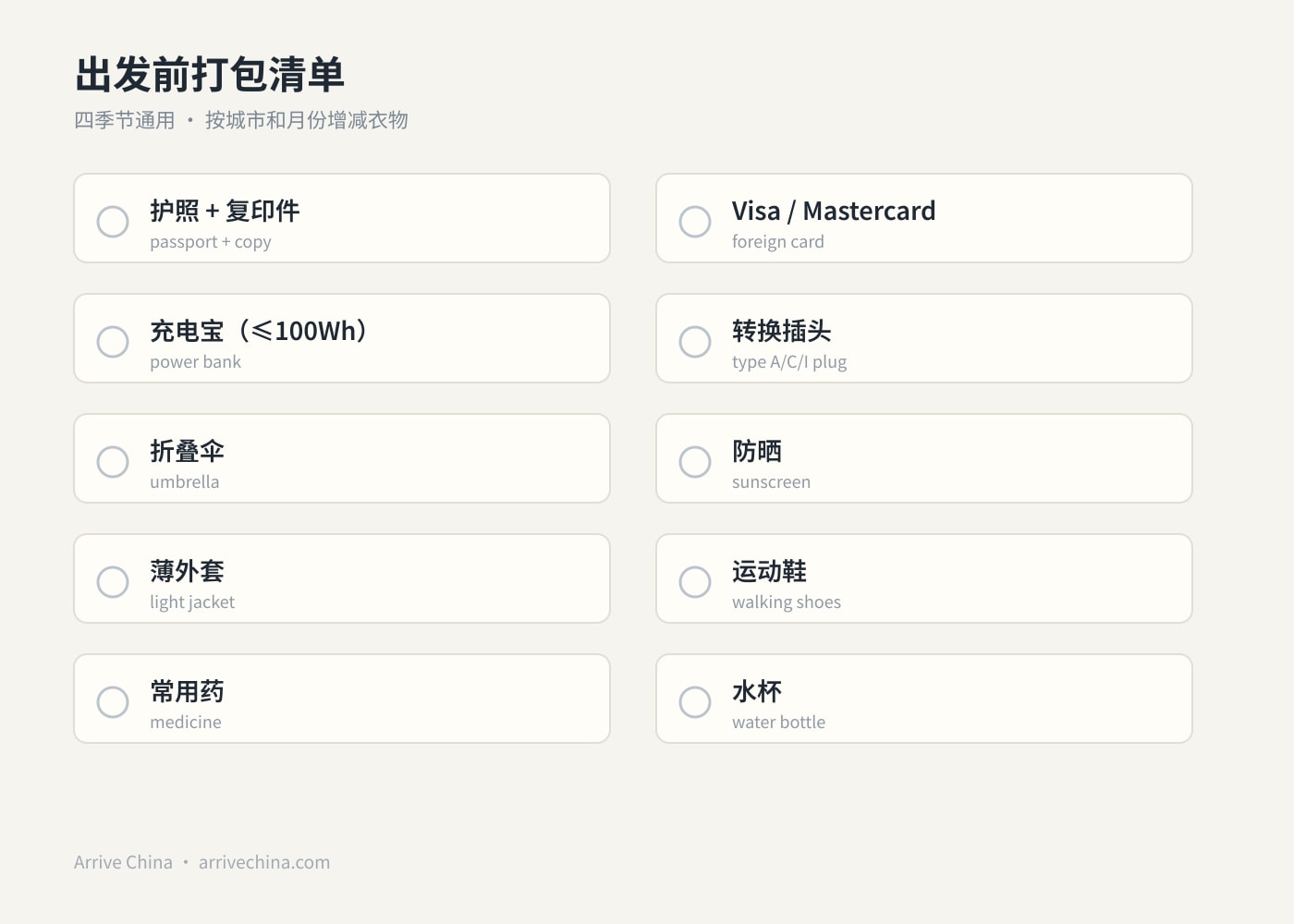
Photo: Made by Arrive China
Southern humidity changes everything
If you live in a dry climate, factor humidity into your packing for Shanghai, Hangzhou, Chengdu, Chongqing, Guangzhou, and Shenzhen.
In summer, high humidity stops sweat from evaporating, and thick cotton shirts hung in a hotel bathroom stay wet for two days—pack synthetic quick-dry or merino underwear, socks, and tees. In winter, cities south of the Qinling–Huaihe line do not have municipal radiator heating. A damp 8°C hotel room or café feels colder than a dry 0°C pavement in Beijing; thermal leggings and warm socks matter more than a heavy unlined fashion coat. Still deciding on your route? Compare entry stops in which city to visit first in China.
Questions visitors ask
- Is the weather the same across China?
- Not at all. China is very wide and very long: in the same week Heilongjiang in the north is frozen while Guangdong in the south is still in T-shirts. Pack for a specific city in a specific month, never for 'China'.
- Should I check the forecast before I fly?
- Yes. The temperature table on this page is a long-term average, useful for judging what season that month is. To decide how many mid-layers to bring, check your destination's forecast a week out and again the day before — a 10°C swing inside one week is normal in Chinese spring and autumn.
- Can I pack the same clothes for Beijing and Chengdu in October?
- Not if you only pack single layers, but a three-layer system (short or light long sleeve, fleece mid-layer, and windproof shell) covers both. Beijing is crisp and dry by late October, while Chengdu and Chongqing stay humid and misty.
- Do I need a heavy down jacket in southern China in winter?
- Not in Guangzhou or Shenzhen, where a light jacket and sweater are enough most days. In Shanghai, Hangzhou, Chengdu, and Chongqing, buildings lack central heating, so a packable down jacket and thermal base layers are essential indoors and out.
- Are shorts or sleeveless tops a problem for tourists in China?
- They are fine on city streets, in malls, and in restaurants. Carry a light cardigan and knee-length trousers or a long skirt on days you visit active Buddhist temples, mosques, or heavily air-conditioned high-speed trains.