Entering China 2026: Visa-Free, Transit, Arrival Card
Before you travel to China, confirm the rule that applies to your passport on the National Immigration Administration website: 50 countries have unilateral visa-free entry for 30 days; 57 countries can use 240-hour visa-free transit; every country can use 24-hour visa-free transit inside the port restricted area; Hainan and other regions have their own visa-free schemes. If none applies, apply for a visa on the China Consular Service Network. Fill in the arrival card online, free, before you take off.
The first thing to do before you travel to China is to find the entry rule that applies to your own passport. Below I follow the order most people need: where to look it up → visa-free → visa-free transit → regional visa-free → the arrival card → accommodation registration → visas → mutual agreements, giving the official wording and then my reading of it.
1. Where to look it up first: the National Immigration Administration website
You can look up the entry rule that applies to your passport on the official site: National Immigration Administration. Note that this is the official website of China’s National Immigration Administration. No other website is authoritative. The site can be switched between several languages.
There is a great deal on that site, so below I have pulled out the original text and the cautions most people actually need. If you need to apply for a visa, see section 7 and the China Consular Service Network.
2. Unilateral visa-free: 50 countries, ordinary passports, 30 days
In February 2026 the National Immigration Administration published the following (from Policy Interpretation — National Immigration Administration): List of Countries Covered by Unilateral Visa Exemption Policies.
(Compiled according to information released by the Ministry of Foreign Affairs of the People’s Republic of China, as of February 17, 2026)
Europe (35 countries): Andorra, Austria, Belgium, Bulgaria, Croatia, Cyprus, Denmark, Estonia, Finland, France, Germany, Greece, Hungary, Iceland, Ireland, Italy, Latvia, Liechtenstein, Luxembourg, Malta, Monaco, Montenegro, Netherlands, North Macedonia, Norway, Poland, Portugal, Romania, Russian Federation, Slovakia, Slovenia, Spain, Sweden, Switzerland, United Kingdom of Great Britain and Northern Ireland
Oceania (2 countries): Australia, New Zealand
Asia (7 countries): Bahrain, Brunei Darussalam, Japan, Kuwait, Oman, Republic of Korea, Saudi Arabia
Americas (6 countries): Argentina, Brazil, Canada, Chile, Peru, Uruguay
Note: Nationals of the above countries holding ordinary passports may enter China visa-free for business, tourism, visits to relatives and friends, exchange visits, or transit, for stays of up to 30 days. The duration of stay is calculated from 00:00 on the day following the date of entry.
What this means:
Good news: if you are a national of one of the countries above and hold an ordinary passport, you can enter China visa-free and stay for up to 30 days. One detail worth noting — the stay is counted from 00:00 on the day after you enter.
3. Visa-free transit: 24 hours and 240 hours
On 20 August 2026 the National Immigration Administration published the following (from Policy Interpretation — National Immigration Administration): Visa-Free Transit Policies.
I. 24-Hour Visa-Free Transit Policy
All open exit-entry ports in China implement this policy for nationals of all other countries around the world. Foreigners transiting through China to third countries or regions may stay in China for no more than 24 hours without a visa, provided that they hold valid international travel documents and onward international flight/ship/train tickets with confirmed seats, and will not leave the restricted areas of ports. For any foreigner who does need to leave the designated restricted area, a temporary entry permit must be obtained first at the immigration inspection authority of the port concerned.
II. 240-Hour Visa-Free Transit Policy
Currently, China is implementing this policy for nationals of 57 countries including Russia, the United Kingdom and the United States. Nationals of these countries, who need to transit through China to third countries or regions, may enter visa-free through any of the designated 65 open exit-entry ports in 24 provinces, autonomous regions and municipalities directly under the Central Government and stay in the permitted areas for no more than 10 days, provided that they hold ordinary passports and onward tickets with confirmed seats and departure dates. Foreign nationals covered by this policy may, within the designated areas, engage in activities like travel activities, business activities, visits, family reunions, etc., during their stay periods. Activities such as work, study, or news reporting still require prior approvals and appropriate visas.
(I) List of 57 Countries
Europe (40 countries): Albania, Austria, Belarus, Belgium, Bosnia and Herzegovina, Bulgaria, Croatia, Cyprus, Czech Republic, Denmark, Estonia, Finland, France, Germany, Greece, Hungary, Iceland, Ireland, Italy, Latvia, Lithuania, Luxembourg, Malta, Monaco, Montenegro, the Netherlands, North Macedonia, Norway, Poland, Portugal, Romania, Russia, Serbia, Slovakia, Slovenia, Spain, Sweden, Switzerland, Ukraine, United Kingdom
North America (2 countries): Canada, United States
South America (4 countries): Argentina, Brazil, Chile, Mexico
Oceania (2 countries): Australia, New Zealand
Asia (9 countries): Brunei, Indonesia, Japan, Kyrgyzstan, Qatar, Singapore, South Korea, United Arab Emirates, Vietnam
(II) Eligible Ports and Permitted Stay Areas
On the official page, “Eligible Ports and Permitted Stay Areas” is an image. Below is a text version I transcribed and translated from that image; the original image on the official site governs.
| No. | Province / region / municipality | Eligible ports | Permitted stay area |
|---|---|---|---|
| 1–2 | Beijing | Beijing Capital International Airport; Beijing Daxing International Airport | Beijing Municipality |
| 3–4 | Tianjin | Tianjin Binhai International Airport; Tianjin Port (passenger) | Tianjin Municipality |
| 5–6 | Hebei | Shijiazhuang Zhengding International Airport; Qinhuangdao Port (passenger) | Hebei Province |
| 7–9 | Liaoning | Shenyang Taoxian International Airport; Dalian Zhoushuizi International Airport; Dalian Port (passenger) | Liaoning Province |
| 10–12 | Shanghai | Shanghai Hongqiao International Airport; Shanghai Pudong International Airport; Shanghai Port (passenger) | Shanghai Municipality |
| 13–16 | Jiangsu | Nanjing Lukou International Airport; Sunan Shuofang International Airport; Yangzhou Taizhou International Airport; Lianyungang Port (passenger) | Jiangsu Province |
| 17–22 | Zhejiang | Hangzhou Xiaoshan International Airport; Ningbo Lishe International Airport; Wenzhou Longwan International Airport; Yiwu Airport; Wenzhou Port (passenger); Zhoushan Port (passenger) | Zhejiang Province |
| 23–24 | Anhui | Hefei Xinqiao International Airport; Huangshan Tunxi International Airport | Anhui Province |
| 25–29 | Fujian | Fuzhou Changle International Airport; Xiamen Gaoqi International Airport; Quanzhou Jinjiang International Airport; Wuyishan Airport; Xiamen Port (passenger) | Fujian Province |
| 30–34 | Shandong | Jinan Yaoqiang International Airport; Qingdao Jiaodong International Airport; Yantai Penglai International Airport; Weihai Dashuibo International Airport; Qingdao Port (passenger) | Shandong Province |
| 35 | Henan | Zhengzhou Xinzheng International Airport | Henan Province |
| 36 | Hubei | Wuhan Tianhe International Airport | Hubei Province |
| 37–38 | Hunan | Changsha Huanghua International Airport; Zhangjiajie Hehua International Airport | Hunan Province |
| 39–48 | Guangdong | Guangzhou Baiyun International Airport; Shenzhen Bao’an International Airport; Jieyang Chaoshan International Airport; Nansha Port (passenger); Shekou Port (passenger); Guangzhou Pazhou Hong Kong–Macao passenger port; Zhongshan Port (passenger); Hengqin Port; Hong Kong–Zhuhai–Macao Bridge Port; Guangzhou–Shenzhen–Hong Kong High Speed Rail West Kowloon Station | Guangdong Province (entry permitted through every open port in the province) |
| 49–50 | Hainan | Haikou Meilan International Airport; Sanya Phoenix International Airport | Hainan Province |
| 51 | Chongqing | Chongqing Jiangbei International Airport | Chongqing Municipality |
| 52 | Guizhou | Guiyang Longdongbao International Airport | Guizhou Province |
| 53 | Shaanxi | Xi’an Xianyang International Airport | Shaanxi Province |
| 54 | Shanxi | Taiyuan Wusu International Airport | Taiyuan and Datong |
| 55 | Heilongjiang | Harbin Taiping International Airport | Harbin |
| 56 | Jiangxi | Nanchang Changbei International Airport | Nanchang and Jingdezhen |
| 57–60 | Guangxi | Nanning Wuxu International Airport; Guilin Liangjiang International Airport; Beihai Fucheng Airport; Beihai Port (passenger) | 12 cities: Nanning, Liuzhou, Guilin, Wuzhou, Beihai, Fangchenggang, Qinzhou, Guigang, Yulin, Hezhou, Hechi, Laibin |
| 61–62 | Sichuan | Chengdu Shuangliu International Airport; Chengdu Tianfu International Airport | Chengdu, Zigong, Panzhihua, Luzhou, Deyang, Suining, Neijiang, Leshan, Yibin, Ya’an, Meishan, Ziyang (the original image says “11 cities” but names 12; the official page governs) |
| 63–65 | Yunnan | Kunming Changshui International Airport; Lijiang Sanyi International Airport; Mohan Railway Port | 9 prefectures and cities: Kunming, Yuxi, Chuxiong, Honghe, Wenshan, Pu’er, Xishuangbanna, Dali, Lijiang |
Note below the table: transit passengers under this policy may travel across provincial boundaries within the permitted stay areas of the 24 provinces, autonomous regions and municipalities, for no more than 240 hours.
What this means:
On one hand, this restates the 240-hour transit policy: if you are a national of one of those 57 countries, hold an ordinary passport and an onward ticket to a third country or region with a confirmed date and seat, you may enter visa-free through any of the 65 ports in the table and stay within the “permitted stay area” listed on your row, for up to 10 days.
On the other hand, note this: if you are simply connecting through China on your way to another country or region, then as long as you hold a passport that is still valid and an onward ticket with a confirmed seat (by international flight, ship or train), do not leave the port restricted area, and stay no more than 24 hours, you need no visa at all. If you do need to leave the port restricted area, you must first apply to the exit-entry border inspection authority at that port for a temporary entry permit.
If you cannot find the border inspection authority at the port, just ask any member of staff. They will usually point you there, and quite often walk you over. A word on this: government staff in China are generally helpful, so do not be shy about asking when you need something. Processing takes roughly 5–15 minutes, or about 20–40 minutes when it is busy (that is from experience; the desk on the day governs). Once it is done you can start planning your 24 hours. Bear in mind that a temporary entry permit does not let you travel anywhere in China either — the area you may enter is whatever border inspection approves.
Separately, since 20 November 2025 the National Immigration Administration has moved the arrival card online, so you can fill it in at home before you take off. See section 5: filling in the arrival card online.
4. Regional visa-free: Hainan, cruises, ASEAN and HK-Macao tour groups
On 20 August 2026 the National Immigration Administration published the following (from Policy Interpretation — National Immigration Administration): Regional Visa-Free Entry Policies for Foreign Nationals.
The major regional visa-free entry policies for foreign nationals of China are as follows.
I. 30-Day Visa-free Entry Policy for Foreign Nationals Entering Hainan Province. Foreign nationals holding ordinary passports from 61 countries may enter and stay within the administrative region of Hainan Province for a maximum of 30 days without a visa for short-term stays for purposes associated with tourism, business, visits, family visits, medical treatment, conferences and exhibitions, sports competitions, etc. The policy does not apply to those who intend to enter for working or studying. The exit-entry ports for the foreign nationals concerned include all the open ports in Hainan. The 61 countries are Albania, Argentina, Australia, Austria, Belarus, Belgium, Bosnia and Herzegovina, Brazil, Brunei, Bulgaria, Canada, Chile, Croatia, Cyprus, the Czech Republic, Denmark, Estonia, Finland, France, Germany, Greece, Hungary, Iceland, Indonesia, Ireland, Italy, Japan, Kazakhstan, Kyrgyzstan, Latvia, Lithuania, Luxembourg, Malaysia, Malta, Mexico, Monaco, Montenegro, the Netherlands, New Zealand, North Macedonia, Norway, the Philippines, Poland, Portugal, Qatar, the Republic of Korea, Romania, Russia, Serbia, Singapore, Slovakia, Slovenia, Spain, Sweden, Switzerland, Thailand, Ukraine, the United Arab Emirates, the United Kingdom, the United States, Vietnam.
II. Visa-Free Entry Policy for Foreign Tourist Groups Traveling by Cruise Ships. Any foreign tourist group consisting of two or more individuals, which is organized and received by a travel agency registered in China, may enter China without a visa by a cruise ship via one of the cruise ports in the following 13 cities: Beihai (Guangxi Zhuang Autonomous Region), Dalian (Liaoning Province), Guangzhou (Guangdong Province), Haikou (Hainan Province), Lianyungang (Jiangsu Province), Qingdao (Shandong Province), Sanya (Hainan Province), Shanghai, Shenzhen (Guangdong Province), Tianjin, Wenzhou (Zhejiang Province), Xiamen (Fujian Province) and Zhoushan (Zhejiang Province). All eligible foreign tourist groups shall continue their journey to the following scheduled ports and depart China with the same cruise ship as scheduled. The tourists concerned may stay in the Beijing and 11 coastal provinces, autonomous regions, and municipalities directly under the Central Government (namely Fujian, Guangdong, Guangxi, Hainan, Hebei, Jiangsu, Liaoning, Shandong, Shanghai, Tianjin, and Zhejiang) for a maximum of 15 days.
III. Visa-Free Entry Policy for Tourist Groups Entering Xishuangbanna, Yunnan Province from ASEAN Member States. Any tourist group (consisting of two or more individuals holding ordinary passports) from a member state of the Association of Southeast Asian Nations (ASEAN) may enter and exit China through Xishuangbanna Gasa International Airport, Mohan Railway Port, and Mohan Highway Port visa-free, provided that the tourist group is organized and received by a travel agency registered in China. The tourists concerned shall enter and leave China as part of their tourist group, and can stay within the administrative region of Xishuangbanna Dai Autonomous Prefecture for a maximum of 6 days. The ASEAN member states include Brunei, Cambodia, Indonesia, Laos, Malaysia, Myanmar, the Philippines, Singapore, Thailand and Vietnam.
IV. Visa-Free Entry Policy for Tourist Groups Entering Guilin, Guangxi Zhuang Autonomous Region from ASEAN Member States. Any tourist group (consisting of two or more individuals holding ordinary passports) from a member state of the Association of Southeast Asian Nations (ASEAN) may enter and exit China through the airport in Guilin visa-free, provided that the tourist group is organized and received by a travel agency registered in China. The tourists concerned shall enter and leave China as part of their tourist group, and can stay within the administrative region of Guilin, Guangxi Zhuang Autonomous Region for a maximum of 6 days. The ASEAN member states include Brunei, Cambodia, Indonesia, Laos, Malaysia, Myanmar, the Philippines, Singapore, Thailand and Vietnam.
V. Visa-Free Entry Policy for Foreign Tourist Groups Traveling from Hong Kong and Macao Special Administrative Regions (SARs) to Guangdong Province. Foreign nationals holding ordinary passports from countries with diplomatic relations with China may enter nine cities in the Guangdong-Hong Kong-Macao Greater Bay Area, as well as Shantou, without a visa, provided that they will enter Hong Kong or Macao SAR first and then enter Guangdong Province as part of a tourist group organized by a travel agency registered in any of the two SARs. The foreign tourists in this case can stay for a maximum of 6 days in the following cities: Dongguan, Foshan, Guangzhou, Huizhou, Jiangmen, Shantou, Shenzhen, Zhaoqing, Zhongshan and Zhuhai. The tourists concerned shall enter and exit the Chinese mainland as part of their tourist group via any of the exit-entry ports in these 10 cities.
VI. Visa-Free Entry Policy for Foreign Tourist Groups Traveling from Hong Kong and Macao Special Administrative Regions (SARs) to Hainan Province. Foreign nationals holding ordinary passports from countries with diplomatic relations with China may enter Hainan Province without a visa, provided that they will enter Hong Kong or Macao SAR first and then enter Hainan Province as part of a tourist group organized by a travel agency registered in any of the two SARs. The tourists concerned shall enter and exit the Hainan Province as part of their tourist group via any of the exit-entry ports in Hainan and can stay for a maximum of 6 days.
The stay period specified in any of the aforementioned policies is calculated from 0:00 on the day after the day of entry. For the individuals who meet the requirements specified in the bilateral visa exemption agreements and the unilateral visa exemption policies of China, the relevant regulations shall prevail.
What this means:
If Hainan Province is the only place you are going, and you are a national of one of the 61 countries in the first paragraph, you can enter visa-free and stay 30 days within Hainan.
A foreign tourist group of two or more people, organised and received by a travel agency registered in China, may enter visa-free by cruise ship through the cruise ports of the 13 cities listed above. Every eligible group must continue to the scheduled following ports and leave China on the same ship as scheduled. Those travellers may stay in Beijing and 11 coastal provinces, autonomous regions and municipalities (Fujian, Guangdong, Guangxi, Hainan, Hebei, Jiangsu, Liaoning, Shandong, Shanghai, Tianjin and Zhejiang) for up to 15 days.
A tourist group of two or more ordinary-passport holders from an ASEAN member state, organised and received by a travel agency registered in China, may enter and leave visa-free through Xishuangbanna Gasa International Airport, Mohan Railway Port or Mohan Highway Port and stay within Xishuangbanna Dai Autonomous Prefecture for up to 6 days; or enter and leave visa-free through the airport at Guilin and stay within Guilin for up to 6 days. In both cases the group must enter and leave together as a group. The list of ASEAN member states is in paragraph III above.
Ordinary-passport holders from countries with diplomatic relations with China, received by a travel agency registered in Hong Kong or Macao, who enter Hong Kong or Macao first and then enter Guangdong Province as a tour group, may enter the nine Greater Bay Area cities plus Shantou visa-free. They may stay up to 6 days in Dongguan, Foshan, Guangzhou, Huizhou, Jiangmen, Shantou, Shenzhen, Zhaoqing, Zhongshan and Zhuhai, entering and leaving the mainland together as a group through any open port in those 10 cities.
Ordinary-passport holders from countries with diplomatic relations with China, received by a travel agency registered in Hong Kong or Macao, who enter Hong Kong or Macao first and then enter Hainan Province as a tour group, may enter Hainan visa-free. They must enter and leave Hainan together as a group through any open port in Hainan, for a maximum stay of 6 days.
One thing to note: the stay period under every policy above is counted from 00:00 on the day after entry. Anyone who qualifies under a bilateral visa-exemption agreement or under China’s unilateral visa-free policy is handled under those rules instead.
5. Filling in the arrival card online
On 22 December 2025 the National Immigration Administration published the following (from Policy Interpretation — National Immigration Administration): How to Submit Your Arrival Card to China Online. The official walkthrough video:
What this means:
There are three official channels for the arrival card:
| Channel | Address |
|---|---|
| Website | https://s.nia.gov.cn/ArrivalCardFillingPC/ |
| App | The “NIA 12367” app |
| Mini program | The “NIA 12367” WeChat mini program |
The official instructions list eight categories of people who do not need to fill in an arrival card:
- Holders of a valid Foreign Permanent Resident ID Card
- Holders of a valid Mainland Travel Permit for Hong Kong and Macao Residents (non-Chinese nationals)
- Passengers in direct 24-hour transit who stay inside the port restricted area and do not leave the port
- Members of foreign tourist groups holding group visas or qualifying for group visa-free entry
- Foreign crew members of aircraft, ships and vehicles, drivers and other staff of cross-border transport
- Passengers who enter by cruise ship and leave on the same cruise ship
- People entitled to the courtesy of centralised document inspection
- Passengers entering through the border inspection fast lane
Please note: filling in the arrival card online is free, and you should only use the official channels above. Scammers outside China have built fake “China arrival card” websites that charge travellers a fee.
And this is not merely a formality — it is part of the policy condition itself. It appears among the requirements for 240-hour visa-free transit, and the official Q&A of local public security bureaus lists it as one of the conditions:
Hold an onward ticket to a third country or region with a confirmed date and seat within 240 hours, or relevant proof thereof, and complete the Arrival Card for Temporary Entry Foreigners.
So, strictly speaking, if you have not filled in the arrival card, your documents are incomplete.
6. Accommodation registration outside hotels
On 21 September 2026 the National Immigration Administration published the following (from Policy Interpretation — National Immigration Administration): Policy Interpretation of the Nationwide Implementation of the Online Accommodation Registration Service for Foreigners Residing or Staying in Domiciles Other Than Hotels.
I. What is the scope of application of online accommodation registration?
According to Article 39 of the Exit and Entry Administration Law of the People’s Republic of China, where foreigners stay in hotels in China, the hotels shall register their accommodation in accordance with the regulations on the public security administration of the hotel industry, and submit foreigners’ accommodation registration information to the public security organs in the places where the hotels are located. For foreigners who reside or stay in domiciles other than hotels, they or the persons who accommodate them shall, within 24 hours after the foreigners’ arrival, go through the registration formalities with the public security organs in the places of residence. To further enhance the convenience for foreigners in China, the NIA has rolled out the online accommodation registration service nationwide for foreigners who reside or stay in domiciles other than hotels. Foreigners who reside or stay in domiciles other than hotels may go through the registration formalities online without the need to visit the public security organs in person. Online registration has the same legal effect as on-site registration.
II. What channels are available for online accommodation registration?
Accommodation hosts or foreigners may access the NIA Government Service Platform, including the official website, the “NIA 12367” App, and “NIA 12367” WeChat mini program, or the Alipay mini program. After completing user registration and identity verification, users may follow the step-by-step prompts of the Accommodation Registration module under Foreigner Service. Upon completion, users may click “Registration Record Inquiry” to view their accommodation registration record.
III. Who may go through the registration formalities online?
Accommodation registration may be completed online either by the foreigners who reside or stay in domiciles or by the persons who accommodate them. Considering that accommodation hosts are generally more familiar with the information regarding the residence, the initial registration should be completed with their assistance to ensure the accuracy of the registration information. Under the following circumstances, the foreigners may go through the registration formalities independently: where the foreigners have previously gone through the registration formalities through the NIA Government Service Platform and need to register again at the same residence; where the foreigners reside at a self-owned residence.
The accommodation host may be either a Chinese citizen or a foreigner.
IV. Under what circumstances can the registration formalities be simplified?
For foreigners who reside or stay in domiciles other than hotels and have already gone through the registration formalities after arrival in accordance with the relevant regulations, re-registration is not required under the following circumstances: where foreigners reside at their own residences within China and return to the same residences after traveling within or outside China; where foreigners holding residence permits or permanent residences permits reside at habitual residence within China and return to the same residences after traveling within or outside China during the validity period of the same permit.
A self-owned residence refers to a residence owned by the foreigner or his/her spouse within China. A habitual residence refers to a residence where the foreigner resides or plans to reside in China for a long term. According to Article 36 of the Regulations of the People’s Republic of China on Administration of the Entry and Exit of Foreigners, “long term” refers to residing in China for a period exceeding 180 days.
V. What should users do if they encounter questions or difficulties when going through the registration formalities online?
Accommodation hosts and foreigners who reside or stay in domiciles may access the Guide to Online Accommodation Registration on the accommodation registration page of the NIA Government Service Platform and follow the instructions provided. They may also call the NIA 12367 service hotline for inquiries. Alternatively, they may visit the exit-entry administration service windows of the local public security organs or local police stations to seek assistance with on-site registration.
VI. Will there be legal liability for failure to go through the registration formalities as required?
According to Article 76 of the Exit and Entry Administration Law of the People’s Republic of China, foreigners or their accommodation hosts who fail to process accommodation registration in accordance with the relevant regulations shall be given a warning and may also be subject to a fine.
What this means:
If you are staying at a hotel, just check in with the front desk’s guidance. The hotel registers you, and none of this applies to you. For how to book a hotel that can receive foreign guests, see staying at hotels.
But if you are staying anywhere other than a hotel — a friend’s home, a relative’s home, a flat you have rented — then within 24 hours of arriving, either you or the person putting you up must register with the public security organ where you are staying. You can do it at the nearest police station (search “派出所” in Amap to find one; see getting around), or online. When doing it online, note that the first registration normally has to be completed with your host’s help; that is a rule, set out in paragraph III. There are also a few situations where re-registration is not needed — check paragraph IV to see whether you qualify. If you run into trouble, paragraph V tells you what to do. And if you forget to register, you will be given a warning and may be fined.
7. Applying for a visa
If none of the visa-free policies above covers you, you need a visa. Start at the China Consular Service Network, or the website of the Chinese embassy or consulate for your area, and check the relevant policy and instructions.
7.1 Visa categories and documents
From the China Consular Service Network: Visa Application Instructions of the People’s Republic of China.
Visa Application Instructions of the People’s Republic of China
Please select the appropriate category of visa according to your main purpose of travel to China
| Visa Category | Who May Apply |
|---|---|
| C | Issued to crew members of international trains, aircraft, and vessels on international voyages who perform crew duties, as well as the accompanying family members of such crew members, and commercial transport vehicle drivers engaged in international road transport |
| D | Issued to permanent residents in China |
| F | Issued to those who intend to go to China for exchanges, visits, study tours and other activities |
| G | Issued to those who intend to transit through China |
| J1 | Issued to journalists of foreign news organizations stationed in China, whose intended duration of residence in China exceeds 180 days |
| J2 | Issued to foreign journalists who intend to go to China for short-term news coverage. The intended duration of stay in China is no more than 180 days |
| L | Issued to those who intend to go to China for tourism |
| M | Issued to those who intend to go to China for commercial and trade activities |
| Q1 | Issued to those who are family members (spouses, parents, sons, daughters, spouses of sons or daughters, brothers, sisters, grandparents, grandsons, granddaughters and parents-in-law) of Chinese citizens or of foreigners with Chinese permanent residence and intend to go to China for family reunion and residence, as well as those who apply to enter and reside in China for foster care or other reasons |
| Q2 | Issued to those who intend to visit their relatives who are Chinese citizens residing in China or foreigners with Chinese permanent residence, for a short-term stay of no more than 180 days |
| R | Issued to foreign high-level talents and specialists whose expertise is in urgent need in China |
| S1 | Issued to those who intend to go to China to visit the foreigners residing in China for work, study or other purposes, to whom they are spouses, parents, sons or daughters under the age of 18 or parents-in-law, and to those who need to reside in China for other private affairs. The intended duration of stay in China exceeds 180 days |
| S2 | Issued to those who intend to visit their family members (spouses, parents, sons, daughters, spouses of sons or daughters, brothers, sisters, grandparents, grandsons, granddaughters and parents-in-law) who are foreigners staying or residing in China for work, study or other purposes, and to those who need to stay in China for other private matters. The intended duration of stay in China is no more than 180 days |
| X1 | Issued to those who intend to study in China for a period of more than 180 days |
| X2 | Issued to those who intend to study in China for a period of no more than 180 days |
| Z | Issued to those who intend to work in China |
When applying for a visa, you need to prepare the following documents:
I. Basic Documents
As required by the Chinese Embassy or Consulate-General in your locality, please fill in the visa application form online and submit the applicant’s passport and photo, proof of legal stay or residence, and the previous Chinese passport or previous Chinese visa (for specific requirements, please refer to the “Guidance on Visa Application” section of the China Online Visa Application System (website: https://consular.mfa.gov.cn/VISA/) or the website of the Chinese Embassy or Consulate-General in your locality), together with the following:
II. Other Supporting Documents
C Visa
A guarantee letter issued by the foreign transport company, or an invitation letter issued by a relevant entity in China.
D Visa
The original and a photocopy of the Confirmation Form for Foreigner’s Permanent Residence Status issued by the Ministry of Public Security of China.
Please note: The holder must, within 30 days of entering China, apply for a residence permit at the exit-entry administration of the public security bureau of the people’s government at or above the county level of the intended place of residence.
F Visa
An invitation letter issued by a relevant entity or individual in China. The invitation letter must contain the following information:
- Personal information of the invited: name, gender, date of birth, etc.;
- Information about the invited person’s visit to China: reason for coming to China, dates of arrival and departure, place of visit, relationship with the inviting entity or the inviting person, who will pay for the travel, etc.;
- Information of the inviting entity or the inviting person: name of the inviting entity or name of the inviting person, phone number, address, official seal of the entity, signature of the legal representative or the inviting person, etc.
G Visa
An onward air (train or ship) ticket with confirmed date and seat to the destination country or region.
J1 Visa
A visa notification letter issued by the Department of Press, Communication and Public Diplomacy of the Ministry of Foreign Affairs of China, and an official letter issued by the media organization for which the journalist works.
The applicant should first contact the press office of the Chinese Embassy or Consulate-General to complete the relevant procedures.
Please note: The holder must, within 30 days of entering China, apply for a residence permit at the exit-entry administration of the public security bureau of the people’s government at or above the county level of the intended place of residence.
J2 Visa
A visa notification letter issued by the Department of Press, Communication and Public Diplomacy of the Ministry of Foreign Affairs of China or a relevant entity, and an official letter issued by the media organization for which the journalist works.
The applicant should first contact the press office of the Chinese Embassy or Consulate-General to complete the relevant procedures.
L Visa
Itinerary documents such as round-trip air ticket booking records and hotel reservations, or an invitation letter issued by an entity or individual in China. The invitation letter must contain the following information:
- Personal information of the invited: name, gender, date of birth, etc.;
- Information about the invited person’s itinerary: dates of arrival and departure, places to visit, etc.;
- Information of the inviting entity or the inviting person: name of the inviting entity or name of the inviting person, phone number, address, official seal of the entity, signature of the legal representative or the inviting person, etc.
M Visa
Invitation documents issued by a trade partner in China, such as documents on commercial activities or invitations to economic and trade fairs. The invitation documents must contain the following information:
- Personal information of the invited: name, gender, date of birth, etc.;
- Information about the invited person’s visit to China: reason for coming to China, dates of arrival and departure, place of visit, relationship with the inviting entity or the inviting person, who will pay for the travel, etc.;
- Information of the inviting entity or the inviting person: name of the inviting entity or name of the inviting person, phone number, address, official seal of the entity, signature of the legal representative or the inviting person, etc.
Q1 Visa
For family reunion purposes, the following documents are required:
- An invitation letter issued by a Chinese citizen residing in China or a foreigner with Chinese permanent residence. The invitation letter must contain the following information:
- Personal information of the invited: name, gender, date of birth, etc.;
- Information about the invited person’s visit to China: reason for coming to China, intended date of arrival, intended place of residence, intended duration of residence, relationship with the inviting individual, who will pay for the travel, etc.;
- Information of the inviting individual: name, phone number, address, signature of the inviting individual, etc.
- A photocopy of the Chinese ID card of the inviting individual, or photocopies of the bio-page of the foreigner’s passport and the permanent residence permit;
- The original and a photocopy of certification (marriage certificate, birth certificate, kinship certification issued by the public security police station, notarized kinship certificate, etc.) showing the relationship of family members (spouses, parents, sons, daughters, spouses of sons or daughters, brothers, sisters, grandparents, grandsons, granddaughters and parents-in-law) between the applicant and the inviting individual.
For foster care purposes, the following documents are required:
- A notarized foster care power of attorney issued by a Chinese Embassy or Consulate-General, or a foster care power of attorney notarized or authenticated in the host country or in China;
- The original and a photocopy of the consignor’s passport, and certification (marriage certificate, birth certificate, kinship certification issued by the public security police station, notarized kinship certificate, etc.) showing the kinship between the consignor and the fostered child;
- A letter of consent to accept the foster care issued by the trustee, and a photocopy of the trustee’s ID card;
- Where one or both parents of the fostered child are Chinese citizens, a photocopy of the certificate showing that the parent(s) of Chinese nationality had settled abroad at the time of the child’s birth must also be provided.
Please note: The holder must, within 30 days of entering China, apply for a residence permit at the exit-entry administration of the public security bureau of the people’s government at or above the county level of the intended place of residence.
Q2 Visa
- An invitation letter issued by a Chinese citizen residing in China or a foreign citizen with Chinese permanent residence. The invitation letter must contain the following information:
- Personal information of the invited: name, gender, date of birth, etc.;
- Information about the invited person’s visit to China: reason for coming to China, dates of arrival and departure, place of visit, relationship with the inviting individual, who will pay for the travel, etc.;
- Information of the inviting individual: name, phone number, address, signature of the inviting individual, etc.
- A photocopy of the Chinese ID card of the inviting individual, or photocopies of the bio-page of the foreigner’s passport and the permanent residence permit.
R Visa
The applicant shall meet the introduction conditions and requirements for foreign high-level talents and urgently-needed specialists as determined by the relevant competent authorities of the Chinese government, and submit the corresponding certification materials as required.
S1 Visa
The following documents are required:
- An invitation letter from the inviting individual (a foreigner who stays or resides in China for work or studies). The invitation letter must contain the following information:
- Personal information of the invited: name, gender, date of birth, etc.;
- Information about the invited person’s visit to China: reason for coming to China, intended date of arrival, intended place of residence, intended duration of residence, relationship with the inviting individual, who will pay for the travel, etc.;
- Information of the inviting individual: name, phone number, address, signature of the inviting individual, etc.
- Photocopies of the inviting individual’s passport bio-page and residence permit;
- The original and a photocopy of certification (marriage certificate, birth certificate, kinship certification issued by the public security police station, notarized kinship certificate, etc.) showing the kinship (spouses, parents, sons or daughters under the age of 18, parents-in-law) between the applicant and the inviting individual.
Please note: The holder must, within 30 days of entering China, apply for a residence permit at the exit-entry administration of the public security bureau of the people’s government at or above the county level of the intended place of residence.
S2 Visa
For short-term family visits, the following documents are required:
- Photocopies of the passport and residence permit of the inviting individual (specifically, a foreigner staying or residing in China for work or studies);
- An invitation letter issued by the inviting individual. The invitation letter must contain the following information:
- Personal information of the invited: name, gender, date of birth, etc.;
- Information about the invited person’s visit to China: reason for coming to China, dates of arrival and departure, place of visit, relationship with the inviting individual, who will pay for the travel, etc.;
- Information of the inviting individual: name, phone number, address, signature of the inviting individual, etc.
- A photocopy of certification (marriage certificate, birth certificate, kinship certification issued by the public security police station, notarized kinship certificate, etc.) showing the relationship of family members (spouses, parents, sons, daughters, spouses of sons or daughters, brothers, sisters, grandparents, grandsons, granddaughters and parents-in-law) between the applicant and the inviting individual.
In case of other personal affairs, relevant supporting materials shall be provided as required by the consular officers.
X1 Visa
- The Admission Letter issued by a school or other admitting entity in China;
- The Confirmation Form for Study in China (Form JW201 or Form JW202).
Please note: The holder must, within 30 days of entering China, apply for a residence permit at the exit-entry administration of the public security bureau of the people’s government at or above the county level of the intended place of residence.
X2 Visa
The Admission Letter issued by a school or other admitting entity in China.
Z Visa
One of the following is required:
- The Notice for the Work Permit for Foreigners of the People’s Republic of China issued by the human resources and social security authority (the authority that centrally administers the employment of foreign experts); where the work period is no more than 90 days, the applicant must apply for the visa before the start date indicated on the Notice for the Work Permit for Foreigners of the People’s Republic of China, and the work time must not exceed the period indicated therein;
- The Registration Certificate of the Resident Representative Office of a Foreign (Regional) Enterprise issued by the market regulation authority;
- The approval document for commercial artistic performances issued by the cultural administrative authority (applicable only to applicants coming to China for commercial performances) and the Certificate of Short-term Work for Foreigners in China, in which case the applicant must apply for the visa before the start date indicated on the Certificate of Short-term Work for Foreigners in China, and the performance time must not exceed the period indicated therein;
- The Invitation Letter for Foreigners to Engage in Offshore Petroleum Operations in the People’s Republic of China issued by China National Offshore Oil Corporation;
Please note: The holder must, within 30 days of entering China, apply for a residence permit at the exit-entry administration of the public security bureau of the people’s government at or above the county level of the intended place of residence, except for those whose visas are marked with “permitted stay of 30 days after entry”.
III. Important Tips
The invitation letter may be a fax, a photocopy or a printout, but the consular officers may require the applicant to provide the original one.
When necessary, the consular officers may require the applicant to provide other supporting documents or supplementary materials, or require the applicant to attend an interview.
The consular officials will decide whether to issue a visa and determine its validity, duration of stay and number of entries according to the applicant’s specific circumstances.
For further details, please visit the website of the relevant Chinese Embassy or Consulate-General abroad.
What this means:
Pick the visa category by your main purpose for coming to China — L for tourism, M for business. The process is: fill in the application form online at consular.mfa.gov.cn/VISA/ → prepare the documents on the checklist of the Chinese embassy or consulate for your area → submit your passport and give fingerprints.
7.2 The online visa application system
The address: consular.mfa.gov.cn/VISA/
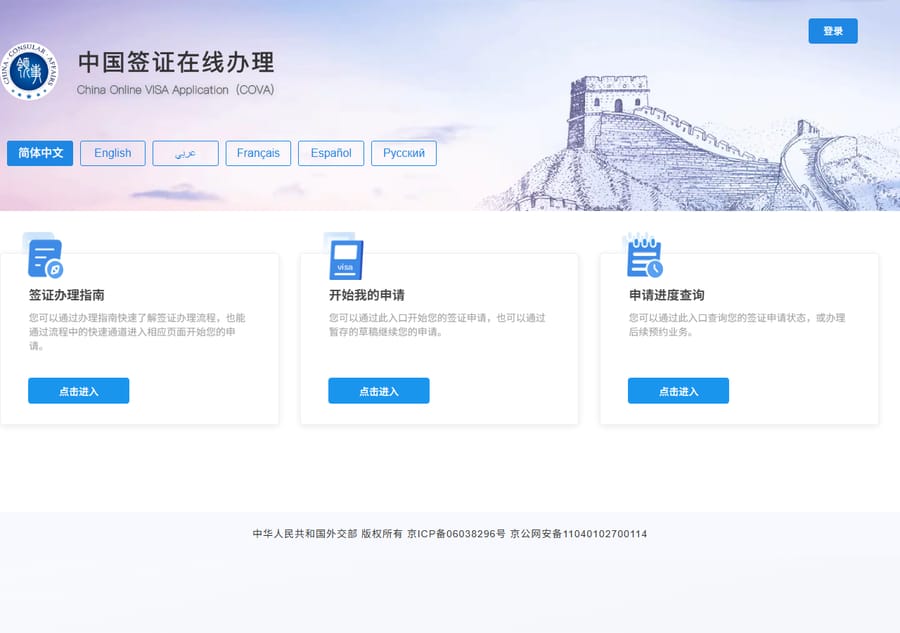
The official portal provides comprehensive online support for the entire Chinese visa application process. It offers access to the detailed Guidance on Visa Application for procedural information, allows applicants to start a new application or continue with a saved draft, and enables status tracking as well as management of subsequent appointments such as interview bookings—all within the same platform. The link is provided below. https://consular.mfa.gov.cn/VISA/
What this means:
This is where you fill in the form, book an appointment and track your application. The top right of the page switches between English, French, Spanish, Russian and Arabic.
8. Treaty entry: mutual visa-exemption agreements
From the China Consular Service Network: Mutual Visa Exemption List. The table lists 160 countries in total; the official table governs. The note below it reads:
Note:
*1. The agreement signed between China and the former Yugoslavia is applicable.
*2. The agreement signed between China and the former Czechoslovakia is applicable.
*3. <AGREEMENT BETWEEN THE PEOPLE’S REPUBLIC OF CHINA AND THE EUROPEAN UNION ON THE SHORT-STAY VISA WAIVER FOR HOLDERS OF DIPLOMATIC PASSPORTS> is applicable.
Exemption of visa requirements does not mean permission to stay and reside in the other contracting country for an indefinite period of time. According to the agreements, holders of valid specified passports are permitted to stay for less than 30 days upon entry into the other contracting country. If a passport holder intends to stay for over 30 days, he or she should go through residence formalities with the local authorities according to relevant regulations as soon as possible.
What this means:
Most entries in that table cover only diplomatic and service passports. The countries whose mutual exemption also covers ordinary passports are these 27 (compiled from the official table):
Albania, Antigua and Barbuda, Armenia, Azerbaijan, the Bahamas, Barbados, Belarus, Bosnia and Herzegovina, Fiji, Georgia, Grenada, Kazakhstan, Malaysia, Maldives, Mauritius, Qatar, Samoa, San Marino, Serbia, Seychelles, Singapore, Solomon Islands, Suriname, Thailand, Tonga, the United Arab Emirates, Uzbekistan.
As a rule, China grants unilateral visa-free entry to countries with no mutual agreement and applies the agreement where one exists; the two tracks are deliberately kept apart. Unilateral visa-free entry (50 countries), visa-free transit (240 hours), regional visa-free schemes (Hainan and others) and mutual agreements (27 countries for ordinary passports) do not stack and do not conflict. Whichever one you qualify for is the one you use. If you already qualify under the unilateral visa-free policy, the entries for your country in the mutual exemption table most likely cover only diplomatic and service passports, and have little to do with you as an ordinary-passport tourist.
9. Screenshot these five things before takeoff
The stretch from the jet bridge to the border desk often has no reliable network, and international roaming tends to stall on SMS verification. Before you take off, make a separate album on your phone and save these five images:
- Your passport information page: you will use it over and over to set up Alipay, to be checked at stations, and to check in at hotels.
- The Chinese name, Chinese address and front-desk phone number of your first night’s hotel: an English-only hotel name is no use to a taxi driver or on the arrival card.
- Your hotel booking confirmation: it must show the guest name (matching your passport) and the check-in date.
- A screenshot of the official policy paragraph covering your nationality: capture the browser address bar and the page date, for check-in agents who are not yet familiar with a new rule.
- Your confirmed onward or return itinerary: the version showing the e-ticket number and departure time. Transit passengers will certainly be asked for it.
Paper still works. Print one page with your hotel’s Chinese address and your onward ticket and keep it in your bag; when your phone is dead or a system is down, you can simply hand it over.
10. At border inspection
Before you reach the inspection booth, take your passport out of its cover and put your phone on silent — photography and phone calls are not allowed in the inspection area.
The officer’s questions are consistent: what you are coming to China for, how long you are staying, where you sleep on the first night, and where you go next. Have your first night’s hotel address and your departure ticket ready, rather than standing at the booth trying to connect to Wi-Fi and search your email. If you are entering under visa-free transit, fill in the arrival card online beforehand (see section 5) and offer your onward ticket to the third country or region without being asked.
Once you are in, the next step is mobile data. If your trip spans several weeks, or if you change your departure flight or exit port along the way, open the National Immigration Administration site and check again. Whenever the “Last verified” date at the top of this page is more than a month old, the official page on the day always wins.
Sources
- National Immigration Administration: list of unilateral visa-free countries (2026-02-17)
- National Immigration Administration: visa-free transit policies (2026-08-20)
- National Immigration Administration: regional visa-free policies
- National Immigration Administration: submitting your arrival card online
- National Immigration Administration: nationwide online accommodation registration
- China Consular Service Network: visa application instructions
- China Online Visa Application System
- China Consular Service Network: mutual visa exemption list
Questions visitors ask
- Which passports can enter China visa-free for 30 days?
- As of 17 February 2026, unilateral visa exemption covers 50 countries (35 in Europe, 2 in Oceania, 7 in Asia, 6 in the Americas). Ordinary passport holders may enter for business, tourism, visiting relatives and friends, exchange visits or transit, for stays of up to 30 days, counted from 00:00 on the day after entry. The National Immigration Administration website is the governing list.
- What do I need for 240-hour visa-free transit?
- You must be a national of one of the 57 eligible countries, hold an ordinary passport and an onward ticket to a third country or region with a confirmed date and seat, enter through one of the 65 designated ports in 24 provinces and municipalities, stay no more than 10 days inside the permitted areas, and fill in the arrival card. Returning to the same country does not count as transit.
- Can I fill in the China arrival card online, and does it cost anything?
- Yes, and it is free. There are only three official channels: the website s.nia.gov.cn/ArrivalCardFillingPC/, the 'NIA 12367' app and the WeChat mini program of the same name. Any 'arrival card website' that charges you is a fake.
- Do I need accommodation registration if I stay with friends rather than at a hotel?
- Yes. Within 24 hours of arriving, either you or the person accommodating you must register with the public security organ where you are staying. Since 21 September 2026 this can be done online anywhere in China; the first registration normally needs your host's help.
- Do mutual visa-exemption agreements conflict with unilateral visa-free entry?
- They neither conflict nor stack. China grants unilateral visa-free entry to countries with no mutual agreement, and applies the agreement where one exists. 27 countries have agreements covering ordinary passports. Whichever rule you qualify for is the one you use.