中国入国2026:ビザ免除・通過ビザ免除・入国カード
中国へ入国する前に、まず自分の旅券に適用される規定を国家移民管理局の公式サイトで確認してください。50か国の普通旅券は一方的ビザ免除で30日滞在できます。57か国は240時間の通過ビザ免除が使えます。どの国の方でも、港の制限区域内なら24時間の通過ビザ免除が使えます。海南などには地域限定のビザ免除があります。どれにも当てはまらない場合は中国領事服務網でビザを申請してください。入国カードは出発前に無料でオンライン記入できます。
中国へ入国する前にまずすべきことは、ご自身の旅券に適用される入国規定を見つけることです。以下では、どこで調べるか → ビザ免除 → 通過ビザ免除 → 地域限定ビザ免除 → 入国カード → 宿泊登録 → ビザ → 相互協定の順に、多くの方に必要な公式原文と、その読み方をまとめます。
一、まずどこで調べるか:国家移民管理局の公式サイト
ご自身の旅券に適用される入国規定は、公式サイトで調べられます。サイトは国家移民管理局 National Immigration Administrationです。これは中国国家移民管理局の公式サイトであり、ほかのどのサイトも当てにはなりません。サイトは複数の言語に切り替えられます。
掲載内容が多いので、以下では多くの方に必要な原文と注意点を抜き出しました。ビザの申請が必要な方は、第七節と中国領事服務網をご覧ください。
二、一方的ビザ免除:50か国の普通旅券、滞在30日
2026年2月、中国国家移民管理局が次の通知を公表しました(出典:Policy Interpretation — National Immigration Administration)。List of Countries Covered by Unilateral Visa Exemption Policies。
(Compiled according to information released by the Ministry of Foreign Affairs of the People’s Republic of China, as of February 17, 2026)
Europe (35 countries): Andorra, Austria, Belgium, Bulgaria, Croatia, Cyprus, Denmark, Estonia, Finland, France, Germany, Greece, Hungary, Iceland, Ireland, Italy, Latvia, Liechtenstein, Luxembourg, Malta, Monaco, Montenegro, Netherlands, North Macedonia, Norway, Poland, Portugal, Romania, Russian Federation, Slovakia, Slovenia, Spain, Sweden, Switzerland, United Kingdom of Great Britain and Northern Ireland
Oceania (2 countries): Australia, New Zealand
Asia (7 countries): Bahrain, Brunei Darussalam, Japan, Kuwait, Oman, Republic of Korea, Saudi Arabia
Americas (6 countries): Argentina, Brazil, Canada, Chile, Peru, Uruguay
Note: Nationals of the above countries holding ordinary passports may enter China visa-free for business, tourism, visits to relatives and friends, exchange visits, or transit, for stays of up to 30 days. The duration of stay is calculated from 00:00 on the day following the date of entry.
解説:
嬉しいお知らせです。上記の国の国籍で普通旅券をお持ちなら、ビザなしで中国に入国し、30日まで滞在できます。一点だけ注意してください。滞在期間は入国の翌日0時から起算されます。
三、通過ビザ免除:24時間と240時間
2026年8月20日、中国国家移民管理局が次の通知を公表しました(出典:Policy Interpretation — National Immigration Administration)。Visa-Free Transit Policies。
I. 24-Hour Visa-Free Transit Policy
All open exit-entry ports in China implement this policy for nationals of all other countries around the world. Foreigners transiting through China to third countries or regions may stay in China for no more than 24 hours without a visa, provided that they hold valid international travel documents and onward international flight/ship/train tickets with confirmed seats, and will not leave the restricted areas of ports. For any foreigner who does need to leave the designated restricted area, a temporary entry permit must be obtained first at the immigration inspection authority of the port concerned.
II. 240-Hour Visa-Free Transit Policy
Currently, China is implementing this policy for nationals of 57 countries including Russia, the United Kingdom and the United States. Nationals of these countries, who need to transit through China to third countries or regions, may enter visa-free through any of the designated 65 open exit-entry ports in 24 provinces, autonomous regions and municipalities directly under the Central Government and stay in the permitted areas for no more than 10 days, provided that they hold ordinary passports and onward tickets with confirmed seats and departure dates. Foreign nationals covered by this policy may, within the designated areas, engage in activities like travel activities, business activities, visits, family reunions, etc., during their stay periods. Activities such as work, study, or news reporting still require prior approvals and appropriate visas.
(I) List of 57 Countries
Europe (40 countries): Albania, Austria, Belarus, Belgium, Bosnia and Herzegovina, Bulgaria, Croatia, Cyprus, Czech Republic, Denmark, Estonia, Finland, France, Germany, Greece, Hungary, Iceland, Ireland, Italy, Latvia, Lithuania, Luxembourg, Malta, Monaco, Montenegro, the Netherlands, North Macedonia, Norway, Poland, Portugal, Romania, Russia, Serbia, Slovakia, Slovenia, Spain, Sweden, Switzerland, Ukraine, United Kingdom
North America (2 countries): Canada, United States
South America (4 countries): Argentina, Brazil, Chile, Mexico
Oceania (2 countries): Australia, New Zealand
Asia (9 countries): Brunei, Indonesia, Japan, Kyrgyzstan, Qatar, Singapore, South Korea, United Arab Emirates, Vietnam
(II) Eligible Ports and Permitted Stay Areas
公式ページの「適用される港と滞在可能区域」は画像です。以下は元の画像を書き起こして訳した文字版で、公式サイトの原画像が基準です。
| 番号 | 省(自治区・直轄市) | 対象の港 | 滞在可能区域 |
|---|---|---|---|
| 1–2 | 北京 | 北京首都国際空港;北京大興国際空港 | 北京市 |
| 3–4 | 天津 | 天津浜海国際空港;天津港(旅客) | 天津市 |
| 5–6 | 河北 | 石家荘正定国際空港;秦皇島港(旅客) | 河北省 |
| 7–9 | 遼寧 | 瀋陽桃仙国際空港;大連周水子国際空港;大連港(旅客) | 遼寧省 |
| 10–12 | 上海 | 上海虹橋国際空港;上海浦東国際空港;上海港(旅客) | 上海市 |
| 13–16 | 江蘇 | 南京禄口国際空港;蘇南碩放国際空港;揚州泰州国際空港;連雲港港(旅客) | 江蘇省 |
| 17–22 | 浙江 | 杭州蕭山国際空港;寧波櫟社国際空港;温州龍湾国際空港;義烏空港;温州港(旅客);舟山港(旅客) | 浙江省 |
| 23–24 | 安徽 | 合肥新橋国際空港;黄山屯渓国際空港 | 安徽省 |
| 25–29 | 福建 | 福州長楽国際空港;厦門高崎国際空港;泉州晋江国際空港;武夷山空港;厦門港(旅客) | 福建省 |
| 30–34 | 山東 | 済南遥墻国際空港;青島膠東国際空港;煙台蓬莱国際空港;威海大水泊国際空港;青島港(旅客) | 山東省 |
| 35 | 河南 | 鄭州新鄭国際空港 | 河南省 |
| 36 | 湖北 | 武漢天河国際空港 | 湖北省 |
| 37–38 | 湖南 | 長沙黄花国際空港;張家界荷花国際空港 | 湖南省 |
| 39–48 | 広東 | 広州白雲国際空港;深圳宝安国際空港;掲陽潮汕国際空港;南沙港(旅客);蛇口港(旅客);広州琶洲の香港マカオ旅客港;中山港(旅客);横琴口岸;港珠澳大橋口岸;広深港高速鉄道・西九龍駅 | 広東省(省内のすべての対外開放港から入国可) |
| 49–50 | 海南 | 海口美蘭国際空港;三亜鳳凰国際空港 | 海南省 |
| 51 | 重慶 | 重慶江北国際空港 | 重慶市 |
| 52 | 貴州 | 貴陽龍洞堡国際空港 | 貴州省 |
| 53 | 陝西 | 西安咸陽国際空港 | 陝西省 |
| 54 | 山西 | 太原武宿国際空港 | 太原市、大同市 |
| 55 | 黒竜江 | ハルビン太平国際空港 | ハルビン市 |
| 56 | 江西 | 南昌昌北国際空港 | 南昌市、景徳鎮市 |
| 57–60 | 広西 | 南寧呉圩国際空港;桂林両江国際空港;北海福成空港;北海港(旅客) | 南寧、柳州、桂林、梧州、北海、防城港、欽州、貴港、玉林、賀州、河池、来賓の計12市 |
| 61–62 | 四川 | 成都双流国際空港;成都天府国際空港 | 成都、自貢、攀枝花、瀘州、徳陽、遂寧、内江、楽山、宜賓、雅安、眉山、資陽(元の画像には「計11市」とありますが、挙げられている都市名は12です。公式サイトが基準です) |
| 63–65 | 雲南 | 昆明長水国際空港;麗江三義国際空港;磨憨鉄道口岸 | 昆明、玉渓、楚雄、紅河、文山、普洱、西双版納、大理、麗江の計9州市 |
表の下の注記:通過ビザ免除の旅客は、24の省(自治区・直轄市)の滞在可能区域内であれば省をまたいで移動でき、滞在は240時間を超えないものとします。
解説:
まず、ここでも240時間の通過ビザ免除に触れています。上記57か国の国籍で、普通旅券と、日付と座席が確定した第三国(地域)行きの接続航空券をお持ちなら、表にある65の港からビザなしで入国し、該当行の「滞在可能区域」の範囲内に最長10日まで滞在できます。
もう一点、こちらにもご注意ください。中国を通過して別の国や地域へ向かうだけであれば、有効期間内の旅券と座席が確定した接続券(国際線の航空便、船舶、列車のいずれでも可)をお持ちで、港の制限区域を出ず、滞在が24時間を超えない限り、ビザは不要です。途中で港の制限区域を出る必要がある場合は、まずその港の出入国辺防検査機関に一時入国許可を申請してください。
その港の出入国辺防検査機関が見つからないときは、現場の係員に尋ねれば大丈夫です。たいていは案内してくれますし、窓口まで連れて行ってくれることもあります。ここで一言。中国の行政の職員は基本的に親切なので、必要があれば遠慮なく声をかけてください。手続きにかかる時間はおよそ5〜15分、混んでいるときで20〜40分ほどです(これは経験則で、現場の状況が基準です)。手続きが済めば、24時間の旅を組み立てられます。ただし、一時入国許可を取っても中国のどこへでも行けるわけではなく、行ける範囲は辺防検査機関が認めた区域によります。
なお、2025年11月20日から、国家移民管理局は入国カードをオンライン化しました。出発前にご自宅で記入できます。詳しくは第五節:オンラインでの入国カード記入をご覧ください。
四、地域限定ビザ免除:海南、クルーズ、東南アジアと香港マカオの団体
2026年8月20日、中国国家移民管理局が次の通知を公表しました(出典:Policy Interpretation — National Immigration Administration)。Regional Visa-Free Entry Policies for Foreign Nationals。
The major regional visa-free entry policies for foreign nationals of China are as follows.
I. 30-Day Visa-free Entry Policy for Foreign Nationals Entering Hainan Province. Foreign nationals holding ordinary passports from 61 countries may enter and stay within the administrative region of Hainan Province for a maximum of 30 days without a visa for short-term stays for purposes associated with tourism, business, visits, family visits, medical treatment, conferences and exhibitions, sports competitions, etc. The policy does not apply to those who intend to enter for working or studying. The exit-entry ports for the foreign nationals concerned include all the open ports in Hainan. The 61 countries are Albania, Argentina, Australia, Austria, Belarus, Belgium, Bosnia and Herzegovina, Brazil, Brunei, Bulgaria, Canada, Chile, Croatia, Cyprus, the Czech Republic, Denmark, Estonia, Finland, France, Germany, Greece, Hungary, Iceland, Indonesia, Ireland, Italy, Japan, Kazakhstan, Kyrgyzstan, Latvia, Lithuania, Luxembourg, Malaysia, Malta, Mexico, Monaco, Montenegro, the Netherlands, New Zealand, North Macedonia, Norway, the Philippines, Poland, Portugal, Qatar, the Republic of Korea, Romania, Russia, Serbia, Singapore, Slovakia, Slovenia, Spain, Sweden, Switzerland, Thailand, Ukraine, the United Arab Emirates, the United Kingdom, the United States, Vietnam.
II. Visa-Free Entry Policy for Foreign Tourist Groups Traveling by Cruise Ships. Any foreign tourist group consisting of two or more individuals, which is organized and received by a travel agency registered in China, may enter China without a visa by a cruise ship via one of the cruise ports in the following 13 cities: Beihai (Guangxi Zhuang Autonomous Region), Dalian (Liaoning Province), Guangzhou (Guangdong Province), Haikou (Hainan Province), Lianyungang (Jiangsu Province), Qingdao (Shandong Province), Sanya (Hainan Province), Shanghai, Shenzhen (Guangdong Province), Tianjin, Wenzhou (Zhejiang Province), Xiamen (Fujian Province) and Zhoushan (Zhejiang Province). All eligible foreign tourist groups shall continue their journey to the following scheduled ports and depart China with the same cruise ship as scheduled. The tourists concerned may stay in the Beijing and 11 coastal provinces, autonomous regions, and municipalities directly under the Central Government (namely Fujian, Guangdong, Guangxi, Hainan, Hebei, Jiangsu, Liaoning, Shandong, Shanghai, Tianjin, and Zhejiang) for a maximum of 15 days.
III. Visa-Free Entry Policy for Tourist Groups Entering Xishuangbanna, Yunnan Province from ASEAN Member States. Any tourist group (consisting of two or more individuals holding ordinary passports) from a member state of the Association of Southeast Asian Nations (ASEAN) may enter and exit China through Xishuangbanna Gasa International Airport, Mohan Railway Port, and Mohan Highway Port visa-free, provided that the tourist group is organized and received by a travel agency registered in China. The tourists concerned shall enter and leave China as part of their tourist group, and can stay within the administrative region of Xishuangbanna Dai Autonomous Prefecture for a maximum of 6 days. The ASEAN member states include Brunei, Cambodia, Indonesia, Laos, Malaysia, Myanmar, the Philippines, Singapore, Thailand and Vietnam.
IV. Visa-Free Entry Policy for Tourist Groups Entering Guilin, Guangxi Zhuang Autonomous Region from ASEAN Member States. Any tourist group (consisting of two or more individuals holding ordinary passports) from a member state of the Association of Southeast Asian Nations (ASEAN) may enter and exit China through the airport in Guilin visa-free, provided that the tourist group is organized and received by a travel agency registered in China. The tourists concerned shall enter and leave China as part of their tourist group, and can stay within the administrative region of Guilin, Guangxi Zhuang Autonomous Region for a maximum of 6 days. The ASEAN member states include Brunei, Cambodia, Indonesia, Laos, Malaysia, Myanmar, the Philippines, Singapore, Thailand and Vietnam.
V. Visa-Free Entry Policy for Foreign Tourist Groups Traveling from Hong Kong and Macao Special Administrative Regions (SARs) to Guangdong Province. Foreign nationals holding ordinary passports from countries with diplomatic relations with China may enter nine cities in the Guangdong-Hong Kong-Macao Greater Bay Area, as well as Shantou, without a visa, provided that they will enter Hong Kong or Macao SAR first and then enter Guangdong Province as part of a tourist group organized by a travel agency registered in any of the two SARs. The foreign tourists in this case can stay for a maximum of 6 days in the following cities: Dongguan, Foshan, Guangzhou, Huizhou, Jiangmen, Shantou, Shenzhen, Zhaoqing, Zhongshan and Zhuhai. The tourists concerned shall enter and exit the Chinese mainland as part of their tourist group via any of the exit-entry ports in these 10 cities.
VI. Visa-Free Entry Policy for Foreign Tourist Groups Traveling from Hong Kong and Macao Special Administrative Regions (SARs) to Hainan Province. Foreign nationals holding ordinary passports from countries with diplomatic relations with China may enter Hainan Province without a visa, provided that they will enter Hong Kong or Macao SAR first and then enter Hainan Province as part of a tourist group organized by a travel agency registered in any of the two SARs. The tourists concerned shall enter and exit the Hainan Province as part of their tourist group via any of the exit-entry ports in Hainan and can stay for a maximum of 6 days.
The stay period specified in any of the aforementioned policies is calculated from 0:00 on the day after the day of entry. For the individuals who meet the requirements specified in the bilateral visa exemption agreements and the unilateral visa exemption policies of China, the relevant regulations shall prevail.
解説:
行き先が海南省だけという場合、第一条に挙げられた61か国の国籍であれば、ビザなしで入国し、海南省内に30日間滞在できます。
中国で登記された旅行社が手配・受け入れる、2人以上の外国人旅行団は、上記13都市のクルーズ港からクルーズ船でビザなしで入国できます。条件を満たす旅行団はすべて、規定どおり同じ船で予定された次の寄港地へ進み、予定どおり出国しなければなりません。該当の旅客は、北京および11の沿海省(自治区・直轄市)(福建、広東、広西、海南、河北、江蘇、遼寧、山東、上海、天津、浙江)に最長15日間滞在できます。
東南アジア諸国連合(ASEAN)加盟国の普通旅券所持者2人以上で構成され、中国で登記された旅行社が手配・受け入れる旅行団は、西双版納嘎洒国際空港、磨憨鉄道港、磨憨道路港からビザなしで出入国し、西双版納タイ族自治州の行政区域内に最長6日間滞在できます。桂林の空港からビザなしで出入国し、桂林市の行政区域内に最長6日間滞在することもできます。いずれの場合も、団体として一括で出入国しなければなりません。ASEAN加盟国の一覧は上記第三条にあります。
中国と国交のある国の普通旅券所持者で、香港または澳門特別行政区で登記された旅行社が手配・受け入れ、まず香港または澳門に入り、その後に旅行団として広東省に入る場合は、粤港澳大湾区の9市および汕頭にビザなしで入れます。滞在できるのは東莞、佛山、広州、恵州、江門、汕頭、深圳、肇慶、中山、珠海で、最長6日間です。該当の旅客は、この10都市のいずれかの対外開放港から、団体として一括で中国本土を出入りしなければなりません。
中国と国交のある国の普通旅券所持者で、香港または澳門特別行政区で登記された旅行社が手配・受け入れ、まず香港または澳門に入り、その後に旅行団として海南省に入る場合は、ビザなしで海南に入れます。海南のいずれかの対外開放港から、団体として一括で海南省を出入りし、最長6日間滞在できます。
ご注意ください。上記いずれの政策でも、滞在期間は入国の翌日0時から起算されます。中国政府間の二国間ビザ免除協定および一方的ビザ免除政策の条件を満たす方は、それぞれの規定に従って扱われます。
五、オンラインでの入国カード記入
2025年12月22日、中国国家移民管理局が次の通知を公表しました(出典:Policy Interpretation — National Immigration Administration)。How to Submit Your Arrival Card to China Online。以下は公式の操作動画です。
解説:
入国カードの公式窓口は3つです。
| 窓口 | アドレス |
|---|---|
| サイト | https://s.nia.gov.cn/ArrivalCardFillingPC/ |
| アプリ | 「移民局12367」アプリ |
| ミニプログラム | WeChatミニプログラム「移民局12367」 |
公式の記入要領には、入国カードが不要な8種類の方が挙げられています。
- 有効な外国人永久居留身分証をお持ちの方
- 有効な港澳居民来往内地通行証をお持ちの方(中国籍以外)
- 24時間の直接通過で、港の制限区域内にとどまり、港を出ない旅客
- 団体ビザをお持ちの方、または団体ビザ免除の入国条件を満たす外国人旅行団の構成員
- 外国籍の乗務員、船員、運転手など、出入国する輸送機関の職員
- クルーズ船で入国し、同じ船で出国する旅客
- 出入国証明書の集中検査の礼遇条件を満たす方
- 辺防検査の快速レーンから入国する旅客
ご注意ください。入国カードのオンライン記入は無料です。必ず上記の公式窓口からアクセスしてください。国外では、詐欺グループが偽の「中国入国カード記入サイト」を作り、旅客から料金を取っています。
しかもこれは単なる「手続き」ではなく、政策の要件そのものです。240時間の通過ビザ免除の申請条件にこの項目が含まれており、地方公安の公式Q&Aでも条件の一つとして挙げられています。
240時間以内に日付と座席が確定した第三国(地域)行きの接続券または関連証明を持ち、かつ《臨時入境外国人入境卡》に記入すること。
ですから厳密に言えば、入国カードを記入していなければ、書類が揃っていないことになります。
六、ホテル以外に泊まるときの宿泊登録
2026年9月21日、中国国家移民管理局が次の通知を公表しました(出典:Policy Interpretation — National Immigration Administration)。Policy Interpretation of the Nationwide Implementation of the Online Accommodation Registration Service for Foreigners Residing or Staying in Domiciles Other Than Hotels。
I. What is the scope of application of online accommodation registration?
According to Article 39 of the Exit and Entry Administration Law of the People’s Republic of China, where foreigners stay in hotels in China, the hotels shall register their accommodation in accordance with the regulations on the public security administration of the hotel industry, and submit foreigners’ accommodation registration information to the public security organs in the places where the hotels are located. For foreigners who reside or stay in domiciles other than hotels, they or the persons who accommodate them shall, within 24 hours after the foreigners’ arrival, go through the registration formalities with the public security organs in the places of residence. To further enhance the convenience for foreigners in China, the NIA has rolled out the online accommodation registration service nationwide for foreigners who reside or stay in domiciles other than hotels. Foreigners who reside or stay in domiciles other than hotels may go through the registration formalities online without the need to visit the public security organs in person. Online registration has the same legal effect as on-site registration.
II. What channels are available for online accommodation registration?
Accommodation hosts or foreigners may access the NIA Government Service Platform, including the official website, the “NIA 12367” App, and “NIA 12367” WeChat mini program, or the Alipay mini program. After completing user registration and identity verification, users may follow the step-by-step prompts of the Accommodation Registration module under Foreigner Service. Upon completion, users may click “Registration Record Inquiry” to view their accommodation registration record.
III. Who may go through the registration formalities online?
Accommodation registration may be completed online either by the foreigners who reside or stay in domiciles or by the persons who accommodate them. Considering that accommodation hosts are generally more familiar with the information regarding the residence, the initial registration should be completed with their assistance to ensure the accuracy of the registration information. Under the following circumstances, the foreigners may go through the registration formalities independently: where the foreigners have previously gone through the registration formalities through the NIA Government Service Platform and need to register again at the same residence; where the foreigners reside at a self-owned residence.
The accommodation host may be either a Chinese citizen or a foreigner.
IV. Under what circumstances can the registration formalities be simplified?
For foreigners who reside or stay in domiciles other than hotels and have already gone through the registration formalities after arrival in accordance with the relevant regulations, re-registration is not required under the following circumstances: where foreigners reside at their own residences within China and return to the same residences after traveling within or outside China; where foreigners holding residence permits or permanent residences permits reside at habitual residence within China and return to the same residences after traveling within or outside China during the validity period of the same permit.
A self-owned residence refers to a residence owned by the foreigner or his/her spouse within China. A habitual residence refers to a residence where the foreigner resides or plans to reside in China for a long term. According to Article 36 of the Regulations of the People’s Republic of China on Administration of the Entry and Exit of Foreigners, “long term” refers to residing in China for a period exceeding 180 days.
V. What should users do if they encounter questions or difficulties when going through the registration formalities online?
Accommodation hosts and foreigners who reside or stay in domiciles may access the Guide to Online Accommodation Registration on the accommodation registration page of the NIA Government Service Platform and follow the instructions provided. They may also call the NIA 12367 service hotline for inquiries. Alternatively, they may visit the exit-entry administration service windows of the local public security organs or local police stations to seek assistance with on-site registration.
VI. Will there be legal liability for failure to go through the registration formalities as required?
According to Article 76 of the Exit and Entry Administration Law of the People’s Republic of China, foreigners or their accommodation hosts who fail to process accommodation registration in accordance with the relevant regulations shall be given a warning and may also be subject to a fine.
解説:
ホテルに泊まる場合は、フロントの案内に従ってチェックインすれば大丈夫です。登録はホテルが代わりに行うので、この節はご自身には関係ありません。外国人客を受け入れられるホテルの予約方法はホテルに泊まるをご覧ください。
ただし、ホテル以外の場所(友人宅、親戚宅、借りた部屋など)に泊まる場合は、到着後24時間以内に、ご本人または泊めてくれる方が、居住地の公安機関で宿泊登録をする必要があります。最寄りの派出所で手続きできますし(高德地図で「派出所」と検索すれば見つかります。移動するを参照)、オンラインでも手続きできます。オンラインの場合、初回の登録は通常、泊めてくれる方の協力のもとで行う必要があります。これは規定です(第三条)。また、再登録が不要になる場合もいくつかあるので、ご自身が当てはまるか確認してください(第四条)。問題が起きたときは第五条をご覧ください。なお、登録を忘れると警告を受け、罰金を科されることがあります。
七、ビザの申請
上記のビザ免除政策のいずれにも当てはまらない場合は、ビザの申請が必要です。まず中国領事服務網、またはお住まいの地域の中国大使館・総領事館の公式サイトで、関連する政策と注意事項を確認してください。
7.1 ビザの種類と必要書類
出典は中国領事服務網:Visa Application Instructions of the People’s Republic of China。
Visa Application Instructions of the People’s Republic of China
Please select the appropriate category of visa according to your main purpose of travel to China
| Visa Category | Who May Apply |
|---|---|
| C | Issued to crew members of international trains, aircraft, and vessels on international voyages who perform crew duties, as well as the accompanying family members of such crew members, and commercial transport vehicle drivers engaged in international road transport |
| D | Issued to permanent residents in China |
| F | Issued to those who intend to go to China for exchanges, visits, study tours and other activities |
| G | Issued to those who intend to transit through China |
| J1 | Issued to journalists of foreign news organizations stationed in China, whose intended duration of residence in China exceeds 180 days |
| J2 | Issued to foreign journalists who intend to go to China for short-term news coverage. The intended duration of stay in China is no more than 180 days |
| L | Issued to those who intend to go to China for tourism |
| M | Issued to those who intend to go to China for commercial and trade activities |
| Q1 | Issued to those who are family members (spouses, parents, sons, daughters, spouses of sons or daughters, brothers, sisters, grandparents, grandsons, granddaughters and parents-in-law) of Chinese citizens or of foreigners with Chinese permanent residence and intend to go to China for family reunion and residence, as well as those who apply to enter and reside in China for foster care or other reasons |
| Q2 | Issued to those who intend to visit their relatives who are Chinese citizens residing in China or foreigners with Chinese permanent residence, for a short-term stay of no more than 180 days |
| R | Issued to foreign high-level talents and specialists whose expertise is in urgent need in China |
| S1 | Issued to those who intend to go to China to visit the foreigners residing in China for work, study or other purposes, to whom they are spouses, parents, sons or daughters under the age of 18 or parents-in-law, and to those who need to reside in China for other private affairs. The intended duration of stay in China exceeds 180 days |
| S2 | Issued to those who intend to visit their family members (spouses, parents, sons, daughters, spouses of sons or daughters, brothers, sisters, grandparents, grandsons, granddaughters and parents-in-law) who are foreigners staying or residing in China for work, study or other purposes, and to those who need to stay in China for other private matters. The intended duration of stay in China is no more than 180 days |
| X1 | Issued to those who intend to study in China for a period of more than 180 days |
| X2 | Issued to those who intend to study in China for a period of no more than 180 days |
| Z | Issued to those who intend to work in China |
When applying for a visa, you need to prepare the following documents:
I. Basic Documents
As required by the Chinese Embassy or Consulate-General in your locality, please fill in the visa application form online and submit the applicant’s passport and photo, proof of legal stay or residence, and the previous Chinese passport or previous Chinese visa (for specific requirements, please refer to the “Guidance on Visa Application” section of the China Online Visa Application System (website: https://consular.mfa.gov.cn/VISA/) or the website of the Chinese Embassy or Consulate-General in your locality), together with the following:
II. Other Supporting Documents
C Visa
A guarantee letter issued by the foreign transport company, or an invitation letter issued by a relevant entity in China.
D Visa
The original and a photocopy of the Confirmation Form for Foreigner’s Permanent Residence Status issued by the Ministry of Public Security of China.
Please note: The holder must, within 30 days of entering China, apply for a residence permit at the exit-entry administration of the public security bureau of the people’s government at or above the county level of the intended place of residence.
F Visa
An invitation letter issued by a relevant entity or individual in China. The invitation letter must contain the following information:
- Personal information of the invited: name, gender, date of birth, etc.;
- Information about the invited person’s visit to China: reason for coming to China, dates of arrival and departure, place of visit, relationship with the inviting entity or the inviting person, who will pay for the travel, etc.;
- Information of the inviting entity or the inviting person: name of the inviting entity or name of the inviting person, phone number, address, official seal of the entity, signature of the legal representative or the inviting person, etc.
G Visa
An onward air (train or ship) ticket with confirmed date and seat to the destination country or region.
J1 Visa
A visa notification letter issued by the Department of Press, Communication and Public Diplomacy of the Ministry of Foreign Affairs of China, and an official letter issued by the media organization for which the journalist works.
The applicant should first contact the press office of the Chinese Embassy or Consulate-General to complete the relevant procedures.
Please note: The holder must, within 30 days of entering China, apply for a residence permit at the exit-entry administration of the public security bureau of the people’s government at or above the county level of the intended place of residence.
J2 Visa
A visa notification letter issued by the Department of Press, Communication and Public Diplomacy of the Ministry of Foreign Affairs of China or a relevant entity, and an official letter issued by the media organization for which the journalist works.
The applicant should first contact the press office of the Chinese Embassy or Consulate-General to complete the relevant procedures.
L Visa
Itinerary documents such as round-trip air ticket booking records and hotel reservations, or an invitation letter issued by an entity or individual in China. The invitation letter must contain the following information:
- Personal information of the invited: name, gender, date of birth, etc.;
- Information about the invited person’s itinerary: dates of arrival and departure, places to visit, etc.;
- Information of the inviting entity or the inviting person: name of the inviting entity or name of the inviting person, phone number, address, official seal of the entity, signature of the legal representative or the inviting person, etc.
M Visa
Invitation documents issued by a trade partner in China, such as documents on commercial activities or invitations to economic and trade fairs. The invitation documents must contain the following information:
- Personal information of the invited: name, gender, date of birth, etc.;
- Information about the invited person’s visit to China: reason for coming to China, dates of arrival and departure, place of visit, relationship with the inviting entity or the inviting person, who will pay for the travel, etc.;
- Information of the inviting entity or the inviting person: name of the inviting entity or name of the inviting person, phone number, address, official seal of the entity, signature of the legal representative or the inviting person, etc.
Q1 Visa
For family reunion purposes, the following documents are required:
- An invitation letter issued by a Chinese citizen residing in China or a foreigner with Chinese permanent residence. The invitation letter must contain the following information:
- Personal information of the invited: name, gender, date of birth, etc.;
- Information about the invited person’s visit to China: reason for coming to China, intended date of arrival, intended place of residence, intended duration of residence, relationship with the inviting individual, who will pay for the travel, etc.;
- Information of the inviting individual: name, phone number, address, signature of the inviting individual, etc.
- A photocopy of the Chinese ID card of the inviting individual, or photocopies of the bio-page of the foreigner’s passport and the permanent residence permit;
- The original and a photocopy of certification (marriage certificate, birth certificate, kinship certification issued by the public security police station, notarized kinship certificate, etc.) showing the relationship of family members (spouses, parents, sons, daughters, spouses of sons or daughters, brothers, sisters, grandparents, grandsons, granddaughters and parents-in-law) between the applicant and the inviting individual.
For foster care purposes, the following documents are required:
- A notarized foster care power of attorney issued by a Chinese Embassy or Consulate-General, or a foster care power of attorney notarized or authenticated in the host country or in China;
- The original and a photocopy of the consignor’s passport, and certification (marriage certificate, birth certificate, kinship certification issued by the public security police station, notarized kinship certificate, etc.) showing the kinship between the consignor and the fostered child;
- A letter of consent to accept the foster care issued by the trustee, and a photocopy of the trustee’s ID card;
- Where one or both parents of the fostered child are Chinese citizens, a photocopy of the certificate showing that the parent(s) of Chinese nationality had settled abroad at the time of the child’s birth must also be provided.
Please note: The holder must, within 30 days of entering China, apply for a residence permit at the exit-entry administration of the public security bureau of the people’s government at or above the county level of the intended place of residence.
Q2 Visa
- An invitation letter issued by a Chinese citizen residing in China or a foreign citizen with Chinese permanent residence. The invitation letter must contain the following information:
- Personal information of the invited: name, gender, date of birth, etc.;
- Information about the invited person’s visit to China: reason for coming to China, dates of arrival and departure, place of visit, relationship with the inviting individual, who will pay for the travel, etc.;
- Information of the inviting individual: name, phone number, address, signature of the inviting individual, etc.
- A photocopy of the Chinese ID card of the inviting individual, or photocopies of the bio-page of the foreigner’s passport and the permanent residence permit.
R Visa
The applicant shall meet the introduction conditions and requirements for foreign high-level talents and urgently-needed specialists as determined by the relevant competent authorities of the Chinese government, and submit the corresponding certification materials as required.
S1 Visa
The following documents are required:
- An invitation letter from the inviting individual (a foreigner who stays or resides in China for work or studies). The invitation letter must contain the following information:
- Personal information of the invited: name, gender, date of birth, etc.;
- Information about the invited person’s visit to China: reason for coming to China, intended date of arrival, intended place of residence, intended duration of residence, relationship with the inviting individual, who will pay for the travel, etc.;
- Information of the inviting individual: name, phone number, address, signature of the inviting individual, etc.
- Photocopies of the inviting individual’s passport bio-page and residence permit;
- The original and a photocopy of certification (marriage certificate, birth certificate, kinship certification issued by the public security police station, notarized kinship certificate, etc.) showing the kinship (spouses, parents, sons or daughters under the age of 18, parents-in-law) between the applicant and the inviting individual.
Please note: The holder must, within 30 days of entering China, apply for a residence permit at the exit-entry administration of the public security bureau of the people’s government at or above the county level of the intended place of residence.
S2 Visa
For short-term family visits, the following documents are required:
- Photocopies of the passport and residence permit of the inviting individual (specifically, a foreigner staying or residing in China for work or studies);
- An invitation letter issued by the inviting individual. The invitation letter must contain the following information:
- Personal information of the invited: name, gender, date of birth, etc.;
- Information about the invited person’s visit to China: reason for coming to China, dates of arrival and departure, place of visit, relationship with the inviting individual, who will pay for the travel, etc.;
- Information of the inviting individual: name, phone number, address, signature of the inviting individual, etc.
- A photocopy of certification (marriage certificate, birth certificate, kinship certification issued by the public security police station, notarized kinship certificate, etc.) showing the relationship of family members (spouses, parents, sons, daughters, spouses of sons or daughters, brothers, sisters, grandparents, grandsons, granddaughters and parents-in-law) between the applicant and the inviting individual.
In case of other personal affairs, relevant supporting materials shall be provided as required by the consular officers.
X1 Visa
- The Admission Letter issued by a school or other admitting entity in China;
- The Confirmation Form for Study in China (Form JW201 or Form JW202).
Please note: The holder must, within 30 days of entering China, apply for a residence permit at the exit-entry administration of the public security bureau of the people’s government at or above the county level of the intended place of residence.
X2 Visa
The Admission Letter issued by a school or other admitting entity in China.
Z Visa
One of the following is required:
- The Notice for the Work Permit for Foreigners of the People’s Republic of China issued by the human resources and social security authority (the authority that centrally administers the employment of foreign experts); where the work period is no more than 90 days, the applicant must apply for the visa before the start date indicated on the Notice for the Work Permit for Foreigners of the People’s Republic of China, and the work time must not exceed the period indicated therein;
- The Registration Certificate of the Resident Representative Office of a Foreign (Regional) Enterprise issued by the market regulation authority;
- The approval document for commercial artistic performances issued by the cultural administrative authority (applicable only to applicants coming to China for commercial performances) and the Certificate of Short-term Work for Foreigners in China, in which case the applicant must apply for the visa before the start date indicated on the Certificate of Short-term Work for Foreigners in China, and the performance time must not exceed the period indicated therein;
- The Invitation Letter for Foreigners to Engage in Offshore Petroleum Operations in the People’s Republic of China issued by China National Offshore Oil Corporation;
Please note: The holder must, within 30 days of entering China, apply for a residence permit at the exit-entry administration of the public security bureau of the people’s government at or above the county level of the intended place of residence, except for those whose visas are marked with “permitted stay of 30 days after entry”.
III. Important Tips
The invitation letter may be a fax, a photocopy or a printout, but the consular officers may require the applicant to provide the original one.
When necessary, the consular officers may require the applicant to provide other supporting documents or supplementary materials, or require the applicant to attend an interview.
The consular officials will decide whether to issue a visa and determine its validity, duration of stay and number of entries according to the applicant’s specific circumstances.
For further details, please visit the website of the relevant Chinese Embassy or Consulate-General abroad.
解説:
中国へ来る主な目的に合わせてビザの種類を選んでください。観光ならLビザ、商用ならMビザです。流れは、consular.mfa.gov.cn/VISA/ でオンライン申請書を記入 → お住まいの地域の中国大使館・総領事館のリストに従って書類を準備 → 旅券を提出して指紋を採取、となります。
7.2 オンライン申請サイト
アドレス:consular.mfa.gov.cn/VISA/
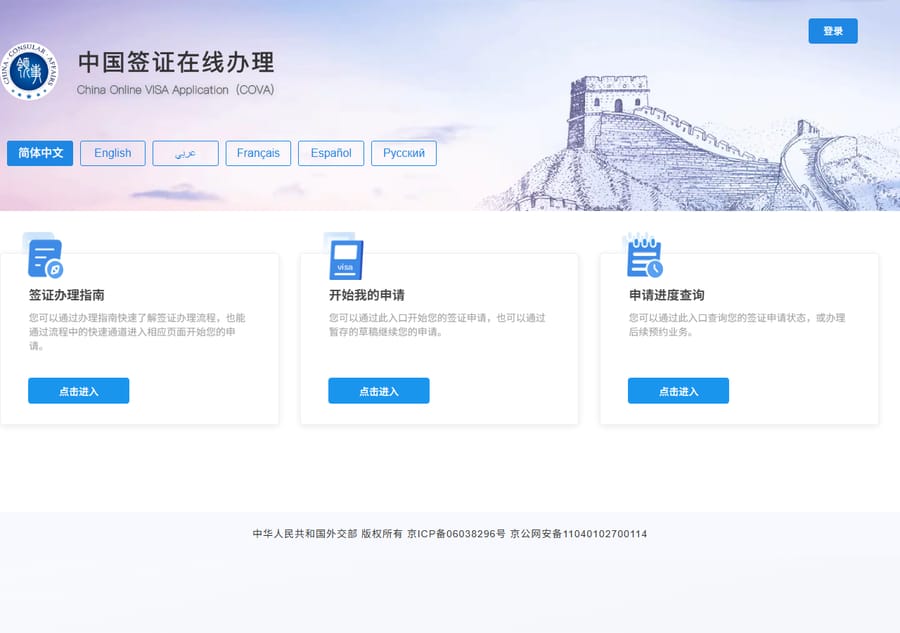
The official portal provides comprehensive online support for the entire Chinese visa application process. It offers access to the detailed Guidance on Visa Application for procedural information, allows applicants to start a new application or continue with a saved draft, and enables status tracking as well as management of subsequent appointments such as interview bookings—all within the same platform. The link is provided below. https://consular.mfa.gov.cn/VISA/
解説:
ここで申請書の記入、予約、進捗の照会ができます。ページ右上で英語、フランス語、スペイン語、ロシア語、アラビア語に切り替えられます。
八、協定による渡航:相互ビザ免除協定
出典は中国領事服務網:Mutual Visa Exemption List。この一覧表には全部で160か国が載っています。完全な内容は公式の原表が基準です。表の後ろの説明の原文は次のとおりです。
Note:
*1. The agreement signed between China and the former Yugoslavia is applicable.
*2. The agreement signed between China and the former Czechoslovakia is applicable.
*3. <AGREEMENT BETWEEN THE PEOPLE’S REPUBLIC OF CHINA AND THE EUROPEAN UNION ON THE SHORT-STAY VISA WAIVER FOR HOLDERS OF DIPLOMATIC PASSPORTS> is applicable.
Exemption of visa requirements does not mean permission to stay and reside in the other contracting country for an indefinite period of time. According to the agreements, holders of valid specified passports are permitted to stay for less than 30 days upon entry into the other contracting country. If a passport holder intends to stay for over 30 days, he or she should go through residence formalities with the local authorities according to relevant regulations as soon as possible.
解説:
この表の大半の項目は外交旅券・公用旅券だけが対象です。普通旅券でも相互にビザが免除されるのは、次の27か国です(公式の原表から整理しました)。
アルバニア、アンティグア・バーブーダ、アルメニア、アゼルバイジャン、バハマ、バルバドス、ベラルーシ、ボスニア・ヘルツェゴビナ、フィジー、ジョージア、グレナダ、カザフスタン、マレーシア、モルディブ、モーリシャス、カタール、サモア、サンマリノ、セルビア、セーシェル、シンガポール、ソロモン諸島、スリナム、タイ、トンガ、アラブ首長国連邦、ウズベキスタン。
一般に、中国は相互免除協定のない国には一方的ビザ免除を与え、協定のある国には協定どおりに運用します。この2本の線は意図的にずらしてあります。一方的ビザ免除(50か国)、通過ビザ免除(240時間)、地域限定ビザ免除(海南など)、相互免除協定(普通旅券は27か国)は、重ねて使うこともできませんし、互いに矛盾もしません。ご自身が当てはまる一つに従ってください。すでに一方的ビザ免除の条件を満たしているなら、相互免除協定一覧表のご自身の国に関する項目は、たいてい外交旅券・公用旅券だけを対象としており、普通旅券の旅行者にはあまり関係がありません。
九、出発前にこの5つをスクリーンショット
搭乗橋から入国審査カウンターまでの区間は、安定したネットワークがないことがよくあります。国際ローミングもSMS認証で止まりがちです。出発前にスマートフォンの写真アプリに専用のアルバムを作り、この5枚を保存しておいてください。
- 旅券の身分事項ページ:このあと支付宝(Alipay)の開設、駅での照合、ホテルのチェックインで繰り返し使います。
- 初日のホテルの中国語名、中国語住所、フロントの電話番号:英語だけの店名はタクシー運転手にも入国カードにも役に立ちません。
- ホテルの予約確認書:宿泊者名(旅券と一致)と宿泊日が読み取れるものにしてください。
- ご自身の国籍を扱う公式政策の段落のスクリーンショット:ブラウザのアドレスバーとページの日付も一緒に写しておくと、新しい規定に不慣れなチェックインカウンターの係員が確認できます。
- 確定済みの接続便または復路便の行程表:航空券番号(e-ticket number)と出発時刻が入っているもの。通過の旅客は必ず確認されます。
紙もまだ役に立ちます。ホテルの中国語住所と接続便の航空券を1枚印刷して手荷物に入れておけば、スマートフォンの電池が切れてもシステム障害に遭っても、そのまま差し出せます。
十、入国審査で
入国審査のブースに着く前に、旅券をカバーから出し、スマートフォンをマナーモードにしてください(審査区域では撮影と通話が禁止されています)。
審査官の質問はだいたい決まっています。中国で何をするのか、何日滞在するのか、初日はどこに泊まるのか、次はどこへ行くのか。 初日のホテルの住所と出国便の航空券はすぐ出せるようにしておき、カウンターの前でWi-Fiにつないでメールを探すようなことは避けてください。通過ビザ免除で入る方は、事前にオンラインで入国カードを記入し(第五節を参照)、第三国(地域)行きの接続券を自分から提示してください。
入国したら、次は携帯のデータ通信の準備です。旅程が数週間にまたがる場合や、旅の途中で出国便を変更したり出国する港を変えたりした場合は、必ず国家移民管理局のサイトをもう一度開いて確認してください。このページ上部の「最終確認」の日付が1か月以上前になっているときは、いつでも公式サイトのその日のページが基準です。
出典
よくある質問
- どの国の旅券なら30日間ビザなしで中国に入国できますか。
- 2026年2月17日時点で、一方的ビザ免除は50か国(欧州35、オセアニア2、アジア7、米州6)が対象です。普通旅券をお持ちの方は、商用、観光、親族友人訪問、交流訪問、通過の目的で入国でき、滞在は30日以内です。滞在期間は入国の翌日0時から起算されます。リストは国家移民管理局の公式サイトが基準です。
- 240時間の通過ビザ免除には何が必要ですか。
- 対象57か国の国籍で、普通旅券と、日付と座席が確定した第三国(地域)行きの接続航空券を持ち、24の省・自治区・直轄市にある指定65港のいずれかから入国し、滞在可能区域内に10日を超えず滞在し、入国カードに記入することが必要です。出発国へ戻る往復は通過に当たりません。
- 中国の入国カードはオンラインで記入できますか。有料ですか。
- できます。しかも無料です。公式の窓口は3つだけです。サイト s.nia.gov.cn/ArrivalCardFillingPC/、「移民局12367」アプリ、同名のWeChatミニプログラムです。料金を請求してくる「入国カード記入サイト」はすべて偽物です。
- ホテルではなく友人宅に泊まる場合、宿泊登録は必要ですか。
- 必要です。到着後24時間以内に、ご本人または泊めてくれる方が、居住地の公安機関に登録してください。2026年9月21日から全国でオンライン手続きができます。初回の登録は通常、泊めてくれる方の協力が必要です。
- 相互ビザ免除協定と一方的ビザ免除は矛盾しますか。
- 矛盾もしませんし、重ねて使うこともできません。中国は協定のない国には一方的ビザ免除を与え、協定のある国には協定どおりに運用します。普通旅券で相互にビザが免除される協定国は27か国です。ご自身が当てはまる一つの規定に従ってください。