중국 입국 2026: 무비자·통과 무비자·입국카드
중국에 입국하기 전에 먼저 본인 여권에 적용되는 규정을 국가이민관리국 공식 사이트에서 확인하세요. 50개국 일반여권은 일방적 무비자로 30일 체류할 수 있습니다. 57개국은 240시간 통과 무비자를 쓸 수 있습니다. 어느 나라 국민이든 출입국장 제한구역 안에서는 24시간 통과 무비자가 가능합니다. 하이난 등에는 별도의 지역 무비자가 있습니다. 어디에도 해당하지 않으면 중국영사서비스망에서 비자를 신청하세요. 입국카드는 출발 전에 무료로 온라인 작성할 수 있습니다.
중국에 입국하기 전 가장 먼저 할 일은 본인 여권에 적용되는 입국 규정을 찾는 것입니다. 아래에서는 어디서 확인하나 → 무비자 → 통과 무비자 → 지역 무비자 → 입국카드 → 숙박 등록 → 비자 → 상호 협정 순서로, 대부분의 분들에게 필요한 공식 원문과 그에 대한 해설을 정리했습니다.
1. 어디서 먼저 확인하나: 국가이민관리국 공식 사이트
본인 여권에 적용되는 입국 규정은 공식 사이트에서 확인할 수 있습니다. 사이트는 국가이민관리국 National Immigration Administration입니다. 이곳이 중국 국가이민관리국의 공식 사이트이고, 다른 어떤 사이트도 믿을 수 없습니다. 사이트는 여러 언어로 전환됩니다.
내용이 워낙 많아서, 아래에는 대부분의 분들에게 필요한 원문과 유의 사항을 뽑아 두었습니다. 비자를 신청해야 한다면 7절과 중국영사서비스망을 보세요.
2. 일방적 무비자: 50개국 일반여권, 30일 체류
2026년 2월, 중국 국가이민관리국이 다음 공지를 발표했습니다(출처: Policy Interpretation — National Immigration Administration). List of Countries Covered by Unilateral Visa Exemption Policies.
(Compiled according to information released by the Ministry of Foreign Affairs of the People’s Republic of China, as of February 17, 2026)
Europe (35 countries): Andorra, Austria, Belgium, Bulgaria, Croatia, Cyprus, Denmark, Estonia, Finland, France, Germany, Greece, Hungary, Iceland, Ireland, Italy, Latvia, Liechtenstein, Luxembourg, Malta, Monaco, Montenegro, Netherlands, North Macedonia, Norway, Poland, Portugal, Romania, Russian Federation, Slovakia, Slovenia, Spain, Sweden, Switzerland, United Kingdom of Great Britain and Northern Ireland
Oceania (2 countries): Australia, New Zealand
Asia (7 countries): Bahrain, Brunei Darussalam, Japan, Kuwait, Oman, Republic of Korea, Saudi Arabia
Americas (6 countries): Argentina, Brazil, Canada, Chile, Peru, Uruguay
Note: Nationals of the above countries holding ordinary passports may enter China visa-free for business, tourism, visits to relatives and friends, exchange visits, or transit, for stays of up to 30 days. The duration of stay is calculated from 00:00 on the day following the date of entry.
해설:
반가운 소식입니다. 위 나라 국적이고 일반여권을 가지고 계시면 무비자로 중국에 입국해 30일까지 머물 수 있습니다. 한 가지만 유의하세요. 체류 기간은 입국한 다음 날 0시부터 계산합니다.
3. 통과 무비자: 24시간과 240시간
2026년 8월 20일, 중국 국가이민관리국이 다음 공지를 발표했습니다(출처: Policy Interpretation — National Immigration Administration). Visa-Free Transit Policies.
I. 24-Hour Visa-Free Transit Policy
All open exit-entry ports in China implement this policy for nationals of all other countries around the world. Foreigners transiting through China to third countries or regions may stay in China for no more than 24 hours without a visa, provided that they hold valid international travel documents and onward international flight/ship/train tickets with confirmed seats, and will not leave the restricted areas of ports. For any foreigner who does need to leave the designated restricted area, a temporary entry permit must be obtained first at the immigration inspection authority of the port concerned.
II. 240-Hour Visa-Free Transit Policy
Currently, China is implementing this policy for nationals of 57 countries including Russia, the United Kingdom and the United States. Nationals of these countries, who need to transit through China to third countries or regions, may enter visa-free through any of the designated 65 open exit-entry ports in 24 provinces, autonomous regions and municipalities directly under the Central Government and stay in the permitted areas for no more than 10 days, provided that they hold ordinary passports and onward tickets with confirmed seats and departure dates. Foreign nationals covered by this policy may, within the designated areas, engage in activities like travel activities, business activities, visits, family reunions, etc., during their stay periods. Activities such as work, study, or news reporting still require prior approvals and appropriate visas.
(I) List of 57 Countries
Europe (40 countries): Albania, Austria, Belarus, Belgium, Bosnia and Herzegovina, Bulgaria, Croatia, Cyprus, Czech Republic, Denmark, Estonia, Finland, France, Germany, Greece, Hungary, Iceland, Ireland, Italy, Latvia, Lithuania, Luxembourg, Malta, Monaco, Montenegro, the Netherlands, North Macedonia, Norway, Poland, Portugal, Romania, Russia, Serbia, Slovakia, Slovenia, Spain, Sweden, Switzerland, Ukraine, United Kingdom
North America (2 countries): Canada, United States
South America (4 countries): Argentina, Brazil, Chile, Mexico
Oceania (2 countries): Australia, New Zealand
Asia (9 countries): Brunei, Indonesia, Japan, Kyrgyzstan, Qatar, Singapore, South Korea, United Arab Emirates, Vietnam
(II) Eligible Ports and Permitted Stay Areas
공식 페이지의 ‘대상 출입국장과 체류 허용 구역’은 이미지입니다. 아래는 원본 이미지를 옮겨 적고 번역한 텍스트 판이며, 공식 사이트의 원본 이미지가 기준입니다.
| 번호 | 성(자치구·직할시) | 대상 출입국장 | 체류 허용 구역 |
|---|---|---|---|
| 1–2 | 베이징 | 베이징 서우두 국제공항; 베이징 다싱 국제공항 | 베이징시 |
| 3–4 | 톈진 | 톈진 빈하이 국제공항; 톈진항(여객) | 톈진시 |
| 5–6 | 허베이 | 스자좡 정딩 국제공항; 친황다오항(여객) | 허베이성 |
| 7–9 | 랴오닝 | 선양 타오셴 국제공항; 다롄 저우수이쯔 국제공항; 다롄항(여객) | 랴오닝성 |
| 10–12 | 상하이 | 상하이 훙차오 국제공항; 상하이 푸둥 국제공항; 상하이항(여객) | 상하이시 |
| 13–16 | 장쑤 | 난징 루커우 국제공항; 쑤난 숴팡 국제공항; 양저우 타이저우 국제공항; 롄윈강항(여객) | 장쑤성 |
| 17–22 | 저장 | 항저우 샤오산 국제공항; 닝보 리서 국제공항; 원저우 룽완 국제공항; 이우 공항; 원저우항(여객); 저우산항(여객) | 저장성 |
| 23–24 | 안후이 | 허페이 신차오 국제공항; 황산 툰시 국제공항 | 안후이성 |
| 25–29 | 푸젠 | 푸저우 창러 국제공항; 샤먼 가오치 국제공항; 취안저우 진장 국제공항; 우이산 공항; 샤먼항(여객) | 푸젠성 |
| 30–34 | 산둥 | 지난 야오창 국제공항; 칭다오 자오둥 국제공항; 옌타이 펑라이 국제공항; 웨이하이 다수이보 국제공항; 칭다오항(여객) | 산둥성 |
| 35 | 허난 | 정저우 신정 국제공항 | 허난성 |
| 36 | 후베이 | 우한 톈허 국제공항 | 후베이성 |
| 37–38 | 후난 | 창사 황화 국제공항; 장자제 허화 국제공항 | 후난성 |
| 39–48 | 광둥 | 광저우 바이윈 국제공항; 선전 바오안 국제공항; 제양 차오산 국제공항; 난사항(여객); 서커우항(여객); 광저우 파저우 홍콩마카오 여객 출입국장; 중산항(여객); 헝친 출입국장; 강주아오 대교 출입국장; 광선강 고속철 시주룽역 | 광둥성(성 내 모든 대외개방 출입국장으로 입국 가능) |
| 49–50 | 하이난 | 하이커우 메이란 국제공항; 싼야 펑황 국제공항 | 하이난성 |
| 51 | 충칭 | 충칭 장베이 국제공항 | 충칭시 |
| 52 | 구이저우 | 구이양 룽둥바오 국제공항 | 구이저우성 |
| 53 | 산시(陝西) | 시안 셴양 국제공항 | 산시성(陝西) |
| 54 | 산시(山西) | 타이위안 우쑤 국제공항 | 타이위안시, 다퉁시 |
| 55 | 헤이룽장 | 하얼빈 타이핑 국제공항 | 하얼빈시 |
| 56 | 장시 | 난창 창베이 국제공항 | 난창시, 징더전시 |
| 57–60 | 광시 | 난닝 우쉬 국제공항; 구이린 량장 국제공항; 베이하이 푸청 공항; 베이하이항(여객) | 난닝, 류저우, 구이린, 우저우, 베이하이, 팡청강, 친저우, 구이강, 위린, 허저우, 허츠, 라이빈 등 12개 시 |
| 61–62 | 쓰촨 | 청두 솽류 국제공항; 청두 톈푸 국제공항 | 청두, 쯔궁, 판즈화, 루저우, 더양, 쑤이닝, 네이장, 러산, 이빈, 야안, 메이산, 쯔양(원본 이미지에는 ‘11개 시’로 적혀 있으나 열거된 도시명은 12개입니다. 공식 사이트가 기준입니다) |
| 63–65 | 윈난 | 쿤밍 창수이 국제공항; 리장 싼이 국제공항; 모한 철도 출입국장 | 쿤밍, 위시, 추슝, 훙허, 원산, 푸얼, 시솽반나, 다리, 리장 등 9개 주·시 |
표 아래 주석: 통과 무비자 여객은 24개 성(자치구·직할시)의 체류 허용 구역 안에서 성을 넘어 이동할 수 있으며, 체류는 240시간을 넘지 않습니다.
해설:
우선 여기서도 240시간 통과 무비자를 다시 언급하고 있습니다. 위 57개국 국적이고 일반여권과 날짜·좌석이 확정된 제3국(지역)행 연결 항공권을 가지고 계시면, 표에 있는 65개 출입국장으로 무비자 입국해 해당 행의 ‘체류 허용 구역’ 범위 안에서 최장 10일까지 머물 수 있습니다.
다른 한편으로 이 점도 유의하세요. 중국을 거쳐 다른 나라나 지역으로 가기만 하는 것이라면, 유효기간이 남은 여권과 좌석이 확정된 연결 승차권(국제선 항공편, 선박, 열차 모두 가능)을 가지고, 출입국장 제한구역을 벗어나지 않으며, 체류가 24시간을 넘지 않는 한 비자가 필요 없습니다. 도중에 제한구역을 나가야 한다면, 먼저 그 출입국장의 출입국 변방검사기관에 임시 입국 허가를 신청하세요.
그 출입국장의 변방검사기관을 못 찾겠다면 현장 직원에게 물어보면 됩니다. 대개 길을 알려 주고, 창구까지 데려다주기도 합니다. 한마디 덧붙이면, 중국의 행정 직원들은 대체로 친절하니 필요할 때 주저하지 말고 물어보세요. 처리 시간은 대략 515분, 붐빌 때는 2040분 정도입니다(경험치이고 현장 상황이 기준입니다). 끝나면 24시간의 여정을 짜면 됩니다. 다만 임시 입국 허가를 받아도 중국 어디든 갈 수 있는 것은 아니고, 갈 수 있는 범위는 변방검사기관이 승인한 구역에 따릅니다.
그리고 2025년 11월 20일부터 국가이민관리국이 입국카드를 온라인으로 옮겼습니다. 출발 전에 집에서 미리 작성할 수 있습니다. 자세한 내용은 5절: 입국카드 온라인 작성을 보세요.
4. 지역 무비자: 하이난, 크루즈, 아세안과 홍콩마카오 단체
2026년 8월 20일, 중국 국가이민관리국이 다음 공지를 발표했습니다(출처: Policy Interpretation — National Immigration Administration). Regional Visa-Free Entry Policies for Foreign Nationals.
The major regional visa-free entry policies for foreign nationals of China are as follows.
I. 30-Day Visa-free Entry Policy for Foreign Nationals Entering Hainan Province. Foreign nationals holding ordinary passports from 61 countries may enter and stay within the administrative region of Hainan Province for a maximum of 30 days without a visa for short-term stays for purposes associated with tourism, business, visits, family visits, medical treatment, conferences and exhibitions, sports competitions, etc. The policy does not apply to those who intend to enter for working or studying. The exit-entry ports for the foreign nationals concerned include all the open ports in Hainan. The 61 countries are Albania, Argentina, Australia, Austria, Belarus, Belgium, Bosnia and Herzegovina, Brazil, Brunei, Bulgaria, Canada, Chile, Croatia, Cyprus, the Czech Republic, Denmark, Estonia, Finland, France, Germany, Greece, Hungary, Iceland, Indonesia, Ireland, Italy, Japan, Kazakhstan, Kyrgyzstan, Latvia, Lithuania, Luxembourg, Malaysia, Malta, Mexico, Monaco, Montenegro, the Netherlands, New Zealand, North Macedonia, Norway, the Philippines, Poland, Portugal, Qatar, the Republic of Korea, Romania, Russia, Serbia, Singapore, Slovakia, Slovenia, Spain, Sweden, Switzerland, Thailand, Ukraine, the United Arab Emirates, the United Kingdom, the United States, Vietnam.
II. Visa-Free Entry Policy for Foreign Tourist Groups Traveling by Cruise Ships. Any foreign tourist group consisting of two or more individuals, which is organized and received by a travel agency registered in China, may enter China without a visa by a cruise ship via one of the cruise ports in the following 13 cities: Beihai (Guangxi Zhuang Autonomous Region), Dalian (Liaoning Province), Guangzhou (Guangdong Province), Haikou (Hainan Province), Lianyungang (Jiangsu Province), Qingdao (Shandong Province), Sanya (Hainan Province), Shanghai, Shenzhen (Guangdong Province), Tianjin, Wenzhou (Zhejiang Province), Xiamen (Fujian Province) and Zhoushan (Zhejiang Province). All eligible foreign tourist groups shall continue their journey to the following scheduled ports and depart China with the same cruise ship as scheduled. The tourists concerned may stay in the Beijing and 11 coastal provinces, autonomous regions, and municipalities directly under the Central Government (namely Fujian, Guangdong, Guangxi, Hainan, Hebei, Jiangsu, Liaoning, Shandong, Shanghai, Tianjin, and Zhejiang) for a maximum of 15 days.
III. Visa-Free Entry Policy for Tourist Groups Entering Xishuangbanna, Yunnan Province from ASEAN Member States. Any tourist group (consisting of two or more individuals holding ordinary passports) from a member state of the Association of Southeast Asian Nations (ASEAN) may enter and exit China through Xishuangbanna Gasa International Airport, Mohan Railway Port, and Mohan Highway Port visa-free, provided that the tourist group is organized and received by a travel agency registered in China. The tourists concerned shall enter and leave China as part of their tourist group, and can stay within the administrative region of Xishuangbanna Dai Autonomous Prefecture for a maximum of 6 days. The ASEAN member states include Brunei, Cambodia, Indonesia, Laos, Malaysia, Myanmar, the Philippines, Singapore, Thailand and Vietnam.
IV. Visa-Free Entry Policy for Tourist Groups Entering Guilin, Guangxi Zhuang Autonomous Region from ASEAN Member States. Any tourist group (consisting of two or more individuals holding ordinary passports) from a member state of the Association of Southeast Asian Nations (ASEAN) may enter and exit China through the airport in Guilin visa-free, provided that the tourist group is organized and received by a travel agency registered in China. The tourists concerned shall enter and leave China as part of their tourist group, and can stay within the administrative region of Guilin, Guangxi Zhuang Autonomous Region for a maximum of 6 days. The ASEAN member states include Brunei, Cambodia, Indonesia, Laos, Malaysia, Myanmar, the Philippines, Singapore, Thailand and Vietnam.
V. Visa-Free Entry Policy for Foreign Tourist Groups Traveling from Hong Kong and Macao Special Administrative Regions (SARs) to Guangdong Province. Foreign nationals holding ordinary passports from countries with diplomatic relations with China may enter nine cities in the Guangdong-Hong Kong-Macao Greater Bay Area, as well as Shantou, without a visa, provided that they will enter Hong Kong or Macao SAR first and then enter Guangdong Province as part of a tourist group organized by a travel agency registered in any of the two SARs. The foreign tourists in this case can stay for a maximum of 6 days in the following cities: Dongguan, Foshan, Guangzhou, Huizhou, Jiangmen, Shantou, Shenzhen, Zhaoqing, Zhongshan and Zhuhai. The tourists concerned shall enter and exit the Chinese mainland as part of their tourist group via any of the exit-entry ports in these 10 cities.
VI. Visa-Free Entry Policy for Foreign Tourist Groups Traveling from Hong Kong and Macao Special Administrative Regions (SARs) to Hainan Province. Foreign nationals holding ordinary passports from countries with diplomatic relations with China may enter Hainan Province without a visa, provided that they will enter Hong Kong or Macao SAR first and then enter Hainan Province as part of a tourist group organized by a travel agency registered in any of the two SARs. The tourists concerned shall enter and exit the Hainan Province as part of their tourist group via any of the exit-entry ports in Hainan and can stay for a maximum of 6 days.
The stay period specified in any of the aforementioned policies is calculated from 0:00 on the day after the day of entry. For the individuals who meet the requirements specified in the bilateral visa exemption agreements and the unilateral visa exemption policies of China, the relevant regulations shall prevail.
해설:
가는 곳이 하이난성뿐이라면, 첫 번째 항목에 나온 61개국 국적일 경우 무비자로 입국해 하이난성 안에서 30일 머물 수 있습니다.
중국에 등록된 여행사가 주관·접수하는, 2명 이상의 외국인 여행단은 위 13개 도시의 크루즈 출입국장에서 크루즈선으로 무비자 입국할 수 있습니다. 조건을 갖춘 여행단은 모두 규정대로 같은 배로 예정된 다음 기항지로 이동해 예정대로 출국해야 합니다. 해당 여객은 베이징과 11개 연해 성(자치구·직할시)(푸젠, 광둥, 광시, 하이난, 허베이, 장쑤, 랴오닝, 산둥, 상하이, 톈진, 저장)에 최장 15일 머물 수 있습니다.
아세안(ASEAN) 회원국 일반여권 소지자 2명 이상으로 구성되고 중국에 등록된 여행사가 주관·접수하는 여행단은, 시솽반나 가사 국제공항, 모한 철도 출입국장, 모한 도로 출입국장으로 무비자 출입국해 시솽반나 다이족자치주 행정구역 안에서 최장 6일 머물 수 있습니다. 구이린의 공항으로 무비자 출입국해 구이린시 행정구역 안에서 최장 6일 머물 수도 있습니다. 두 경우 모두 단체로 함께 출입국해야 합니다. 아세안 회원국 명단은 위 세 번째 항목에 있습니다.
중국과 수교한 나라의 일반여권 소지자로서, 홍콩 또는 마카오 특별행정구에 등록된 여행사가 주관·접수하고, 먼저 홍콩이나 마카오에 들어간 뒤 여행단으로 광둥성에 들어가는 경우에는, 웨강아오 대만구 9개 시와 산터우에 무비자로 들어갈 수 있습니다. 머물 수 있는 곳은 둥관, 포산, 광저우, 후이저우, 장먼, 산터우, 선전, 자오칭, 중산, 주하이이고 최장 6일입니다. 해당 여객은 이 10개 도시의 대외 개방 출입국장 중 한 곳으로 단체가 함께 중국 본토를 드나들어야 합니다.
중국과 수교한 나라의 일반여권 소지자로서, 홍콩 또는 마카오 특별행정구에 등록된 여행사가 주관·접수하고, 먼저 홍콩이나 마카오에 들어간 뒤 여행단으로 하이난성에 들어가는 경우에는 무비자로 하이난에 들어갈 수 있습니다. 하이난의 대외 개방 출입국장 중 한 곳으로 단체가 함께 하이난성을 드나들어야 하며, 최장 6일 머물 수 있습니다.
유의하세요. 위 모든 정책에서 체류 기간은 입국 다음 날 0시부터 계산합니다. 중국 정부 간 양자 비자 면제 협정과 일방적 무비자 정책의 조건을 충족하는 분은 해당 규정에 따라 처리됩니다.
5. 입국카드 온라인 작성
2025년 12월 22일, 중국 국가이민관리국이 다음 공지를 발표했습니다(출처: Policy Interpretation — National Immigration Administration). How to Submit Your Arrival Card to China Online. 아래는 공식 안내 영상입니다.
해설:
입국카드의 공식 창구는 세 개입니다.
| 창구 | 주소 |
|---|---|
| 사이트 | https://s.nia.gov.cn/ArrivalCardFillingPC/ |
| 앱 | ‘이민국 12367’ 앱 |
| 미니프로그램 | 위챗 미니프로그램 ‘이민국 12367’ |
공식 작성 안내에는 입국카드가 필요 없는 여덟 부류가 나와 있습니다.
- 유효한 외국인 영주 신분증을 가진 사람
- 유효한 홍콩·마카오 주민 내지 왕래 통행증을 가진 사람(중국 국적 제외)
- 24시간 직접 통과로, 출입국장 제한구역에 머물며 출입국장을 나가지 않는 여객
- 단체 비자를 가졌거나 단체 무비자 입국 조건을 갖춘 외국인 여행단 구성원
- 외국 국적 승무원, 선원, 운전사 등 출입국 운송수단 종사자
- 크루즈선으로 입국해 같은 배로 출국하는 여객
- 출입국 증명서 집중 검사 예우 조건에 해당하는 사람
- 변방검사 신속 통로로 입국하는 여객
유의하세요. 입국카드 온라인 작성은 무료이며, 반드시 위 공식 창구로만 접속하세요. 국외에서 사기 조직이 가짜 ‘중국 입국카드 작성 사이트’를 만들어 여행자에게 돈을 받고 있습니다.
게다가 이것은 단순한 ‘절차’가 아니라 정책 요건 그 자체입니다. 240시간 통과 무비자의 신청 조건에 이 항목이 들어 있고, 지방 공안의 공식 문답에서도 조건의 하나로 열거하고 있습니다.
240시간 이내 날짜와 좌석이 확정된 제3국(지역)행 연결 승차권 또는 관련 증명을 소지하고, 《임시 입국 외국인 입국카드》를 작성할 것.
그러니 엄밀히 말하면 입국카드를 쓰지 않았다면 서류가 갖춰지지 않은 것입니다.
6. 호텔이 아닌 곳에 묵을 때 숙박 등록
2026년 9월 21일, 중국 국가이민관리국이 다음 공지를 발표했습니다(출처: Policy Interpretation — National Immigration Administration). Policy Interpretation of the Nationwide Implementation of the Online Accommodation Registration Service for Foreigners Residing or Staying in Domiciles Other Than Hotels.
I. What is the scope of application of online accommodation registration?
According to Article 39 of the Exit and Entry Administration Law of the People’s Republic of China, where foreigners stay in hotels in China, the hotels shall register their accommodation in accordance with the regulations on the public security administration of the hotel industry, and submit foreigners’ accommodation registration information to the public security organs in the places where the hotels are located. For foreigners who reside or stay in domiciles other than hotels, they or the persons who accommodate them shall, within 24 hours after the foreigners’ arrival, go through the registration formalities with the public security organs in the places of residence. To further enhance the convenience for foreigners in China, the NIA has rolled out the online accommodation registration service nationwide for foreigners who reside or stay in domiciles other than hotels. Foreigners who reside or stay in domiciles other than hotels may go through the registration formalities online without the need to visit the public security organs in person. Online registration has the same legal effect as on-site registration.
II. What channels are available for online accommodation registration?
Accommodation hosts or foreigners may access the NIA Government Service Platform, including the official website, the “NIA 12367” App, and “NIA 12367” WeChat mini program, or the Alipay mini program. After completing user registration and identity verification, users may follow the step-by-step prompts of the Accommodation Registration module under Foreigner Service. Upon completion, users may click “Registration Record Inquiry” to view their accommodation registration record.
III. Who may go through the registration formalities online?
Accommodation registration may be completed online either by the foreigners who reside or stay in domiciles or by the persons who accommodate them. Considering that accommodation hosts are generally more familiar with the information regarding the residence, the initial registration should be completed with their assistance to ensure the accuracy of the registration information. Under the following circumstances, the foreigners may go through the registration formalities independently: where the foreigners have previously gone through the registration formalities through the NIA Government Service Platform and need to register again at the same residence; where the foreigners reside at a self-owned residence.
The accommodation host may be either a Chinese citizen or a foreigner.
IV. Under what circumstances can the registration formalities be simplified?
For foreigners who reside or stay in domiciles other than hotels and have already gone through the registration formalities after arrival in accordance with the relevant regulations, re-registration is not required under the following circumstances: where foreigners reside at their own residences within China and return to the same residences after traveling within or outside China; where foreigners holding residence permits or permanent residences permits reside at habitual residence within China and return to the same residences after traveling within or outside China during the validity period of the same permit.
A self-owned residence refers to a residence owned by the foreigner or his/her spouse within China. A habitual residence refers to a residence where the foreigner resides or plans to reside in China for a long term. According to Article 36 of the Regulations of the People’s Republic of China on Administration of the Entry and Exit of Foreigners, “long term” refers to residing in China for a period exceeding 180 days.
V. What should users do if they encounter questions or difficulties when going through the registration formalities online?
Accommodation hosts and foreigners who reside or stay in domiciles may access the Guide to Online Accommodation Registration on the accommodation registration page of the NIA Government Service Platform and follow the instructions provided. They may also call the NIA 12367 service hotline for inquiries. Alternatively, they may visit the exit-entry administration service windows of the local public security organs or local police stations to seek assistance with on-site registration.
VI. Will there be legal liability for failure to go through the registration formalities as required?
According to Article 76 of the Exit and Entry Administration Law of the People’s Republic of China, foreigners or their accommodation hosts who fail to process accommodation registration in accordance with the relevant regulations shall be given a warning and may also be subject to a fine.
해설:
호텔에 묵는다면 프런트 안내에 따라 체크인하면 됩니다. 등록은 호텔이 대신 해 주므로 이 절은 본인과 상관없습니다. 외국인 손님을 받을 수 있는 호텔 예약 방법은 호텔에 묵기를 보세요.
하지만 호텔이 아닌 곳(친구 집, 친척 집, 빌린 집 등)에 묵는다면, 도착 후 24시간 안에 본인 또는 재워 주는 사람이 거주지 공안기관에 숙박 등록을 해야 합니다. 가까운 파출소에서 할 수도 있고(가오더 지도에서 ‘派出所’를 검색하면 찾을 수 있습니다. 이동하기 참고), 온라인으로도 할 수 있습니다. 온라인으로 할 때는 첫 등록은 보통 재워 주는 사람의 도움을 받아야 한다는 점에 유의하세요. 규정으로 정해져 있습니다(세 번째 항목). 또 다시 등록할 필요가 없는 경우도 몇 가지 있으니 본인이 해당하는지 확인해 보세요(네 번째 항목). 문제가 생기면 다섯 번째 항목을 참고하세요. 그리고 등록을 잊으면 경고를 받고 벌금이 부과될 수 있습니다.
7. 비자 신청
위 무비자 정책 가운데 어디에도 해당하지 않는다면 비자를 신청해야 합니다. 먼저 중국영사서비스망 또는 거주 지역의 중국 대사관·총영사관 공식 사이트에서 관련 정책과 유의 사항을 확인하세요.
7.1 비자 종류와 필요 서류
출처는 중국영사서비스망: Visa Application Instructions of the People’s Republic of China.
Visa Application Instructions of the People’s Republic of China
Please select the appropriate category of visa according to your main purpose of travel to China
| Visa Category | Who May Apply |
|---|---|
| C | Issued to crew members of international trains, aircraft, and vessels on international voyages who perform crew duties, as well as the accompanying family members of such crew members, and commercial transport vehicle drivers engaged in international road transport |
| D | Issued to permanent residents in China |
| F | Issued to those who intend to go to China for exchanges, visits, study tours and other activities |
| G | Issued to those who intend to transit through China |
| J1 | Issued to journalists of foreign news organizations stationed in China, whose intended duration of residence in China exceeds 180 days |
| J2 | Issued to foreign journalists who intend to go to China for short-term news coverage. The intended duration of stay in China is no more than 180 days |
| L | Issued to those who intend to go to China for tourism |
| M | Issued to those who intend to go to China for commercial and trade activities |
| Q1 | Issued to those who are family members (spouses, parents, sons, daughters, spouses of sons or daughters, brothers, sisters, grandparents, grandsons, granddaughters and parents-in-law) of Chinese citizens or of foreigners with Chinese permanent residence and intend to go to China for family reunion and residence, as well as those who apply to enter and reside in China for foster care or other reasons |
| Q2 | Issued to those who intend to visit their relatives who are Chinese citizens residing in China or foreigners with Chinese permanent residence, for a short-term stay of no more than 180 days |
| R | Issued to foreign high-level talents and specialists whose expertise is in urgent need in China |
| S1 | Issued to those who intend to go to China to visit the foreigners residing in China for work, study or other purposes, to whom they are spouses, parents, sons or daughters under the age of 18 or parents-in-law, and to those who need to reside in China for other private affairs. The intended duration of stay in China exceeds 180 days |
| S2 | Issued to those who intend to visit their family members (spouses, parents, sons, daughters, spouses of sons or daughters, brothers, sisters, grandparents, grandsons, granddaughters and parents-in-law) who are foreigners staying or residing in China for work, study or other purposes, and to those who need to stay in China for other private matters. The intended duration of stay in China is no more than 180 days |
| X1 | Issued to those who intend to study in China for a period of more than 180 days |
| X2 | Issued to those who intend to study in China for a period of no more than 180 days |
| Z | Issued to those who intend to work in China |
When applying for a visa, you need to prepare the following documents:
I. Basic Documents
As required by the Chinese Embassy or Consulate-General in your locality, please fill in the visa application form online and submit the applicant’s passport and photo, proof of legal stay or residence, and the previous Chinese passport or previous Chinese visa (for specific requirements, please refer to the “Guidance on Visa Application” section of the China Online Visa Application System (website: https://consular.mfa.gov.cn/VISA/) or the website of the Chinese Embassy or Consulate-General in your locality), together with the following:
II. Other Supporting Documents
C Visa
A guarantee letter issued by the foreign transport company, or an invitation letter issued by a relevant entity in China.
D Visa
The original and a photocopy of the Confirmation Form for Foreigner’s Permanent Residence Status issued by the Ministry of Public Security of China.
Please note: The holder must, within 30 days of entering China, apply for a residence permit at the exit-entry administration of the public security bureau of the people’s government at or above the county level of the intended place of residence.
F Visa
An invitation letter issued by a relevant entity or individual in China. The invitation letter must contain the following information:
- Personal information of the invited: name, gender, date of birth, etc.;
- Information about the invited person’s visit to China: reason for coming to China, dates of arrival and departure, place of visit, relationship with the inviting entity or the inviting person, who will pay for the travel, etc.;
- Information of the inviting entity or the inviting person: name of the inviting entity or name of the inviting person, phone number, address, official seal of the entity, signature of the legal representative or the inviting person, etc.
G Visa
An onward air (train or ship) ticket with confirmed date and seat to the destination country or region.
J1 Visa
A visa notification letter issued by the Department of Press, Communication and Public Diplomacy of the Ministry of Foreign Affairs of China, and an official letter issued by the media organization for which the journalist works.
The applicant should first contact the press office of the Chinese Embassy or Consulate-General to complete the relevant procedures.
Please note: The holder must, within 30 days of entering China, apply for a residence permit at the exit-entry administration of the public security bureau of the people’s government at or above the county level of the intended place of residence.
J2 Visa
A visa notification letter issued by the Department of Press, Communication and Public Diplomacy of the Ministry of Foreign Affairs of China or a relevant entity, and an official letter issued by the media organization for which the journalist works.
The applicant should first contact the press office of the Chinese Embassy or Consulate-General to complete the relevant procedures.
L Visa
Itinerary documents such as round-trip air ticket booking records and hotel reservations, or an invitation letter issued by an entity or individual in China. The invitation letter must contain the following information:
- Personal information of the invited: name, gender, date of birth, etc.;
- Information about the invited person’s itinerary: dates of arrival and departure, places to visit, etc.;
- Information of the inviting entity or the inviting person: name of the inviting entity or name of the inviting person, phone number, address, official seal of the entity, signature of the legal representative or the inviting person, etc.
M Visa
Invitation documents issued by a trade partner in China, such as documents on commercial activities or invitations to economic and trade fairs. The invitation documents must contain the following information:
- Personal information of the invited: name, gender, date of birth, etc.;
- Information about the invited person’s visit to China: reason for coming to China, dates of arrival and departure, place of visit, relationship with the inviting entity or the inviting person, who will pay for the travel, etc.;
- Information of the inviting entity or the inviting person: name of the inviting entity or name of the inviting person, phone number, address, official seal of the entity, signature of the legal representative or the inviting person, etc.
Q1 Visa
For family reunion purposes, the following documents are required:
- An invitation letter issued by a Chinese citizen residing in China or a foreigner with Chinese permanent residence. The invitation letter must contain the following information:
- Personal information of the invited: name, gender, date of birth, etc.;
- Information about the invited person’s visit to China: reason for coming to China, intended date of arrival, intended place of residence, intended duration of residence, relationship with the inviting individual, who will pay for the travel, etc.;
- Information of the inviting individual: name, phone number, address, signature of the inviting individual, etc.
- A photocopy of the Chinese ID card of the inviting individual, or photocopies of the bio-page of the foreigner’s passport and the permanent residence permit;
- The original and a photocopy of certification (marriage certificate, birth certificate, kinship certification issued by the public security police station, notarized kinship certificate, etc.) showing the relationship of family members (spouses, parents, sons, daughters, spouses of sons or daughters, brothers, sisters, grandparents, grandsons, granddaughters and parents-in-law) between the applicant and the inviting individual.
For foster care purposes, the following documents are required:
- A notarized foster care power of attorney issued by a Chinese Embassy or Consulate-General, or a foster care power of attorney notarized or authenticated in the host country or in China;
- The original and a photocopy of the consignor’s passport, and certification (marriage certificate, birth certificate, kinship certification issued by the public security police station, notarized kinship certificate, etc.) showing the kinship between the consignor and the fostered child;
- A letter of consent to accept the foster care issued by the trustee, and a photocopy of the trustee’s ID card;
- Where one or both parents of the fostered child are Chinese citizens, a photocopy of the certificate showing that the parent(s) of Chinese nationality had settled abroad at the time of the child’s birth must also be provided.
Please note: The holder must, within 30 days of entering China, apply for a residence permit at the exit-entry administration of the public security bureau of the people’s government at or above the county level of the intended place of residence.
Q2 Visa
- An invitation letter issued by a Chinese citizen residing in China or a foreign citizen with Chinese permanent residence. The invitation letter must contain the following information:
- Personal information of the invited: name, gender, date of birth, etc.;
- Information about the invited person’s visit to China: reason for coming to China, dates of arrival and departure, place of visit, relationship with the inviting individual, who will pay for the travel, etc.;
- Information of the inviting individual: name, phone number, address, signature of the inviting individual, etc.
- A photocopy of the Chinese ID card of the inviting individual, or photocopies of the bio-page of the foreigner’s passport and the permanent residence permit.
R Visa
The applicant shall meet the introduction conditions and requirements for foreign high-level talents and urgently-needed specialists as determined by the relevant competent authorities of the Chinese government, and submit the corresponding certification materials as required.
S1 Visa
The following documents are required:
- An invitation letter from the inviting individual (a foreigner who stays or resides in China for work or studies). The invitation letter must contain the following information:
- Personal information of the invited: name, gender, date of birth, etc.;
- Information about the invited person’s visit to China: reason for coming to China, intended date of arrival, intended place of residence, intended duration of residence, relationship with the inviting individual, who will pay for the travel, etc.;
- Information of the inviting individual: name, phone number, address, signature of the inviting individual, etc.
- Photocopies of the inviting individual’s passport bio-page and residence permit;
- The original and a photocopy of certification (marriage certificate, birth certificate, kinship certification issued by the public security police station, notarized kinship certificate, etc.) showing the kinship (spouses, parents, sons or daughters under the age of 18, parents-in-law) between the applicant and the inviting individual.
Please note: The holder must, within 30 days of entering China, apply for a residence permit at the exit-entry administration of the public security bureau of the people’s government at or above the county level of the intended place of residence.
S2 Visa
For short-term family visits, the following documents are required:
- Photocopies of the passport and residence permit of the inviting individual (specifically, a foreigner staying or residing in China for work or studies);
- An invitation letter issued by the inviting individual. The invitation letter must contain the following information:
- Personal information of the invited: name, gender, date of birth, etc.;
- Information about the invited person’s visit to China: reason for coming to China, dates of arrival and departure, place of visit, relationship with the inviting individual, who will pay for the travel, etc.;
- Information of the inviting individual: name, phone number, address, signature of the inviting individual, etc.
- A photocopy of certification (marriage certificate, birth certificate, kinship certification issued by the public security police station, notarized kinship certificate, etc.) showing the relationship of family members (spouses, parents, sons, daughters, spouses of sons or daughters, brothers, sisters, grandparents, grandsons, granddaughters and parents-in-law) between the applicant and the inviting individual.
In case of other personal affairs, relevant supporting materials shall be provided as required by the consular officers.
X1 Visa
- The Admission Letter issued by a school or other admitting entity in China;
- The Confirmation Form for Study in China (Form JW201 or Form JW202).
Please note: The holder must, within 30 days of entering China, apply for a residence permit at the exit-entry administration of the public security bureau of the people’s government at or above the county level of the intended place of residence.
X2 Visa
The Admission Letter issued by a school or other admitting entity in China.
Z Visa
One of the following is required:
- The Notice for the Work Permit for Foreigners of the People’s Republic of China issued by the human resources and social security authority (the authority that centrally administers the employment of foreign experts); where the work period is no more than 90 days, the applicant must apply for the visa before the start date indicated on the Notice for the Work Permit for Foreigners of the People’s Republic of China, and the work time must not exceed the period indicated therein;
- The Registration Certificate of the Resident Representative Office of a Foreign (Regional) Enterprise issued by the market regulation authority;
- The approval document for commercial artistic performances issued by the cultural administrative authority (applicable only to applicants coming to China for commercial performances) and the Certificate of Short-term Work for Foreigners in China, in which case the applicant must apply for the visa before the start date indicated on the Certificate of Short-term Work for Foreigners in China, and the performance time must not exceed the period indicated therein;
- The Invitation Letter for Foreigners to Engage in Offshore Petroleum Operations in the People’s Republic of China issued by China National Offshore Oil Corporation;
Please note: The holder must, within 30 days of entering China, apply for a residence permit at the exit-entry administration of the public security bureau of the people’s government at or above the county level of the intended place of residence, except for those whose visas are marked with “permitted stay of 30 days after entry”.
III. Important Tips
The invitation letter may be a fax, a photocopy or a printout, but the consular officers may require the applicant to provide the original one.
When necessary, the consular officers may require the applicant to provide other supporting documents or supplementary materials, or require the applicant to attend an interview.
The consular officials will decide whether to issue a visa and determine its validity, duration of stay and number of entries according to the applicant’s specific circumstances.
For further details, please visit the website of the relevant Chinese Embassy or Consulate-General abroad.
해설:
중국에 오는 주된 목적에 맞춰 비자 종류를 고르세요. 관광이면 L 비자, 상용이면 M 비자입니다. 절차는 consular.mfa.gov.cn/VISA/ 에서 온라인 신청서 작성 → 거주 지역 중국 대사관·총영사관의 목록대로 서류 준비 → 여권 제출과 지문 채취 순입니다.
7.2 온라인 신청 사이트
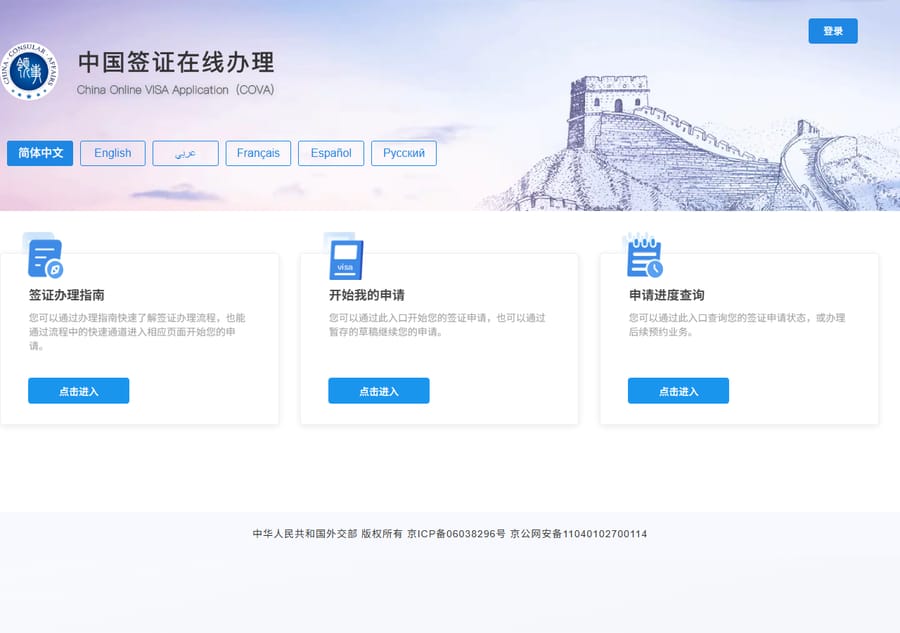
The official portal provides comprehensive online support for the entire Chinese visa application process. It offers access to the detailed Guidance on Visa Application for procedural information, allows applicants to start a new application or continue with a saved draft, and enables status tracking as well as management of subsequent appointments such as interview bookings—all within the same platform. The link is provided below. https://consular.mfa.gov.cn/VISA/
해설:
여기서 신청서 작성, 예약, 진행 상황 조회를 할 수 있습니다. 페이지 오른쪽 위에서 영어, 프랑스어, 스페인어, 러시아어, 아랍어로 전환됩니다.
8. 협정에 따른 입국: 상호 비자 면제 협정
출처는 중국영사서비스망: Mutual Visa Exemption List. 이 일람표에는 모두 160개국이 실려 있습니다. 전체 내용은 공식 원표가 기준입니다. 표 뒤 설명의 원문은 다음과 같습니다.
Note:
*1. The agreement signed between China and the former Yugoslavia is applicable.
*2. The agreement signed between China and the former Czechoslovakia is applicable.
*3. <AGREEMENT BETWEEN THE PEOPLE’S REPUBLIC OF CHINA AND THE EUROPEAN UNION ON THE SHORT-STAY VISA WAIVER FOR HOLDERS OF DIPLOMATIC PASSPORTS> is applicable.
Exemption of visa requirements does not mean permission to stay and reside in the other contracting country for an indefinite period of time. According to the agreements, holders of valid specified passports are permitted to stay for less than 30 days upon entry into the other contracting country. If a passport holder intends to stay for over 30 days, he or she should go through residence formalities with the local authorities according to relevant regulations as soon as possible.
해설:
이 표의 대부분 항목은 외교여권·관용여권만 대상으로 합니다. 일반여권으로도 상호 비자가 면제되는 곳은 다음 27개국입니다(공식 원표에서 정리했습니다).
알바니아, 앤티가 바부다, 아르메니아, 아제르바이잔, 바하마, 바베이도스, 벨라루스, 보스니아 헤르체고비나, 피지, 조지아, 그레나다, 카자흐스탄, 말레이시아, 몰디브, 모리셔스, 카타르, 사모아, 산마리노, 세르비아, 세이셸, 싱가포르, 솔로몬 제도, 수리남, 태국, 통가, 아랍에미리트, 우즈베키스탄.
일반적으로 중국은 상호 면제 협정이 없는 나라에는 일방적 무비자를 주고, 협정이 있는 나라에는 협정대로 운용합니다. 두 갈래는 의도적으로 겹치지 않게 되어 있습니다. 일방적 무비자(50개국), 통과 무비자(240시간), 지역 무비자(하이난 등), 상호 면제 협정(일반여권 27개국)은 중복 적용되지도, 서로 충돌하지도 않습니다. 본인에게 해당하는 하나를 따르면 됩니다. 이미 일방적 무비자 조건을 충족한다면, 상호 면제 협정 일람표에서 본인 나라에 관한 항목은 대개 외교여권·관용여권만 대상으로 하므로 일반여권 여행자와는 큰 관련이 없습니다.
9. 출발 전에 이 5가지를 캡처하세요
탑승교에서 입국심사 창구까지 구간은 네트워크가 안정적이지 않은 경우가 많고, 국제 로밍도 문자 인증에서 막히기 일쑤입니다. 출발 전에 휴대폰 앨범에 전용 폴더를 하나 만들고 이 다섯 장을 저장해 두세요.
- 여권 인적사항면: 이후 알리페이 개통, 역에서의 확인, 호텔 체크인에서 반복해서 씁니다.
- 첫날 묵을 호텔의 중국어 이름, 중국어 주소, 프런트 전화번호: 영문 이름만으로는 택시 기사에게도 입국카드에도 쓸모가 없습니다.
- 호텔 예약 확인서: 투숙객 이름(여권과 일치)과 체크인 날짜가 보여야 합니다.
- 본인 국적을 다루는 공식 정책 문단 캡처: 브라우저 주소창과 페이지 날짜까지 함께 담아 두면, 새 규정에 익숙하지 않은 체크인 직원이 확인할 수 있습니다.
- 확정된 연결편 또는 귀국편 일정표: 항공권 번호(e-ticket number)와 출발 시각이 나온 것으로. 통과 여객은 반드시 확인받습니다.
종이도 여전히 쓸모가 있습니다. 호텔 중국어 주소와 연결편 항공권을 한 장 인쇄해 가방에 넣어 두면, 휴대폰 배터리가 없거나 시스템 장애가 있어도 그대로 내밀 수 있습니다.
10. 입국심사에서
심사대 앞에 서기 전에 여권을 커버에서 빼고 휴대폰을 무음으로 바꾸세요(심사 구역에서는 촬영과 통화가 금지됩니다).
심사관의 질문은 거의 정해져 있습니다. 중국에 무엇을 하러 왔는지, 며칠 머무는지, 첫날 어디서 자는지, 다음은 어디로 가는지. 첫날 호텔 주소와 출국 항공권을 바로 꺼낼 수 있게 해 두고, 창구 앞에서 와이파이를 잡아 메일을 뒤지는 일은 피하세요. 통과 무비자로 들어가는 분은 미리 온라인으로 입국카드를 작성하고(5절 참고), 제3국(지역)행 연결 항공권을 먼저 보여 주세요.
입국한 다음 단계는 휴대폰 데이터 준비입니다. 일정이 몇 주에 걸쳐 있거나, 여행 중에 출국편을 바꾸거나 출국 출입국장을 바꿨다면, 반드시 국가이민관리국 사이트를 다시 열어 확인하세요. 이 페이지 맨 위의 ‘최종 확인’ 날짜가 한 달이 넘었다면, 언제나 공식 사이트의 그날 페이지가 기준입니다.
출처
자주 묻는 질문
- 어느 나라 여권이면 무비자로 30일 중국에 들어갈 수 있나요?
- 2026년 2월 17일 기준 일방적 무비자는 50개국(유럽 35, 오세아니아 2, 아시아 7, 미주 6)이 대상입니다. 일반여권 소지자는 상용, 관광, 친지 방문, 교류 방문, 통과 목적으로 입국할 수 있고 체류는 30일 이내입니다. 체류 기간은 입국 다음 날 0시부터 계산합니다. 명단은 국가이민관리국 공식 사이트가 기준입니다.
- 240시간 통과 무비자는 무엇이 필요한가요?
- 대상 57개국 국적이어야 하고, 일반여권과 날짜·좌석이 확정된 제3국(지역)행 연결 항공권을 가지고, 24개 성·자치구·직할시의 지정 65개 출입국장 중 한 곳으로 입국해, 체류 허용 구역 안에서 10일을 넘기지 않고 머물며, 입국카드를 작성해야 합니다. 출발한 나라로 돌아가는 왕복은 통과로 보지 않습니다.
- 중국 입국카드는 온라인으로 쓸 수 있나요? 유료인가요?
- 쓸 수 있고 무료입니다. 공식 창구는 세 개뿐입니다. 사이트 s.nia.gov.cn/ArrivalCardFillingPC/, '이민국 12367' 앱, 같은 이름의 위챗 미니프로그램입니다. 돈을 받는 '입국카드 작성 사이트'는 전부 가짜입니다.
- 호텔이 아니라 친구 집에 묵으면 숙박 등록을 해야 하나요?
- 해야 합니다. 도착 후 24시간 안에 본인 또는 재워 주는 사람이 거주지 공안기관에 등록해야 합니다. 2026년 9월 21일부터 전국에서 온라인 처리가 가능합니다. 첫 등록은 보통 재워 주는 사람의 도움이 필요합니다.
- 상호 비자 면제 협정과 일방적 무비자는 충돌하나요?
- 충돌하지도, 중복 적용되지도 않습니다. 중국은 협정이 없는 나라에는 일방적 무비자를 주고, 협정이 있는 나라에는 협정대로 운용합니다. 일반여권으로 상호 비자가 면제되는 협정국은 27개국입니다. 본인에게 해당하는 하나를 따르면 됩니다.