外国人入境中国规则 2026:免签、过境免签、入境卡与签证
入境中国前,先在国家移民管理局官网确认适用于您护照的规则:50 国普通护照可单方面免签停留 30 天;57 国可走 240 小时过境免签;所有国家都能在口岸限定区域 24 小时过境免签;海南等地另有区域性免签。都不符合就在中国领事服务网办签证。起飞前在线免费填好入境卡。
入境中国之前,您要做的第一件事,就是找到适用于您护照的入境规则。下面我按「先去哪里查 → 免签 → 过境免签 → 区域性免签 → 入境卡 → 住宿登记 → 签证 → 互免协定」的顺序,给出大多数人需要的官方原文和我的解读。
一、先去哪里查:国家移民管理局官网
首先,您可以在官网查到适用于您护照的入境规则。官网是:国家移民管理局 National Immigration Administration。请注意,这是中国国家移民管理局的官方网站,其余任何网站都不可信!网站可以切换多种语言,便于理解。
因为网站的内容太多,下面我将给出大多数人需要的原文和注意事项。如果您需要办理签证,请看第七节的中国领事服务网。
二、单方面免签:50 国普通护照,停留 30 天
2026 年 2 月,中国国家移民管理局发布通知(来自 Policy Interpretation_National Immigration Administration):List of Countries Covered by Unilateral Visa Exemption Policies。
(Compiled according to information released by the Ministry of Foreign Affairs of the People’s Republic of China, as of February 17, 2026)
Europe (35 countries): Andorra, Austria, Belgium, Bulgaria, Croatia, Cyprus, Denmark, Estonia, Finland, France, Germany, Greece, Hungary, Iceland, Ireland, Italy, Latvia, Liechtenstein, Luxembourg, Malta, Monaco, Montenegro, Netherlands, North Macedonia, Norway, Poland, Portugal, Romania, Russian Federation, Slovakia, Slovenia, Spain, Sweden, Switzerland, United Kingdom of Great Britain and Northern Ireland
Oceania (2 countries): Australia, New Zealand
Asia (7 countries): Bahrain, Brunei Darussalam, Japan, Kuwait, Oman, Republic of Korea, Saudi Arabia
Americas (6 countries): Argentina, Brazil, Canada, Chile, Peru, Uruguay
Note: Nationals of the above countries holding ordinary passports may enter China visa-free for business, tourism, visits to relatives and friends, exchange visits, or transit, for stays of up to 30 days. The duration of stay is calculated from 00:00 on the day following the date of entry.
解读:
很荣幸地通知您:如果您是上述国家的公民并持普通护照,就可以免签入境中国,停留期限不超过 30 天。需要注意的是:停留期限自入境次日的 0 时起算。
三、过境免签:24 小时与 240 小时
2026 年 8 月 20 日,中国国家移民管理局发布通知(来自 Policy Interpretation_National Immigration Administration):Visa-Free Transit Policies。
I. 24-Hour Visa-Free Transit Policy
All open exit-entry ports in China implement this policy for nationals of all other countries around the world. Foreigners transiting through China to third countries or regions may stay in China for no more than 24 hours without a visa, provided that they hold valid international travel documents and onward international flight/ship/train tickets with confirmed seats, and will not leave the restricted areas of ports. For any foreigner who does need to leave the designated restricted area, a temporary entry permit must be obtained first at the immigration inspection authority of the port concerned.
II. 240-Hour Visa-Free Transit Policy
Currently, China is implementing this policy for nationals of 57 countries including Russia, the United Kingdom and the United States. Nationals of these countries, who need to transit through China to third countries or regions, may enter visa-free through any of the designated 65 open exit-entry ports in 24 provinces, autonomous regions and municipalities directly under the Central Government and stay in the permitted areas for no more than 10 days, provided that they hold ordinary passports and onward tickets with confirmed seats and departure dates. Foreign nationals covered by this policy may, within the designated areas, engage in activities like travel activities, business activities, visits, family reunions, etc., during their stay periods. Activities such as work, study, or news reporting still require prior approvals and appropriate visas.
(I) List of 57 Countries
Europe (40 countries): Albania, Austria, Belarus, Belgium, Bosnia and Herzegovina, Bulgaria, Croatia, Cyprus, Czech Republic, Denmark, Estonia, Finland, France, Germany, Greece, Hungary, Iceland, Ireland, Italy, Latvia, Lithuania, Luxembourg, Malta, Monaco, Montenegro, the Netherlands, North Macedonia, Norway, Poland, Portugal, Romania, Russia, Serbia, Slovakia, Slovenia, Spain, Sweden, Switzerland, Ukraine, United Kingdom
North America (2 countries): Canada, United States
South America (4 countries): Argentina, Brazil, Chile, Mexico
Oceania (2 countries): Australia, New Zealand
Asia (9 countries): Brunei, Indonesia, Japan, Kyrgyzstan, Qatar, Singapore, South Korea, United Arab Emirates, Vietnam
(II) Eligible Ports and Permitted Stay Areas
官方页面上的「适用口岸与允许停留区域」是一张图片,下面是我根据原图整理翻译的文字版,请以官网原图为准:
| 序号 | 省(自治区、直辖市) | 适用口岸 | 允许停留区域 |
|---|---|---|---|
| 1–2 | 北京 | 北京首都国际机场;北京大兴国际机场 | 北京市 |
| 3–4 | 天津 | 天津滨海国际机场;天津港(客运) | 天津市 |
| 5–6 | 河北 | 石家庄正定国际机场;秦皇岛港(客运) | 河北省 |
| 7–9 | 辽宁 | 沈阳桃仙国际机场;大连周水子国际机场;大连港(客运) | 辽宁省 |
| 10–12 | 上海 | 上海虹桥国际机场;上海浦东国际机场;上海港(客运) | 上海市 |
| 13–16 | 江苏 | 南京禄口国际机场;苏南硕放国际机场;扬州泰州国际机场;连云港港(客运) | 江苏省 |
| 17–22 | 浙江 | 杭州萧山国际机场;宁波栎社国际机场;温州龙湾国际机场;义乌机场;温州港(客运);舟山港(客运) | 浙江省 |
| 23–24 | 安徽 | 合肥新桥国际机场;黄山屯溪国际机场 | 安徽省 |
| 25–29 | 福建 | 福州长乐国际机场;厦门高崎国际机场;泉州晋江国际机场;武夷山机场;厦门港(客运) | 福建省 |
| 30–34 | 山东 | 济南遥墙国际机场;青岛胶东国际机场;烟台蓬莱国际机场;威海大水泊国际机场;青岛港(客运) | 山东省 |
| 35 | 河南 | 郑州新郑国际机场 | 河南省 |
| 36 | 湖北 | 武汉天河国际机场 | 湖北省 |
| 37–38 | 湖南 | 长沙黄花国际机场;张家界荷花国际机场 | 湖南省 |
| 39–48 | 广东 | 广州白云国际机场;深圳宝安国际机场;揭阳潮汕国际机场;南沙港(客运);蛇口港(客运);广州琶洲港澳客运口岸;中山港(客运);横琴口岸;港珠澳大桥口岸;广深港高铁西九龙站 | 广东省(可从全省所有对外开放口岸入境) |
| 49–50 | 海南 | 海口美兰国际机场;三亚凤凰国际机场 | 海南省 |
| 51 | 重庆 | 重庆江北国际机场 | 重庆市 |
| 52 | 贵州 | 贵阳龙洞堡国际机场 | 贵州省 |
| 53 | 陕西 | 西安咸阳国际机场 | 陕西省 |
| 54 | 山西 | 太原武宿国际机场 | 太原市、大同市 |
| 55 | 黑龙江 | 哈尔滨太平国际机场 | 哈尔滨市 |
| 56 | 江西 | 南昌昌北国际机场 | 南昌市、景德镇市 |
| 57–60 | 广西 | 南宁吴圩国际机场;桂林两江国际机场;北海福成机场;北海港(客运) | 南宁、柳州、桂林、梧州、北海、防城港、钦州、贵港、玉林、贺州、河池、来宾共 12 市 |
| 61–62 | 四川 | 成都双流国际机场;成都天府国际机场 | 成都、自贡、攀枝花、泸州、德阳、遂宁、内江、乐山、宜宾、雅安、眉山、资阳(原图写「共 11 市」,但列出了 12 个城市名,请以官网为准) |
| 63–65 | 云南 | 昆明长水国际机场;丽江三义国际机场;磨憨铁路口岸 | 昆明、玉溪、楚雄、红河、文山、普洱、西双版纳、大理、丽江共 9 个州市 |
表下注:过境免签旅客可在 24 个省(自治区、直辖市)的允许停留区域内跨省活动,停留不超过 240 小时。
解读:
一方面,这里再次提到了 240 小时过境免签政策:如果您是上面 57 个国家的公民,持普通护照和已确定日期、座位的前往第三国(地区)的联程客票,就可以从表中的 65 个口岸免签入境,在表里「允许停留区域」列出的范围内停留,最长不超过 10 天。
另一方面请注意:假如您只是在中国境内中转,前往的是另一个国家或地区,那么只要您持有有效期内的护照和已订妥座位的联程客票(交通方式可以是国际航班、船舶或列车),不离开口岸限定区域,并且停留不超过 24 小时,就可以不用办理签证。如果您中途需要离开口岸限定区域,应当先向该口岸的出入境边防检查机关申请办理临时入境许可。
假如您找不到该口岸的出入境边防检查机关,只要向现场的工作人员询问即可,他们一般会为您指路,甚至带您过去办理。在这里我要提一句,中国的政府工作人员一般都很热心,只要您有需要,就可以向他们寻求帮助,请不要吝啬您的语言。办理时间大概 5–15 分钟,人多的时候大概 20–40 分钟(这是经验值,以现场为准),办好之后就可以规划您的 24 小时之旅啦。当然,办理临时入境许可之后也不是全中国哪里都可以去,能去的范围以边检机关批准的为准。
另外,自 2025 年 11 月 20 日起,国家移民管理局把入境卡搬到了线上,您可以在起飞前就在家里先填好,详情请看下面的第五节:在线填写入境卡。
四、区域性免签:海南、邮轮、东盟与港澳旅游团
2026 年 8 月 20 日,中国国家移民管理局发布通知(来自 Policy Interpretation_National Immigration Administration):Regional Visa-Free Entry Policies for Foreign Nationals。
The major regional visa-free entry policies for foreign nationals of China are as follows.
I. 30-Day Visa-free Entry Policy for Foreign Nationals Entering Hainan Province. Foreign nationals holding ordinary passports from 61 countries may enter and stay within the administrative region of Hainan Province for a maximum of 30 days without a visa for short-term stays for purposes associated with tourism, business, visits, family visits, medical treatment, conferences and exhibitions, sports competitions, etc. The policy does not apply to those who intend to enter for working or studying. The exit-entry ports for the foreign nationals concerned include all the open ports in Hainan. The 61 countries are Albania, Argentina, Australia, Austria, Belarus, Belgium, Bosnia and Herzegovina, Brazil, Brunei, Bulgaria, Canada, Chile, Croatia, Cyprus, the Czech Republic, Denmark, Estonia, Finland, France, Germany, Greece, Hungary, Iceland, Indonesia, Ireland, Italy, Japan, Kazakhstan, Kyrgyzstan, Latvia, Lithuania, Luxembourg, Malaysia, Malta, Mexico, Monaco, Montenegro, the Netherlands, New Zealand, North Macedonia, Norway, the Philippines, Poland, Portugal, Qatar, the Republic of Korea, Romania, Russia, Serbia, Singapore, Slovakia, Slovenia, Spain, Sweden, Switzerland, Thailand, Ukraine, the United Arab Emirates, the United Kingdom, the United States, Vietnam.
II. Visa-Free Entry Policy for Foreign Tourist Groups Traveling by Cruise Ships. Any foreign tourist group consisting of two or more individuals, which is organized and received by a travel agency registered in China, may enter China without a visa by a cruise ship via one of the cruise ports in the following 13 cities: Beihai (Guangxi Zhuang Autonomous Region), Dalian (Liaoning Province), Guangzhou (Guangdong Province), Haikou (Hainan Province), Lianyungang (Jiangsu Province), Qingdao (Shandong Province), Sanya (Hainan Province), Shanghai, Shenzhen (Guangdong Province), Tianjin, Wenzhou (Zhejiang Province), Xiamen (Fujian Province) and Zhoushan (Zhejiang Province). All eligible foreign tourist groups shall continue their journey to the following scheduled ports and depart China with the same cruise ship as scheduled. The tourists concerned may stay in the Beijing and 11 coastal provinces, autonomous regions, and municipalities directly under the Central Government (namely Fujian, Guangdong, Guangxi, Hainan, Hebei, Jiangsu, Liaoning, Shandong, Shanghai, Tianjin, and Zhejiang) for a maximum of 15 days.
III. Visa-Free Entry Policy for Tourist Groups Entering Xishuangbanna, Yunnan Province from ASEAN Member States. Any tourist group (consisting of two or more individuals holding ordinary passports) from a member state of the Association of Southeast Asian Nations (ASEAN) may enter and exit China through Xishuangbanna Gasa International Airport, Mohan Railway Port, and Mohan Highway Port visa-free, provided that the tourist group is organized and received by a travel agency registered in China. The tourists concerned shall enter and leave China as part of their tourist group, and can stay within the administrative region of Xishuangbanna Dai Autonomous Prefecture for a maximum of 6 days. The ASEAN member states include Brunei, Cambodia, Indonesia, Laos, Malaysia, Myanmar, the Philippines, Singapore, Thailand and Vietnam.
IV. Visa-Free Entry Policy for Tourist Groups Entering Guilin, Guangxi Zhuang Autonomous Region from ASEAN Member States. Any tourist group (consisting of two or more individuals holding ordinary passports) from a member state of the Association of Southeast Asian Nations (ASEAN) may enter and exit China through the airport in Guilin visa-free, provided that the tourist group is organized and received by a travel agency registered in China. The tourists concerned shall enter and leave China as part of their tourist group, and can stay within the administrative region of Guilin, Guangxi Zhuang Autonomous Region for a maximum of 6 days. The ASEAN member states include Brunei, Cambodia, Indonesia, Laos, Malaysia, Myanmar, the Philippines, Singapore, Thailand and Vietnam.
V. Visa-Free Entry Policy for Foreign Tourist Groups Traveling from Hong Kong and Macao Special Administrative Regions (SARs) to Guangdong Province. Foreign nationals holding ordinary passports from countries with diplomatic relations with China may enter nine cities in the Guangdong-Hong Kong-Macao Greater Bay Area, as well as Shantou, without a visa, provided that they will enter Hong Kong or Macao SAR first and then enter Guangdong Province as part of a tourist group organized by a travel agency registered in any of the two SARs. The foreign tourists in this case can stay for a maximum of 6 days in the following cities: Dongguan, Foshan, Guangzhou, Huizhou, Jiangmen, Shantou, Shenzhen, Zhaoqing, Zhongshan and Zhuhai. The tourists concerned shall enter and exit the Chinese mainland as part of their tourist group via any of the exit-entry ports in these 10 cities.
VI. Visa-Free Entry Policy for Foreign Tourist Groups Traveling from Hong Kong and Macao Special Administrative Regions (SARs) to Hainan Province. Foreign nationals holding ordinary passports from countries with diplomatic relations with China may enter Hainan Province without a visa, provided that they will enter Hong Kong or Macao SAR first and then enter Hainan Province as part of a tourist group organized by a travel agency registered in any of the two SARs. The tourists concerned shall enter and exit the Hainan Province as part of their tourist group via any of the exit-entry ports in Hainan and can stay for a maximum of 6 days.
The stay period specified in any of the aforementioned policies is calculated from 0:00 on the day after the day of entry. For the individuals who meet the requirements specified in the bilateral visa exemption agreements and the unilateral visa exemption policies of China, the relevant regulations shall prevail.
解读:
当您只需要前往海南省时,如果您是第一条中提到的 61 个国家的公民,那么可以免签入境,在海南省境内停留 30 天。
由在中国注册的旅行社组织接待、人数在 2 人以上的外国旅游团,可以乘坐邮轮从上述 13 个城市的邮轮口岸免签入境。所有符合条件的外国旅游团须按规定随同一邮轮继续前往预定的后续港口,并如期离境。相关人员可在北京以及 11 个沿海省(自治区、直辖市)(即福建、广东、广西、海南、河北、江苏、辽宁、山东、上海、天津、浙江)停留,最长 15 天。
由东盟成员国持普通护照人员组成、人数在 2 人以上的旅游团,经在中国注册的旅行社组织接待,可以从西双版纳嘎洒国际机场、磨憨铁路口岸、磨憨公路口岸免签入出境,在西双版纳傣族自治州行政区域内停留,最长 6 天;也可以从桂林的机场免签入出境,在广西壮族自治区桂林市行政区域内停留,最长 6 天。两种情况下,相关人员都须随团整团入出境。东盟成员国名单见上方第三条。
与中国建交国家的持普通护照人员,由在香港或澳门特别行政区注册的旅行社组织接待,先进入香港或澳门,再以旅游团形式进入广东省的,可免签进入粤港澳大湾区九市以及汕头。相关外国游客可在下列城市停留,最长 6 天:东莞、佛山、广州、惠州、江门、汕头、深圳、肇庆、中山、珠海。相关人员须随团整团、经上述 10 个城市中任一对外开放口岸出入中国内地。
与中国建交国家的持普通护照人员,由在香港或澳门特别行政区注册的旅行社组织接待,先进入香港或澳门,再以旅游团形式进入海南省的,可免签入境海南。相关人员须随团整团、经海南任一对外开放口岸出入海南省,最长停留 6 天。
需要注意的是:上述各项政策规定的停留期限,均自入境次日的 0 时起计算。符合中国政府间双边免签协定及单方面免签政策条件的人员,按相关规定执行。
五、在线填写入境卡
2025 年 12 月 22 日,中国国家移民管理局发布通知(来自 Policy Interpretation_National Immigration Administration):How to Submit Your Arrival Card to China Online。下面是官方的操作视频:
解读:
填写入境卡有三个官方渠道:
| 渠道 | 地址 |
|---|---|
| 网站 | https://s.nia.gov.cn/ArrivalCardFillingPC/ |
| App | 「移民局 12367」App |
| 小程序 | 微信小程序「移民局 12367」 |
官方填报须知列出了八类不用填入境卡的人:
- 持有效外国人永久居留身份证的人员
- 持有效港澳居民来往内地通行证的人员(非中国籍)
- 24 小时直接过境,并且停留在口岸限定区域内、不离开口岸的旅客
- 持团体签证或符合团体免签入境条件的外国旅游团成员
- 外国籍机组人员、船员、司机等出入境交通运输工具员工
- 乘坐邮轮入境,并随同一邮轮离境的旅客
- 符合集中交验出入境证件礼遇条件的人员
- 经边检快捷通道入境的旅客
请注意:在线填写入境卡是免费的,请只通过上述官方渠道访问。境外有骗子搭建了假冒的「中国入境卡填写网站」向旅客收费。
而且这不只是「手续」,它是政策条件本身。240 小时过境免签的申请条件里就包含这一项,地方公安的官方问答把它列为条件之一:
持 240 小时内已确定日期及座位的前往第三国(地区)的联程客票或相关证明,并填写《临时入境外国人入境卡》。
所以严格来讲,如果不填入境卡,您的材料就是不齐的。
六、不住酒店时的住宿登记
2026 年 9 月 21 日,中国国家移民管理局发布通知(来自 Policy Interpretation_National Immigration Administration):Policy Interpretation of the Nationwide Implementation of the Online Accommodation Registration Service for Foreigners Residing or Staying in Domiciles Other Than Hotels。
I. What is the scope of application of online accommodation registration?
According to Article 39 of the Exit and Entry Administration Law of the People’s Republic of China, where foreigners stay in hotels in China, the hotels shall register their accommodation in accordance with the regulations on the public security administration of the hotel industry, and submit foreigners’ accommodation registration information to the public security organs in the places where the hotels are located. For foreigners who reside or stay in domiciles other than hotels, they or the persons who accommodate them shall, within 24 hours after the foreigners’ arrival, go through the registration formalities with the public security organs in the places of residence. To further enhance the convenience for foreigners in China, the NIA has rolled out the online accommodation registration service nationwide for foreigners who reside or stay in domiciles other than hotels. Foreigners who reside or stay in domiciles other than hotels may go through the registration formalities online without the need to visit the public security organs in person. Online registration has the same legal effect as on-site registration.
II. What channels are available for online accommodation registration?
Accommodation hosts or foreigners may access the NIA Government Service Platform, including the official website, the “NIA 12367” App, and “NIA 12367” WeChat mini program, or the Alipay mini program. After completing user registration and identity verification, users may follow the step-by-step prompts of the Accommodation Registration module under Foreigner Service. Upon completion, users may click “Registration Record Inquiry” to view their accommodation registration record.
III. Who may go through the registration formalities online?
Accommodation registration may be completed online either by the foreigners who reside or stay in domiciles or by the persons who accommodate them. Considering that accommodation hosts are generally more familiar with the information regarding the residence, the initial registration should be completed with their assistance to ensure the accuracy of the registration information. Under the following circumstances, the foreigners may go through the registration formalities independently: where the foreigners have previously gone through the registration formalities through the NIA Government Service Platform and need to register again at the same residence; where the foreigners reside at a self-owned residence.
The accommodation host may be either a Chinese citizen or a foreigner.
IV. Under what circumstances can the registration formalities be simplified?
For foreigners who reside or stay in domiciles other than hotels and have already gone through the registration formalities after arrival in accordance with the relevant regulations, re-registration is not required under the following circumstances: where foreigners reside at their own residences within China and return to the same residences after traveling within or outside China; where foreigners holding residence permits or permanent residences permits reside at habitual residence within China and return to the same residences after traveling within or outside China during the validity period of the same permit.
A self-owned residence refers to a residence owned by the foreigner or his/her spouse within China. A habitual residence refers to a residence where the foreigner resides or plans to reside in China for a long term. According to Article 36 of the Regulations of the People’s Republic of China on Administration of the Entry and Exit of Foreigners, “long term” refers to residing in China for a period exceeding 180 days.
V. What should users do if they encounter questions or difficulties when going through the registration formalities online?
Accommodation hosts and foreigners who reside or stay in domiciles may access the Guide to Online Accommodation Registration on the accommodation registration page of the NIA Government Service Platform and follow the instructions provided. They may also call the NIA 12367 service hotline for inquiries. Alternatively, they may visit the exit-entry administration service windows of the local public security organs or local police stations to seek assistance with on-site registration.
VI. Will there be legal liability for failure to go through the registration formalities as required?
According to Article 76 of the Exit and Entry Administration Law of the People’s Republic of China, foreigners or their accommodation hosts who fail to process accommodation registration in accordance with the relevant regulations shall be given a warning and may also be subject to a fine.
解读:
假如您住的是酒店,那么在酒店前台的指导下办理入住即可,酒店会替您完成登记,这一条就和您没关系啦。怎么订能接待外国客人的酒店,请看入住酒店。
但是如果您住在酒店之外的任何一个地方(比如朋友家、亲戚家或者租住的房子),就需要在入住后 24 小时内,由您本人或者留宿您的人,向居住地的公安机关办理住宿登记。您可以去最近的派出所办理(在高德地图里搜索「派出所」就能找到,见出行),也可以在线上办理。线上办理时请注意,第一次登记一般需要在留宿人的协助下完成,这里是有规定的(见第三条)。此外,也有几种情况无需重新登记,请看看您是否符合(见第四条)。遇到任何问题请参考第五条。另外,如果忘记登记,会被给予警告,并可能被处以罚款。
七、办理签证
如果上面的免签政策您都不符合,就需要办理签证。请先访问中国领事服务网,或者您当地的中国使领馆官网,查询相关政策与须知。
7.1 来华签证简介
来自中国领事服务网:Visa Application Instructions of the People’s Republic of China。
Visa Application Instructions of the People’s Republic of China
Please select the appropriate category of visa according to your main purpose of travel to China
| Visa Category | Who May Apply |
|---|---|
| C | Issued to crew members of international trains, aircraft, and vessels on international voyages who perform crew duties, as well as the accompanying family members of such crew members, and commercial transport vehicle drivers engaged in international road transport |
| D | Issued to permanent residents in China |
| F | Issued to those who intend to go to China for exchanges, visits, study tours and other activities |
| G | Issued to those who intend to transit through China |
| J1 | Issued to journalists of foreign news organizations stationed in China, whose intended duration of residence in China exceeds 180 days |
| J2 | Issued to foreign journalists who intend to go to China for short-term news coverage. The intended duration of stay in China is no more than 180 days |
| L | Issued to those who intend to go to China for tourism |
| M | Issued to those who intend to go to China for commercial and trade activities |
| Q1 | Issued to those who are family members (spouses, parents, sons, daughters, spouses of sons or daughters, brothers, sisters, grandparents, grandsons, granddaughters and parents-in-law) of Chinese citizens or of foreigners with Chinese permanent residence and intend to go to China for family reunion and residence, as well as those who apply to enter and reside in China for foster care or other reasons |
| Q2 | Issued to those who intend to visit their relatives who are Chinese citizens residing in China or foreigners with Chinese permanent residence, for a short-term stay of no more than 180 days |
| R | Issued to foreign high-level talents and specialists whose expertise is in urgent need in China |
| S1 | Issued to those who intend to go to China to visit the foreigners residing in China for work, study or other purposes, to whom they are spouses, parents, sons or daughters under the age of 18 or parents-in-law, and to those who need to reside in China for other private affairs. The intended duration of stay in China exceeds 180 days |
| S2 | Issued to those who intend to visit their family members (spouses, parents, sons, daughters, spouses of sons or daughters, brothers, sisters, grandparents, grandsons, granddaughters and parents-in-law) who are foreigners staying or residing in China for work, study or other purposes, and to those who need to stay in China for other private matters. The intended duration of stay in China is no more than 180 days |
| X1 | Issued to those who intend to study in China for a period of more than 180 days |
| X2 | Issued to those who intend to study in China for a period of no more than 180 days |
| Z | Issued to those who intend to work in China |
When applying for a visa, you need to prepare the following documents:
I. Basic Documents
As required by the Chinese Embassy or Consulate-General in your locality, please fill in the visa application form online and submit the applicant’s passport and photo, proof of legal stay or residence, and the previous Chinese passport or previous Chinese visa (for specific requirements, please refer to the “Guidance on Visa Application” section of the China Online Visa Application System (website: https://consular.mfa.gov.cn/VISA/) or the website of the Chinese Embassy or Consulate-General in your locality), together with the following:
II. Other Supporting Documents
C Visa
A guarantee letter issued by the foreign transport company, or an invitation letter issued by a relevant entity in China.
D Visa
The original and a photocopy of the Confirmation Form for Foreigner’s Permanent Residence Status issued by the Ministry of Public Security of China.
Please note: The holder must, within 30 days of entering China, apply for a residence permit at the exit-entry administration of the public security bureau of the people’s government at or above the county level of the intended place of residence.
F Visa
An invitation letter issued by a relevant entity or individual in China. The invitation letter must contain the following information:
- Personal information of the invited: name, gender, date of birth, etc.;
- Information about the invited person’s visit to China: reason for coming to China, dates of arrival and departure, place of visit, relationship with the inviting entity or the inviting person, who will pay for the travel, etc.;
- Information of the inviting entity or the inviting person: name of the inviting entity or name of the inviting person, phone number, address, official seal of the entity, signature of the legal representative or the inviting person, etc.
G Visa
An onward air (train or ship) ticket with confirmed date and seat to the destination country or region.
J1 Visa
A visa notification letter issued by the Department of Press, Communication and Public Diplomacy of the Ministry of Foreign Affairs of China, and an official letter issued by the media organization for which the journalist works.
The applicant should first contact the press office of the Chinese Embassy or Consulate-General to complete the relevant procedures.
Please note: The holder must, within 30 days of entering China, apply for a residence permit at the exit-entry administration of the public security bureau of the people’s government at or above the county level of the intended place of residence.
J2 Visa
A visa notification letter issued by the Department of Press, Communication and Public Diplomacy of the Ministry of Foreign Affairs of China or a relevant entity, and an official letter issued by the media organization for which the journalist works.
The applicant should first contact the press office of the Chinese Embassy or Consulate-General to complete the relevant procedures.
L Visa
Itinerary documents such as round-trip air ticket booking records and hotel reservations, or an invitation letter issued by an entity or individual in China. The invitation letter must contain the following information:
- Personal information of the invited: name, gender, date of birth, etc.;
- Information about the invited person’s itinerary: dates of arrival and departure, places to visit, etc.;
- Information of the inviting entity or the inviting person: name of the inviting entity or name of the inviting person, phone number, address, official seal of the entity, signature of the legal representative or the inviting person, etc.
M Visa
Invitation documents issued by a trade partner in China, such as documents on commercial activities or invitations to economic and trade fairs. The invitation documents must contain the following information:
- Personal information of the invited: name, gender, date of birth, etc.;
- Information about the invited person’s visit to China: reason for coming to China, dates of arrival and departure, place of visit, relationship with the inviting entity or the inviting person, who will pay for the travel, etc.;
- Information of the inviting entity or the inviting person: name of the inviting entity or name of the inviting person, phone number, address, official seal of the entity, signature of the legal representative or the inviting person, etc.
Q1 Visa
For family reunion purposes, the following documents are required:
- An invitation letter issued by a Chinese citizen residing in China or a foreigner with Chinese permanent residence. The invitation letter must contain the following information:
- Personal information of the invited: name, gender, date of birth, etc.;
- Information about the invited person’s visit to China: reason for coming to China, intended date of arrival, intended place of residence, intended duration of residence, relationship with the inviting individual, who will pay for the travel, etc.;
- Information of the inviting individual: name, phone number, address, signature of the inviting individual, etc.
- A photocopy of the Chinese ID card of the inviting individual, or photocopies of the bio-page of the foreigner’s passport and the permanent residence permit;
- The original and a photocopy of certification (marriage certificate, birth certificate, kinship certification issued by the public security police station, notarized kinship certificate, etc.) showing the relationship of family members (spouses, parents, sons, daughters, spouses of sons or daughters, brothers, sisters, grandparents, grandsons, granddaughters and parents-in-law) between the applicant and the inviting individual.
For foster care purposes, the following documents are required:
- A notarized foster care power of attorney issued by a Chinese Embassy or Consulate-General, or a foster care power of attorney notarized or authenticated in the host country or in China;
- The original and a photocopy of the consignor’s passport, and certification (marriage certificate, birth certificate, kinship certification issued by the public security police station, notarized kinship certificate, etc.) showing the kinship between the consignor and the fostered child;
- A letter of consent to accept the foster care issued by the trustee, and a photocopy of the trustee’s ID card;
- Where one or both parents of the fostered child are Chinese citizens, a photocopy of the certificate showing that the parent(s) of Chinese nationality had settled abroad at the time of the child’s birth must also be provided.
Please note: The holder must, within 30 days of entering China, apply for a residence permit at the exit-entry administration of the public security bureau of the people’s government at or above the county level of the intended place of residence.
Q2 Visa
- An invitation letter issued by a Chinese citizen residing in China or a foreign citizen with Chinese permanent residence. The invitation letter must contain the following information:
- Personal information of the invited: name, gender, date of birth, etc.;
- Information about the invited person’s visit to China: reason for coming to China, dates of arrival and departure, place of visit, relationship with the inviting individual, who will pay for the travel, etc.;
- Information of the inviting individual: name, phone number, address, signature of the inviting individual, etc.
- A photocopy of the Chinese ID card of the inviting individual, or photocopies of the bio-page of the foreigner’s passport and the permanent residence permit.
R Visa
The applicant shall meet the introduction conditions and requirements for foreign high-level talents and urgently-needed specialists as determined by the relevant competent authorities of the Chinese government, and submit the corresponding certification materials as required.
S1 Visa
The following documents are required:
- An invitation letter from the inviting individual (a foreigner who stays or resides in China for work or studies). The invitation letter must contain the following information:
- Personal information of the invited: name, gender, date of birth, etc.;
- Information about the invited person’s visit to China: reason for coming to China, intended date of arrival, intended place of residence, intended duration of residence, relationship with the inviting individual, who will pay for the travel, etc.;
- Information of the inviting individual: name, phone number, address, signature of the inviting individual, etc.
- Photocopies of the inviting individual’s passport bio-page and residence permit;
- The original and a photocopy of certification (marriage certificate, birth certificate, kinship certification issued by the public security police station, notarized kinship certificate, etc.) showing the kinship (spouses, parents, sons or daughters under the age of 18, parents-in-law) between the applicant and the inviting individual.
Please note: The holder must, within 30 days of entering China, apply for a residence permit at the exit-entry administration of the public security bureau of the people’s government at or above the county level of the intended place of residence.
S2 Visa
For short-term family visits, the following documents are required:
- Photocopies of the passport and residence permit of the inviting individual (specifically, a foreigner staying or residing in China for work or studies);
- An invitation letter issued by the inviting individual. The invitation letter must contain the following information:
- Personal information of the invited: name, gender, date of birth, etc.;
- Information about the invited person’s visit to China: reason for coming to China, dates of arrival and departure, place of visit, relationship with the inviting individual, who will pay for the travel, etc.;
- Information of the inviting individual: name, phone number, address, signature of the inviting individual, etc.
- A photocopy of certification (marriage certificate, birth certificate, kinship certification issued by the public security police station, notarized kinship certificate, etc.) showing the relationship of family members (spouses, parents, sons, daughters, spouses of sons or daughters, brothers, sisters, grandparents, grandsons, granddaughters and parents-in-law) between the applicant and the inviting individual.
In case of other personal affairs, relevant supporting materials shall be provided as required by the consular officers.
X1 Visa
- The Admission Letter issued by a school or other admitting entity in China;
- The Confirmation Form for Study in China (Form JW201 or Form JW202).
Please note: The holder must, within 30 days of entering China, apply for a residence permit at the exit-entry administration of the public security bureau of the people’s government at or above the county level of the intended place of residence.
X2 Visa
The Admission Letter issued by a school or other admitting entity in China.
Z Visa
One of the following is required:
- The Notice for the Work Permit for Foreigners of the People’s Republic of China issued by the human resources and social security authority (the authority that centrally administers the employment of foreign experts); where the work period is no more than 90 days, the applicant must apply for the visa before the start date indicated on the Notice for the Work Permit for Foreigners of the People’s Republic of China, and the work time must not exceed the period indicated therein;
- The Registration Certificate of the Resident Representative Office of a Foreign (Regional) Enterprise issued by the market regulation authority;
- The approval document for commercial artistic performances issued by the cultural administrative authority (applicable only to applicants coming to China for commercial performances) and the Certificate of Short-term Work for Foreigners in China, in which case the applicant must apply for the visa before the start date indicated on the Certificate of Short-term Work for Foreigners in China, and the performance time must not exceed the period indicated therein;
- The Invitation Letter for Foreigners to Engage in Offshore Petroleum Operations in the People’s Republic of China issued by China National Offshore Oil Corporation;
Please note: The holder must, within 30 days of entering China, apply for a residence permit at the exit-entry administration of the public security bureau of the people’s government at or above the county level of the intended place of residence, except for those whose visas are marked with “permitted stay of 30 days after entry”.
III. Important Tips
The invitation letter may be a fax, a photocopy or a printout, but the consular officers may require the applicant to provide the original one.
When necessary, the consular officers may require the applicant to provide other supporting documents or supplementary materials, or require the applicant to attend an interview.
The consular officials will decide whether to issue a visa and determine its validity, duration of stay and number of entries according to the applicant’s specific circumstances.
For further details, please visit the website of the relevant Chinese Embassy or Consulate-General abroad.
解读:
请根据您来中国的主要目的选择签证类别,比如旅游选 L 签证,商务选 M 签证。办理流程是:先在 consular.mfa.gov.cn/VISA/ 在线填写申请表 → 按您所在地中国使领馆的清单准备材料 → 递交护照并采集指纹。
7.2 在线签证办理网址
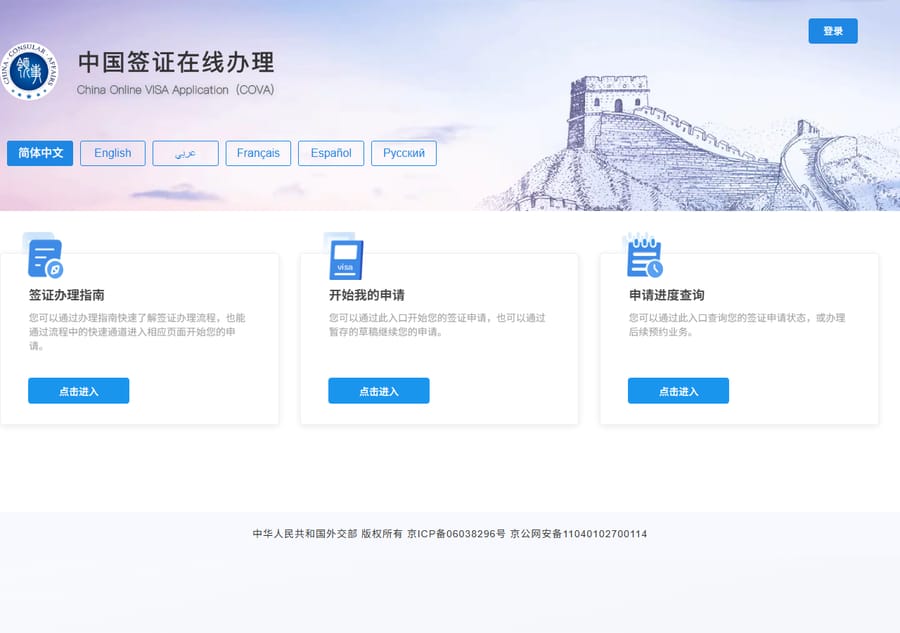
The official portal provides comprehensive online support for the entire Chinese visa application process. It offers access to the detailed Guidance on Visa Application for procedural information, allows applicants to start a new application or continue with a saved draft, and enables status tracking as well as management of subsequent appointments such as interview bookings—all within the same platform. The link is provided below. https://consular.mfa.gov.cn/VISA/
解读:
在这里,您可以在线填表、预约,以及查询办理进度。页面右上方可以切换英语、法语、西班牙语、俄语、阿拉伯语。
八、协定来华:互免签证协定
来自中国领事服务网:Mutual Visa Exemption List。这张一览表一共有 160 个国家,完整内容请以官方原表为准。表后的说明原文如下:
Note:
*1. The agreement signed between China and the former Yugoslavia is applicable.
*2. The agreement signed between China and the former Czechoslovakia is applicable.
*3. <AGREEMENT BETWEEN THE PEOPLE’S REPUBLIC OF CHINA AND THE EUROPEAN UNION ON THE SHORT-STAY VISA WAIVER FOR HOLDERS OF DIPLOMATIC PASSPORTS> is applicable.
Exemption of visa requirements does not mean permission to stay and reside in the other contracting country for an indefinite period of time. According to the agreements, holders of valid specified passports are permitted to stay for less than 30 days upon entry into the other contracting country. If a passport holder intends to stay for over 30 days, he or she should go through residence formalities with the local authorities according to relevant regulations as soon as possible.
解读:
这张表的大部分条目只涉及外交、公务护照。持普通护照也可以互免签证的,是下面这 27 个国家(整理自官方原表):
阿尔巴尼亚、安提瓜和巴布达、亚美尼亚、阿塞拜疆、巴哈马、巴巴多斯、白俄罗斯、波斯尼亚和黑塞哥维那、斐济、格鲁吉亚、格林纳达、哈萨克斯坦、马来西亚、马尔代夫、毛里求斯、卡塔尔、萨摩亚、圣马力诺、塞尔维亚、塞舌尔、新加坡、所罗门群岛、苏里南、泰国、汤加、阿联酋、乌兹别克斯坦。
一般来说,中国对没有互免协定的国家给予单方面免签,对有协定的国家按协定执行,两条线是刻意错开的。单方面免签(50 国)、过境免签(240 小时)、区域性免签(海南等)、互免协定(27 国普通护照),它们之间不叠加、不冲突,您符合哪一条就走哪一条。假如您已经符合单方面免签政策,那么互免协定一览表里和您国家有关的条目,大多只覆盖外交、公务护照,和持普通护照的游客关系不大。
九、起飞前截这 5 样
廊桥到边检柜台这段路往往还没有稳定的网络,国际漫游弹窗也常常卡在短信验证。起飞前在手机相册里建一个单独相册,存好这 5 张图:
- 护照资料页:后续开通支付宝、车站核验、酒店入住都会反复用到。
- 第一晚酒店的中文名称、中文地址与前台电话:纯英文店名对出租车司机和入境卡都没用。
- 酒店预订确认单:必须能看出入住人姓名(与护照一致)和入住日期。
- 覆盖您国籍的官方政策段落截图:把浏览器地址栏和页面日期截进去,供不熟悉新规的值机柜员核对。
- 已确认的续程或返程机票行程单:带票号(e-ticket number)和起飞时间的版本,过境旅客必查。
纸质件仍然管用。把酒店中文地址和续程机票打印一页塞进随身包,手机没电或遇到系统故障时能直接递过去。
十、过边检时
走到边检通道前,把护照从保护套里取出来,手机调成静音(边检区域禁止拍照和通话)。
边检警官常问的问题很固定:来中国做什么、待几天、第一晚住哪、下一站去哪里。把第一晚酒店地址和离境机票直接翻出来,不要站在柜台前临时连 Wi-Fi 翻邮箱。走过境免签的旅客,请提前在线填好入境卡(见第五节),并主动出示前往第三国(地区)的联程客票。
入境之后,下一步是准备手机流量。如果您的行程跨了好几周,或者旅途中改签了离境航班、换了出境口岸,务必重新打开国家移民管理局网站核对一次。本页顶部的「最后核验」日期超过一个月时,永远以官网当天页面为准。
来源
游客常问
- 哪些国家的护照可以免签入境中国 30 天?
- 截至 2026 年 2 月 17 日,单方面免签覆盖 50 个国家(欧洲 35 国、大洋洲 2 国、亚洲 7 国、美洲 6 国)。持普通护照可因商务、旅游、探亲访友、交流访问、过境免签入境,停留不超过 30 天,自入境次日 0 时起算。名单以国家移民管理局官网为准。
- 240 小时过境免签需要满足什么条件?
- 您必须是 57 个适用国家的公民,持普通护照和已确定日期、座位的前往第三国(地区)联程客票,从 24 个省区市的 65 个指定口岸之一入境,在允许区域内停留不超过 10 天,并且要填写入境卡。往返同一个国家不算过境。
- 中国入境卡可以在线填写吗?收费吗?
- 可以,而且免费。官方渠道只有三个:网站 s.nia.gov.cn/ArrivalCardFillingPC/、「移民局 12367」App 和同名微信小程序。向您收费的「入境卡网站」都是假冒的。
- 不住酒店、住在朋友家,需要做住宿登记吗?
- 需要。入住后 24 小时内,由您本人或留宿人向居住地公安机关登记。自 2026 年 9 月 21 日起全国都可以线上办理,第一次登记一般需要留宿人协助。未按规定登记会被警告,并可能被罚款。
- 中外互免签证协定和单方面免签冲突吗?
- 不冲突,也不叠加。中国对没有互免协定的国家给予单方面免签,对有协定的国家按协定执行。持普通护照可互免签证的协定国有 27 个,您符合哪一条就走哪一条。