Ordering Food in China: Allergies, Vegetarian & Halal
A translation app may call a dish 'vegetable,' while the kitchen starts the wok with lard, pork broth, or oyster sauce. Put your dietary rules on a printed or full-screen Chinese card, show it before ordering, name the exact ingredients to exclude, and walk out if the staff smiles without checking with the cook.
A camera translation app will translate a menu line as “braised seasonal greens,” while the cook ladles pork bone stock and oyster sauce into the wok. To eat safely in China with an allergy or dietary restriction, turn your rules into plain, specific Chinese sentences that the kitchen can read before you order.
Carry a card, not a speech
In a loud dining room, three lines of bold Chinese text beat five minutes of charades. Copy the row that matches your restriction into a full-screen phone note or print it on a card (see our dedicated Chinese food allergy card guide):
| Restriction | Chinese text to show the server and kitchen before ordering |
|---|---|
| Severe allergy (peanuts / tree nuts / shellfish) | 我有严重食物过敏,吃到【花生 / 花生油 / 坚果 / 虾蟹海鲜】会进医院急救。请用洗净的锅和纯植物油单炒,不要放任何含该成分的酱料。如果做不到请直接告诉我。 (I have a severe allergy; eating peanuts/peanut oil/nuts/shellfish sends me to the hospital. Please use a washed wok and pure vegetable oil with no sauces containing them. If not possible, please tell me.) |
| Strict vegan / vegetarian | 我吃严格全素:不吃任何肉、鸡、鱼、海鲜、鸡蛋、牛奶,也不吃猪油、鸡汤、肉汤、蚝油和虾皮。请用纯植物油和清水炒青菜或豆腐,谢谢。 (I eat strict vegan: no meat, poultry, fish, seafood, egg, dairy, lard, chicken/meat broth, oyster sauce, or dried shrimp. Please cook vegetables or tofu in vegetable oil and water.) |
| Halal (no pork or alcohol) | 我只吃清真饮食:不吃猪肉、猪油、火腿、培根和含酒精的料酒,也不用炒过猪肉的锅。如果本店不是清真厨房,请直接告诉我。 (I only eat Halal: no pork, lard, ham, bacon, or cooking wine, and no woks used for pork. Please tell me if this is not a Halal kitchen.) |
Show the card before you place the order, not after a dish arrives at the table.
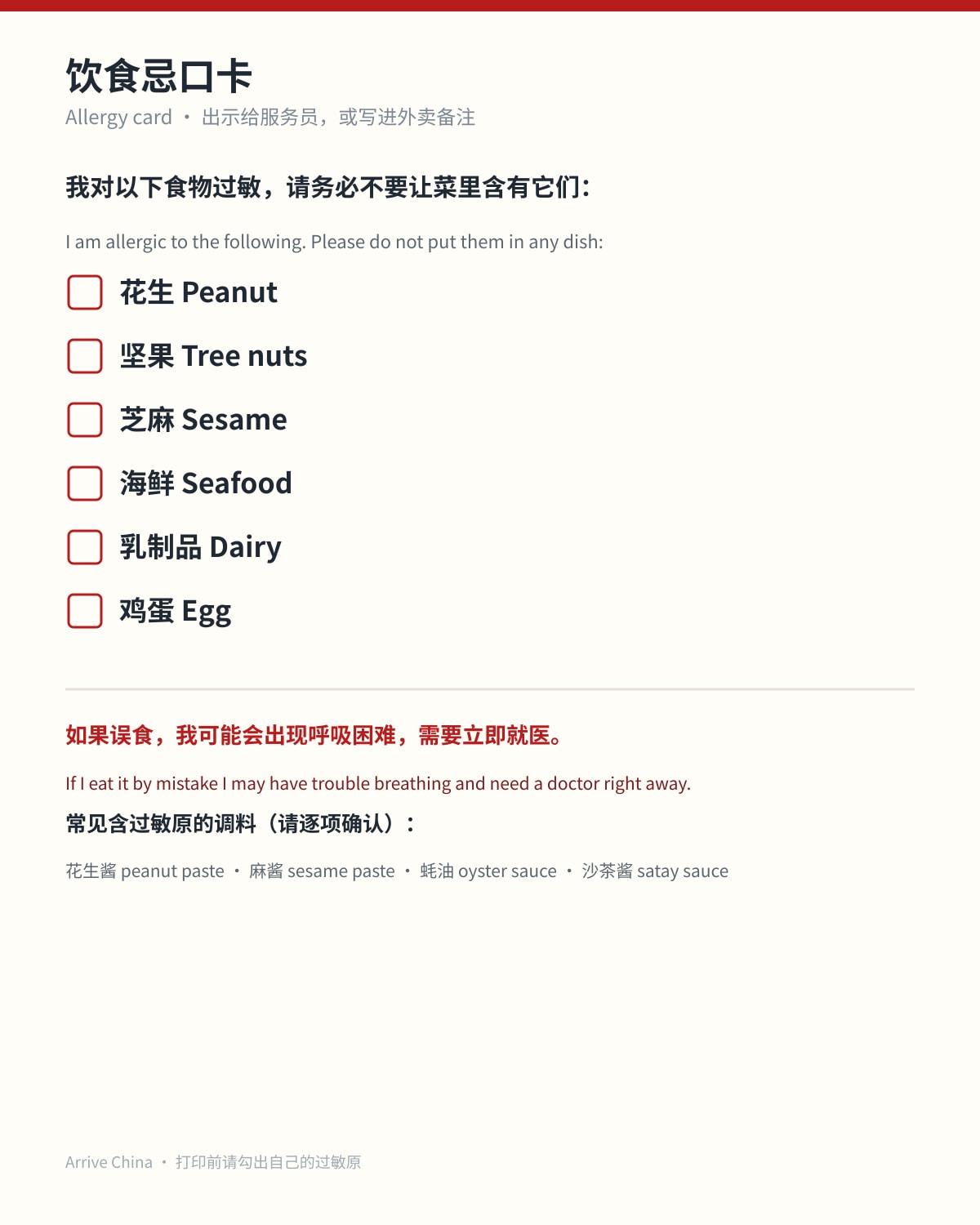
Photo: Made by Arrive China
“Vegetable” (素) does not mean vegan
In a standard neighbourhood restaurant, 素 (sù) means “no main meat cut,” not plant-based. Five hidden ingredients trip up visitors every day:
- Stock (高汤 — chicken or pork bone broth): ladled into noodle bowls, braised tofu, and sautéed greens.
- Lard (猪油): used in traditional kitchens to give stir-fried greens a glossy finish.
- Oyster sauce (蚝油): made from real oyster extract and poured over most “stir-fried seasonal vegetables.”
- Minced pork or dried baby shrimp (肉末 / 虾皮): treated as a garnish or seasoning in Mapo tofu, dry-fried green beans, and soups.
- Egg (鸡蛋): tomato-and-egg stir-fry and egg-drop soup sit under the “vegetable” heading on many menus.
For zero animal products, search maps for Buddhist vegetarian restaurants (素食 or 净素), or follow the dish-by-dish strategy in how to eat vegetarian in China. For a strictly pork-free kitchen, look for green 清真 (Halal) signs—Lanzhou hand-pulled noodle shops and Xinjiang restaurants are in almost every city.
“Not spicy” is a request, not the default
In Sichuan, Chongqing, Hunan, Guizhou, and spicy regional chains across China, chili oil and Sichuan peppercorn go into the pan unless you stop them in advance. Asking for “mild” (微辣) still brings a dish that burns if you are not used to chilies.
Say and write 完全免辣,一点辣椒、红油、花椒都不要放 (completely non-spicy—no chilies, chili oil, or Sichuan pepper at all) when you order. Note that pre-braised meats and red soup bases cannot be made non-spicy; ask which stir-fries are cooked fresh to order. More phrasing is in how to order non-spicy food in China.
Hotpot rules
Vegetarians and allergy-conscious diners can eat at a hotpot table only if two rules hold:
- Order an individual pot or a divided two-flavour pot (鸳鸯锅), and keep separate ladles and chopsticks for each side.
- Do not accept the default white “clear” broth, which is usually simmered from pork bones and chicken. Ask for plain water, mushroom broth, or fresh tomato broth opened in front of you.
Watch the dipping sauce bar too: shacha sauce (沙茶酱) contains dried shrimp and fish, XO sauce contains shellfish, and crushed peanuts sit right next to sesame paste.
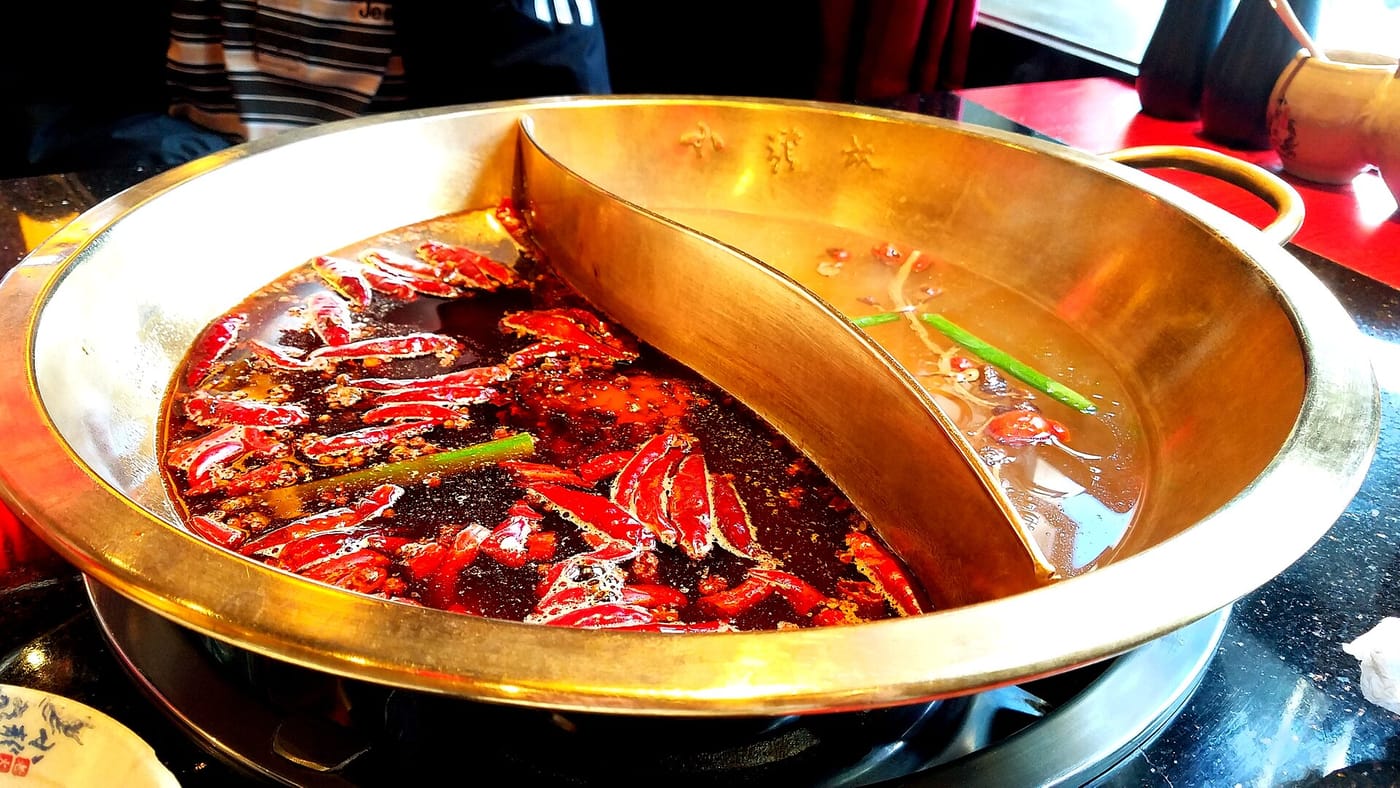
Photo: Wikimedia Commons
Get a definite answer before you decide to eat there
Many servers feel awkward saying “no” to a guest’s face, so they smile and say kěyǐ, kěyǐ (“okay, okay”). That kind of vague agreement is not a confirmation.
Hold out for a definite answer before you decide whether to eat there. A definite answer looks like this: the server takes your card into the kitchen, asks the cook, and comes back to tell you which dishes they can make, how they will make them, and which ones they cannot. An indefinite answer is a smile, an “OK”, or “should be fine”.
Not speaking Chinese is not an obstacle. Two tools work well, and both are worth setting up before you walk in:
- A translation app on your phone (Google Translate, DeepL, Baidu Translate and Youdao all work). Save your dietary sentence as a favourite so you can show it the moment you sit down, and switch to live voice translation when the server replies, so they can speak into the phone and you read the answer on the spot.
- An AI voice assistant with live call translation. Many phones and keyboards now include real-time translated calls, which relay each side’s speech to the other. When the restaurant is loud, or when you need the kitchen to confirm which oil or which broth they use, that back-and-forth is far clearer than gestures.
One type of place is a bad bet no matter how well the conversation goes: a packed street stall or barbecue counter at peak hours. One wok turning out five dishes in three minutes cannot be scrubbed and re-oiled for you. Thank them, leave, and find a larger restaurant with a kitchen that has room to accommodate you.
Still deciding where to eat
This page is about what to say once you are inside. Choosing which door to walk through is a separate job, and locals do it with one app: filter by distance, then rating, then local cuisine, and look at photos of the dishes to judge whether the kitchen can make anything you can eat. See how to use Dianping to pick a restaurant in China.
Attraction tickets
You can always walk twenty metres to another restaurant, but you cannot walk up to major museums or palaces without a timed slot. National museums and headline sights open bookings up to 7 days ahead and sell out before breakfast on holidays. Check which China attraction tickets sell out in advance before you lock your daily schedule.
Affiliate link. Compare prices on the partner site before you pay.
Questions visitors ask
- If the server says 'kěyǐ, kěyǐ', is that a confirmation?
- No. Saying 'we can't' to a guest's face feels rude in China, so servers often smile and agree first. Wait for a definite answer — the server takes your card into the kitchen, asks the cook, and comes back to explain which dishes they can make and how — before deciding to eat there.
- How do I talk to the server and the kitchen if I do not speak Chinese?
- Save your dietary sentence as a favourite in a translation app (Google Translate, DeepL, Baidu Translate and Youdao all work) and show it as soon as you sit down, then switch to live voice translation for their reply. Your phone's real-time translated-call feature works well too, and a back-and-forth is far clearer than gestures.
- Does the character 素 (sù) on a Chinese menu mean vegan?
- No. In everyday restaurants, 素 usually means there is no big slab of meat on the plate—the dish may still use pork broth, lard, oyster sauce, dried shrimp, or egg. You must name the specific animal ingredients to leave out.
- How do I communicate a life-threatening peanut or shellfish allergy?
- Do not rely on spoken English or gestures. Show a large-print Chinese allergy card before ordering, ask the server to take it into the kitchen, and confirm whether the wok and frying oil are shared. If they hesitate, leave.
- Can a vegetarian or vegan eat at a Chinese hotpot restaurant?
- Yes, if you order an individual pot or a split pot filled with plain water, mushroom, or tomato base opened at your table—never the default milky bone broth—and use separate tongs.