Where to go
Where to go on a first trip to China
Decide what you came for. Palaces and city walls mean Beijing and Xi'an; spice, hotpot and three-dimensional streets mean Chengdu and Chongqing; river views and walkable neighbourhoods mean Shanghai and Hangzhou; food and winter warmth mean Guangzhou and Shenzhen. Give each city three days, and never plan more than three cities in ten days.
Eight cities with completely different personalities. Some people come to China for the red walls of the Forbidden City, some to sit in a Chengdu teahouse all afternoon, some just to eat. Pick the city from what you want, then argue about days.
This page covers choosing, how many days, and what to eat. The full itinerary for each city (airport transfers, which neighbourhood to stay in, how to book tickets, when to arrive before the crowds) lives in its own guide — click through from the list at the bottom.
1. Start with this table
| What you want | Where to go | Days |
|---|---|---|
| Palaces, city walls, the most “China” history | Beijing, Xi’an | 3–4 each |
| Spice, hotpot, street life, vertical cities | Chengdu, Chongqing | 2–3 each, back to back |
| River views, old mansions, wandering, easiest landing | Shanghai | 3 |
| Lakes, tea hills, Jiangnan gardens | Hangzhou (add Suzhou) | 2 |
| Dim sum, roast meats, winter warmth | Guangzhou | 3 |
| Modern city, arriving from Hong Kong, travelling with kids | Shenzhen | 2 |
One more practical filter: how much walking can you do? Beijing and Xi’an are standing-and-walking cities, 15,000 steps a day before lunch. Shanghai, Hangzhou and Chengdu let you slow down and sit with a drink. Travelling with parents or a bad knee, plan the second kind.
2. Eight cities, eight temperaments
Beijing: where emperors lived, and a wall built 2,000 years ago
Three things exist here and nowhere else like them. The Forbidden City is the palace complex where 24 emperors of the Ming and Qing dynasties lived across five centuries — over 9,000 rooms, and you walk into the halls that once only the imperial family and senior officials could enter. The Great Wall is a rampart built more than 2,000 years ago to keep out cavalry from the northern steppe, running along mountain ridges; Badaling is one of the better-preserved stretches. The Temple of Heaven is where the emperor prayed for a good harvest each year: a round, three-tiered hall put together without a single nail.
These are not next door to each other, and one of them eats most of a day. The price is crowds, distance and security checks; three sights in one day is the ceiling.
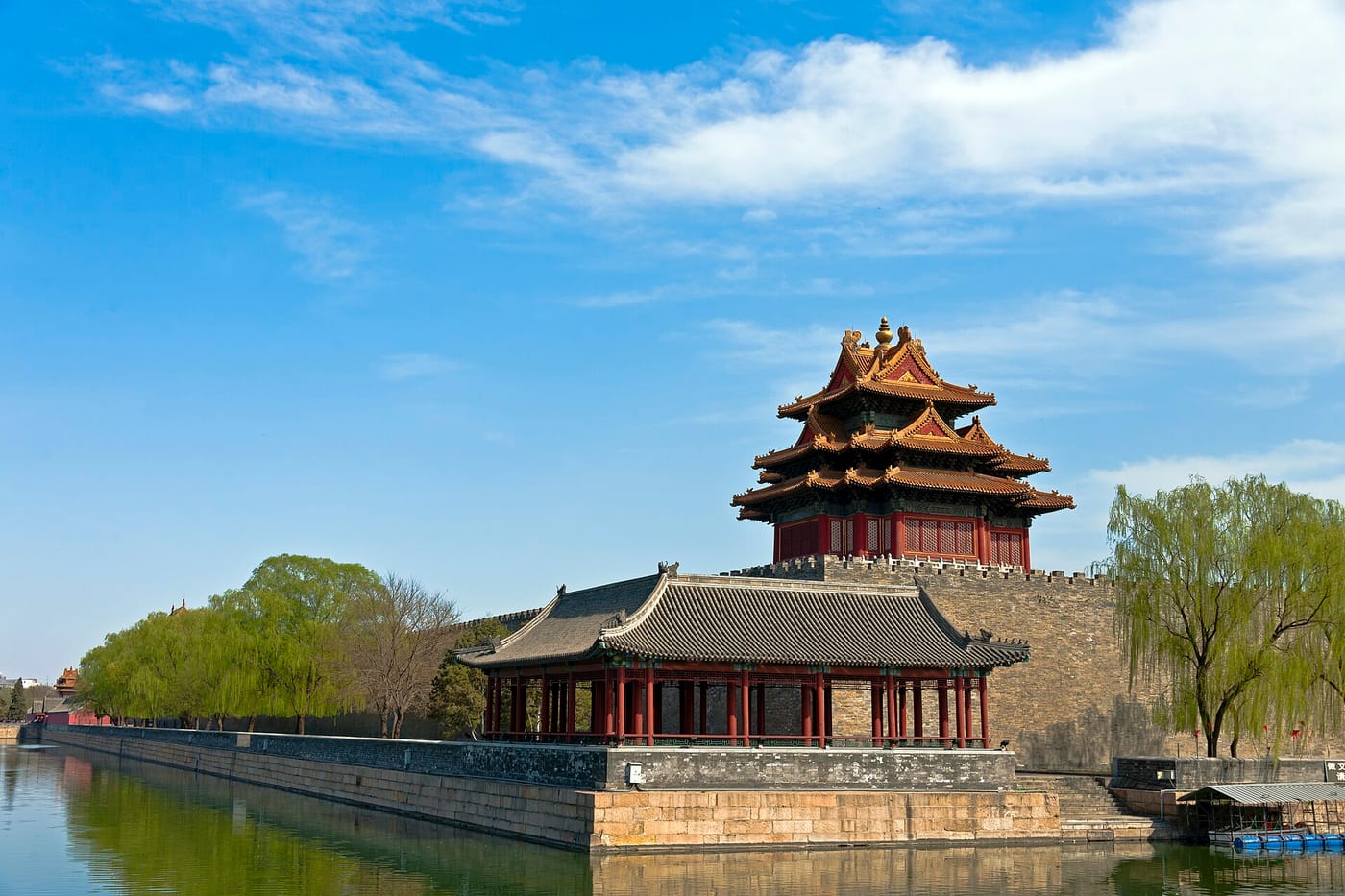
Photo: Daniel Case / CC BY-SA 3.0, via Wikimedia Commons
Days: four. Forbidden City and Jingshan one day, the Great Wall one day, Temple of Heaven plus Qianmen or the Summer Palace one day, National Museum or Lama Temple plus hutongs one day.
Eat:
- Peking duck — the whole bird is roasted over charcoal until the skin crisps, then carved at the table into thin slices and rolled in a pancake with scallion, cucumber and sweet bean sauce. Two people need half a duck plus a vegetable and duck-bone soup, not a whole bird
- Zhajiangmian — hand-pulled noodles tossed with pork minced in fermented soybean paste, cucumber and beansprouts
- Copper-pot lamb hotpot — a pot of clear water with scallion and ginger; paper-thin lamb slices go in for ten seconds and come out dipped in sesame paste. Avoid that sauce entirely if you have a sesame or peanut allergy
- Mending rou bing (pan-fried beef pies), ludagun (glutinous rice rolls dusted in roasted soybean flour) and wandouhuang (chilled pea-flour cake) as snacks
- Douzhi with jiaoquan is a local breakfast: douzhi is fermented mung-bean liquid with a sharp sour taste. Order a small bowl out of curiosity, not hunger
Avoid: the Forbidden City needs a booking seven days ahead, and Tiananmen Square is a separate booking — without it you cannot even reach the outer security checkpoint. Wangfujing Snack Street is expensive and mediocre; walk 200 metres into a side hutong instead.
Xi’an: an army buried underground 2,000 years ago
The Terracotta Army is the tomb guard of an emperor who died in the 3rd century BC: more than 7,000 clay soldiers at life size, every face different, standing in three pits that were originally painted in colour. Local farmers hit them while digging a well in 1974. A hangar now covers the original site, so you stand at the edge of the pit looking at an active excavation.
Xi’an also has a complete Ming-dynasty city wall, 13.7 km around the old town, and you can cycle the whole loop on top. The Big Wild Goose Pagoda is a seven-storey brick tower built in the 7th century by a monk who walked to India and back for Buddhist texts.
Two thousand years stacked in one city — that is why it earns its own stop.
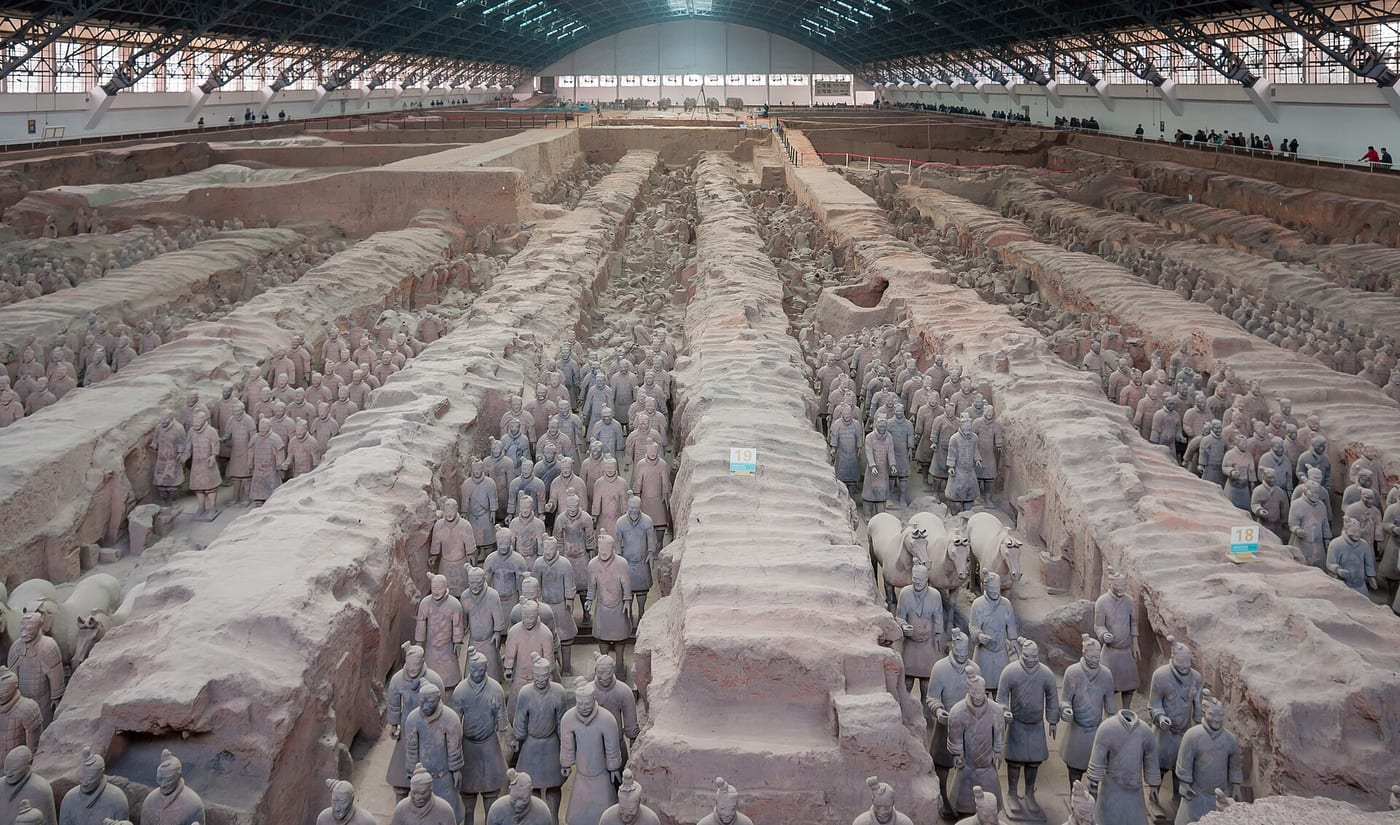
Photo: CEphoto, Uwe Aranas / CC BY-SA 3.0, via Wikimedia Commons
Days: three. East line to the Terracotta Army and Huaqing Pool one day, inside the walls for the Bell and Drum Towers and the Muslim Quarter one day, Shaanxi History Museum and the Big Wild Goose Pagoda one day.
Eat:
- Roujiamo — a flatbread split open and filled with chopped meat. Note the standard “lazhi” version is pork; in the Muslim Quarter order the beef version
- Yangrou paomo — torn flatbread soaked in lamb soup. Tearing the bread yourself is the ritual; ask for machine-cut if you are hungry
- Biangbiang and youpo noodles — as wide as a belt, topped with chilli flakes and garlic, then hit with a ladle of smoking hot oil
- Liangpi (cold wide rice noodles), zenggao (sticky rice and jujube cake) and jinggao (small steamed rice cakes) from street stalls and the Muslim Quarter
- Hulatang with a meatball for breakfast — the most local start you can get
Avoid: anyone at the station square offering “no queue, real Terracotta Army” is taking you to a fake site — the only official name is 秦始皇帝陵博物院. And do not climb the wall at midday in summer: 13 km with no shade will make you ill within half an hour.
Chengdu: a city built for slowing down
Chengdu has no monument you must tick off. What it has is pace. People’s Park has hundreds of bamboo chairs under the trees; a cup of tea costs a couple of yuan and buys you an afternoon, someone will come along to clean your ears, and nobody hurries you out. That is hard to find anywhere else in China.
Three things are worth seeing: the Giant Panda base, which is exactly what it sounds like — pandas eating bamboo and climbing outside in the morning, back indoors asleep after about 10:30; Wuhou Shrine, a temple to a third-century prime minister, with the best photo spot on the red-walled walkway; and Dujiangyan, an irrigation system built more than 2,000 years ago that still waters the Chengdu plain.
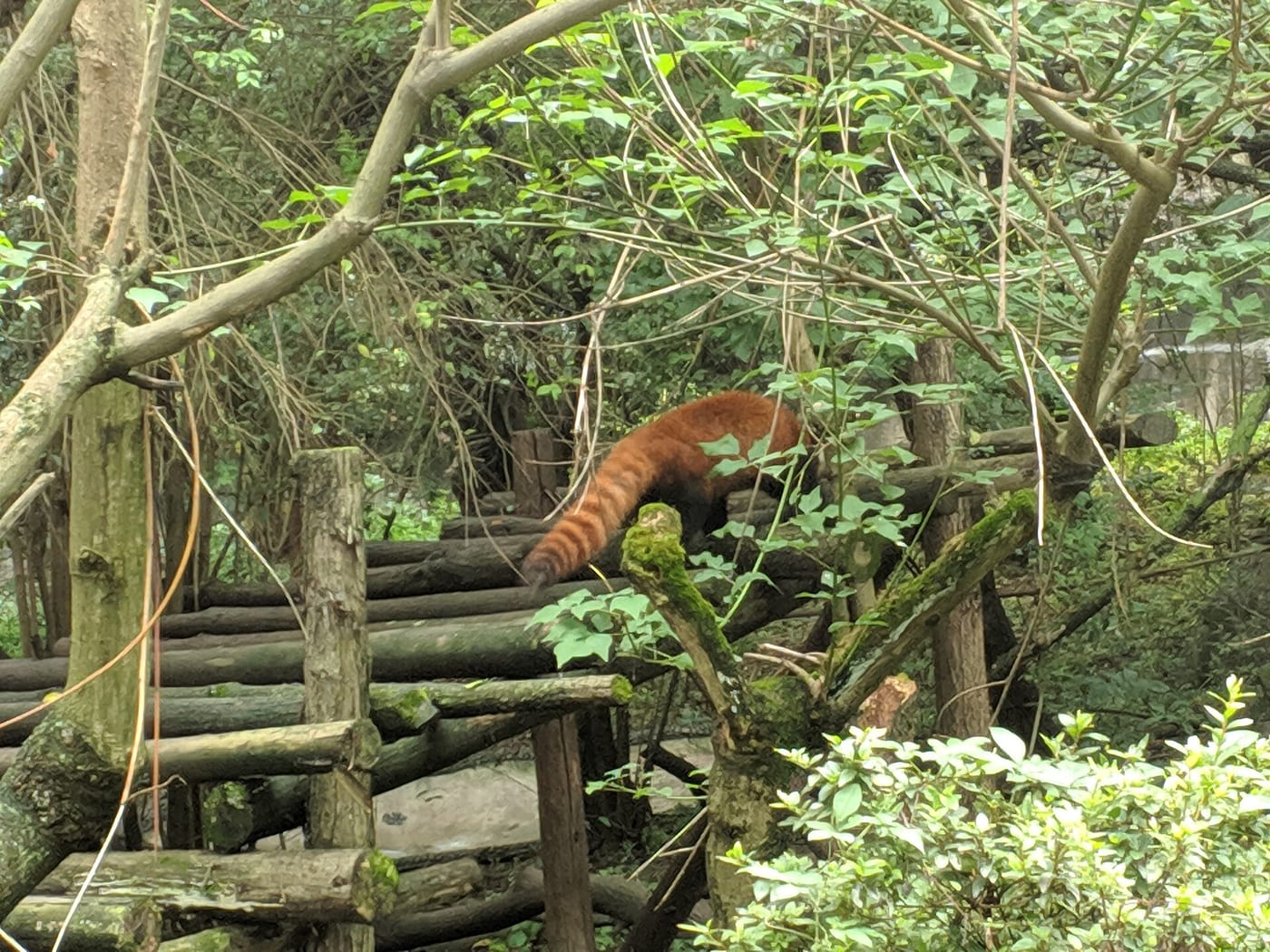
Photo: Jimmyshjj / CC BY-SA 4.0, via Wikimedia Commons
Days: three to four. Panda base, People’s Park and Kuanzhai Alley one day; Wuhou Shrine and Du Fu’s Cottage one day; Dujiangyan or Sanxingdui one day.
Eat:
- Hotpot — a pot of red broth boiling in the middle of the table; you cook meat, tripe and vegetables in it. Order a split pot (clear broth in the middle, spicy around it) and dip in sesame oil with garlic
- Chuanchuan skewers — the same pot, but everything arrives on bamboo skewers; you are charged by the empty sticks
- Bobo chicken (cold dressed chicken and vegetable skewers), sweet water noodles (thick noodles in a sweet-savoury sauce), danhonggao (small griddled cakes with sweet filling) and brown-sugar ciba (glutinous rice bars in brown sugar) — small plates, so you can try several
- Lao ma ti hua — pork trotters stewed until the meat falls off, in a milky broth with no chilli at all
- Qiaojiao beef — beef slices in clear soup, safe for anyone who cannot take heat
Avoid: the panda base opens at 7:30 and the pandas sleep from about 10:30, leaving you their backs. Kuanzhai Alley’s main street is a walk-through; eat 500 metres away on Kuixinglou Street.
Chongqing: a city built on a hillside
The ground in Chongqing is not flat. Walk to the end of a street and the pavement may drop eleven floors to the river below; the monorail runs straight through the middle of a residential tower while people go on living in it. After dark the whole hillside lights up at once and the river throws it back — that is the image Chongqing is famous for.
Hongyadong is a stack of stilt-style shops and restaurants built against the river cliff, eleven floors from the road at the top down to the water. There is no gate and no ticket; the best view is from the bridge opposite, or from the road at the top after dark.

Photo: Yumeto / CC BY-SA 4.0, via Wikimedia Commons
Days: two to three. Yuzhong peninsula one day, monorail and the south bank one day, Dazu Rock Carvings on the third.
Eat:
- Beef-tallow hotpot — the broth is rendered beef fat cooked down with chilli. It is genuinely hot, and “mild” in Chongqing is still hot; order a split pot if you cannot
- Chongqing xiaomian — a bowl of plain noodles in a numbing chilli broth, eaten for breakfast, in a small “two liang” portion; you can ask for clear broth
- Suanlafen — sweet potato noodles in a sour and hot red-oil soup, very slippery
- Maoxuewang (duck blood and tripe simmered in chilli broth) and laziji (fried chicken tossed with a heap of dried chillies) — both built for rice
- Escape routes: wontons in clear soup, shancheng tangyuan (sweet glutinous rice balls), and ask for “no chilli” on anything
Avoid: Hongyadong has no paid gate — enter from Cangbai Road on the 11th floor or Jiabin Road at ground level, both free; anyone selling a “fast-track ticket” is a scam. Do not wear new shoes to climb hills, and do not book a hotel halfway up a slope where you must carry your case up four flights of outdoor steps.
Shanghai: one river, two banks
The Huangpu River splits Shanghai in two. The west bank is the Bund: a row of banks and trading houses from the early 1900s, stone facades, clock towers, domes, floodlit at night. The east bank is Lujiazui: glass towers thrown up in the last thirty years, including the Pearl Tower and Shanghai Tower. Stand on the west bank and you are looking at a hundred years facing thirty, across a river.
There is also a district worth walking: the residential quarter of the old foreign concession, where the streets were planted with plane trees a century ago and the villas, bookshops, coffee places and small restaurants are still there. No ticket, just walk.
Shanghai does not compete on ancient monuments. It wins on flat pavements, full English signage, front desks that know foreign passports, and jet lag you can sleep off. For a first trip to China it is the lowest-risk start.
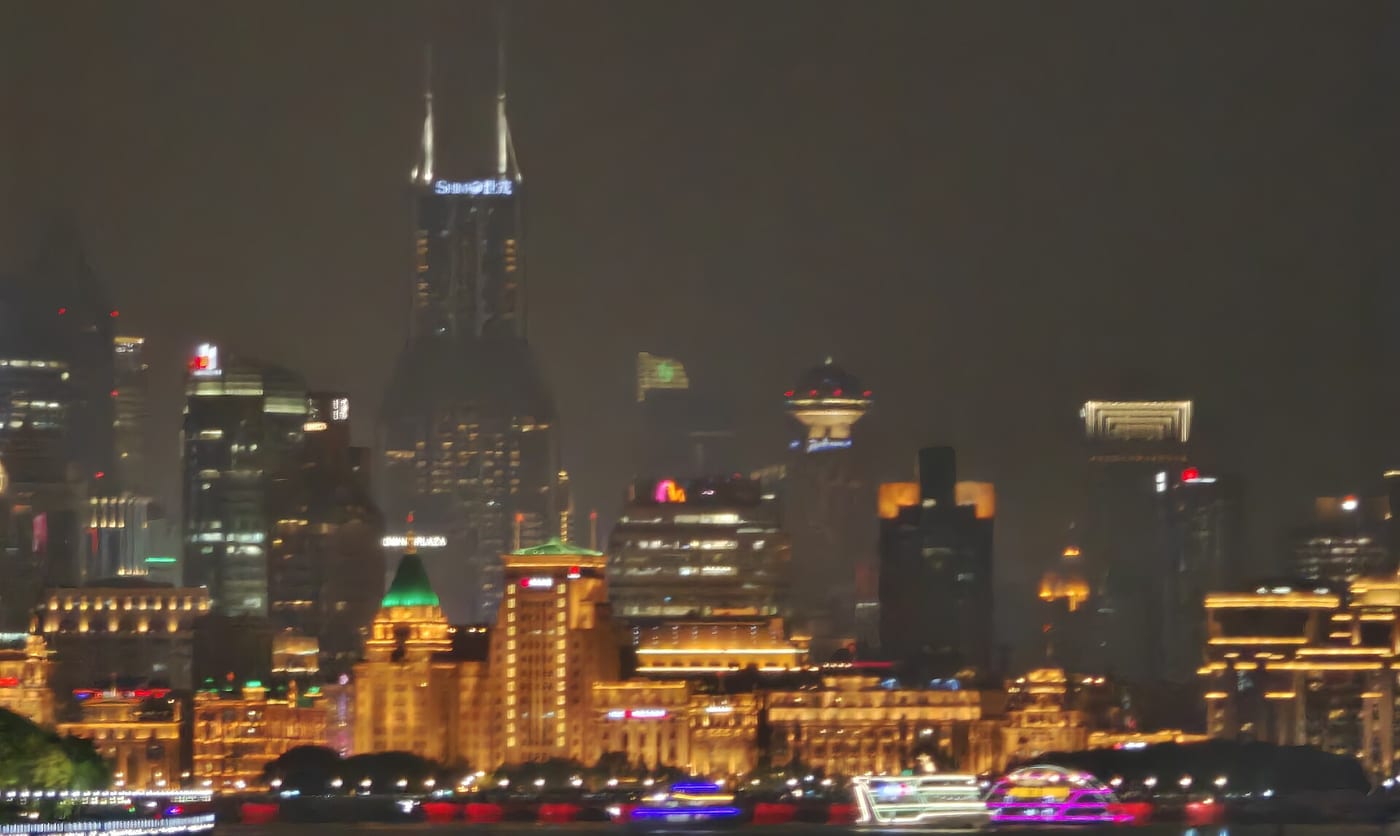
Photo: DvTor8303 / CC0, via Wikimedia Commons
Days: three. Bund and the old town one day, plane-tree district and a museum one day, Lujiazui and the riverside one day. A fourth day goes to Suzhou or Hangzhou as a day trip.
Eat:
- Shengjianbao — small round buns fried crisp on the bottom, filled with pork and hot soup inside. Bite a small hole and let it cool, or you will burn your mouth
- Xiaolongbao — thin-skinned steamed buns holding a mouthful of hot broth, eaten with shredded ginger and vinegar
- Scallion-oil noodles — noodles tossed in oil that scallions have been fried in, plus soy. Simple, addictive, a perfect breakfast
- Braised pork belly (slow-cooked in soy and sugar), oil-exploded prawns (whole small river prawns flash-fried) and yanduxian (salt pork and fresh pork simmered with spring bamboo) — Shanghainese cooking is sweet, rich and not spicy at all
- Fresh pork mooncakes — flaky pastry filled with pork, only around mid-autumn, and only good while hot
Avoid: squeezing from Nanjing East Road to the Bund at 19:30 takes 40 minutes for one kilometre; go before 08:00 instead and the waterfront is empty. Skip the Bund Sightseeing Tunnel train — it is a lit-up underground tunnel, nothing more.
Guangzhou: a city that lives at the table
Guangzhou people put most of their social life on the dining table. Morning tea is breakfast, running from about 7am to noon: bamboo baskets of dumplings and a pot of tea, a family talking for two or three hours. This is not a tourist show, it is the local routine. You come to Guangzhou to eat, not to look.
There is still plenty to look at. Shamian is a small island where trading houses and consulates from a century ago still stand, under dense trees, on flat ground. In Xiguan the old streets have qilou — an arcade floor projecting over the pavement, so you can walk a whole street in the rain without an umbrella.
The food is light and not spicy, winter is warm, and there are direct flights from Southeast Asia, Australia and the Middle East. With children or older parents it is the least tiring option.
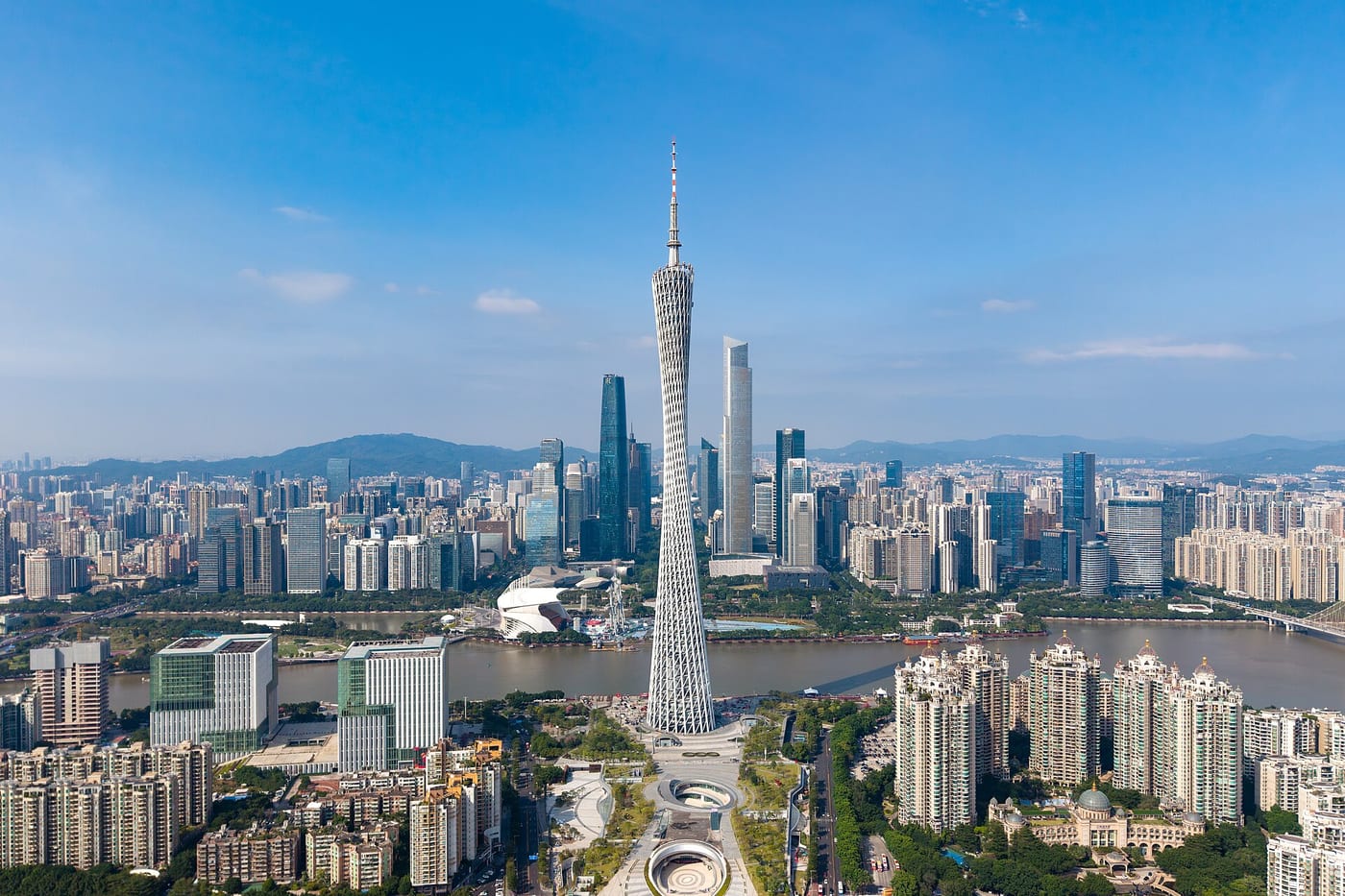
Photo: Tim Wu / CC BY-SA 4.0, via Wikimedia Commons
Days: three. Xiguan old town and Shamian one day, dim sum plus Yuexiu and Zhujiang New Town one day, a third day for Liwan or free eating.
Eat:
- Dim sum: har gow (translucent dumplings around a whole prawn), siu mai (pork and prawn), char siu bao (steamed buns with sweet roast pork), rice rolls wrapped around prawn and fried dough, chicken feet braised in black bean sauce, and custard buns that run when you bite them. Order in rounds and do not treat it as fast food
- Roast goose and roast duck — the whole bird roasted until the skin crisps, chopped into pieces and served with a sour plum sauce
- Rice noodle rolls — rice batter steamed thin and rolled around pork or prawn; the “bula” style is silkiest
- Claypot rice — rice cooked in a small clay pot, and the crust at the bottom is the whole point
- Double-skin milk, ginger milk curd and sweet soups, all desserts, eaten in the afternoon
Avoid: give dim sum at least two hours, or you miss the point. Hotel rates multiply during the Canton Fair — check the dates before booking.
Shenzhen: a city built in forty years
Forty-odd years ago Shenzhen was a cluster of fishing villages. It is now a city of more than 17 million people. So there are no antiquities — what is worth seeing is the city itself: whole blocks of glass towers, a coastal greenway tens of kilometres long that you can cycle, and old factories turned into studios and cafés. It is also China’s youngest migrant city; almost everyone you pass came from somewhere else.
Easiest arrival from Hong Kong: 14 minutes by high-speed rail to Futian, and for many people their trip to China starts here. Travelling with children, the parks, the coast and the malls beat monuments easily.
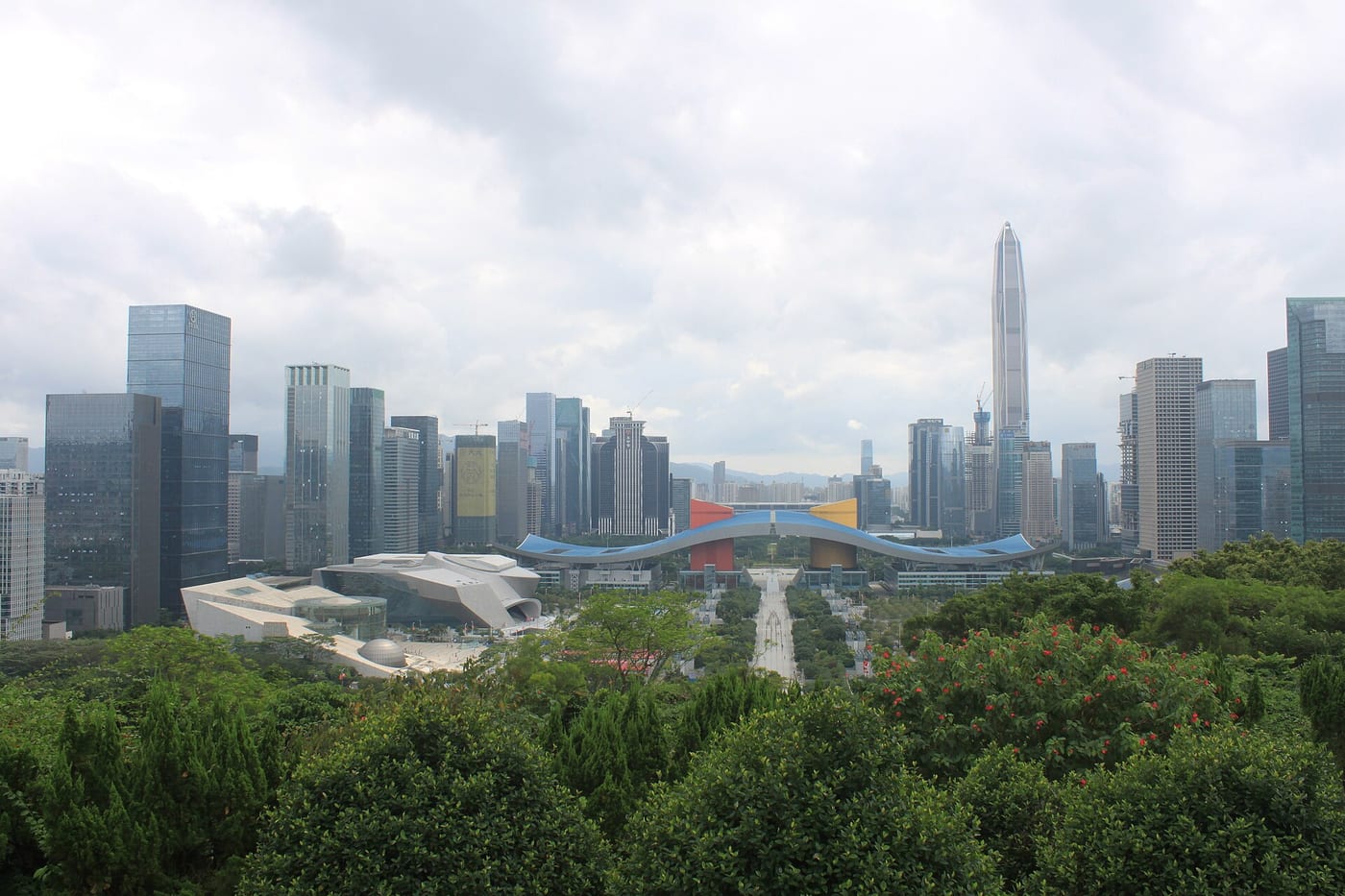
Photo: Huangdan2060 / CC BY 3.0, via Wikimedia Commons
Days: two. Shenzhen Bay Park and OCT-LOFT one day, Lianhuashan for the Futian skyline plus a museum the other.
Eat:
- Chaoshan beef hotpot — clear broth, beef sliced to order by cut, each cut cooked for a different number of seconds
- Coconut chicken — a whole chicken poached in coconut water; sweet, not spicy, ideal with children
- Rice noodle rolls and claypot congee, which locals eat late at night
- Hakka dishes: salt-baked chicken (buried in coarse salt and cooked) and stuffed tofu
Avoid: Window of the World is a miniature theme park with a steep ticket; skip it on a short trip. Huaqiangbei is fun to walk through, but do not buy electronics there without knowing the market.
Hangzhou: a lake, a ring of hills, a hillside of tea
West Lake is a freshwater lake ringed on three sides by hills, about 15 km around. It is famous not because it is big or especially beautiful, but because for a thousand years poets and officials kept building causeways, bridges, pavilions and planting trees here, layer on layer, until every angle looked composed.
In the hills behind it stands Lingyin Temple, a Buddhist temple 1,700 years old built against a rock face, with hundreds of Buddhas carved into the caves and boulders. Further in is Longjing village, where China’s most famous green tea grows in terraced rows up the slopes.
West Lake is free, which is why tour groups arrive from 08:00. Two hours earlier and it is a different place.
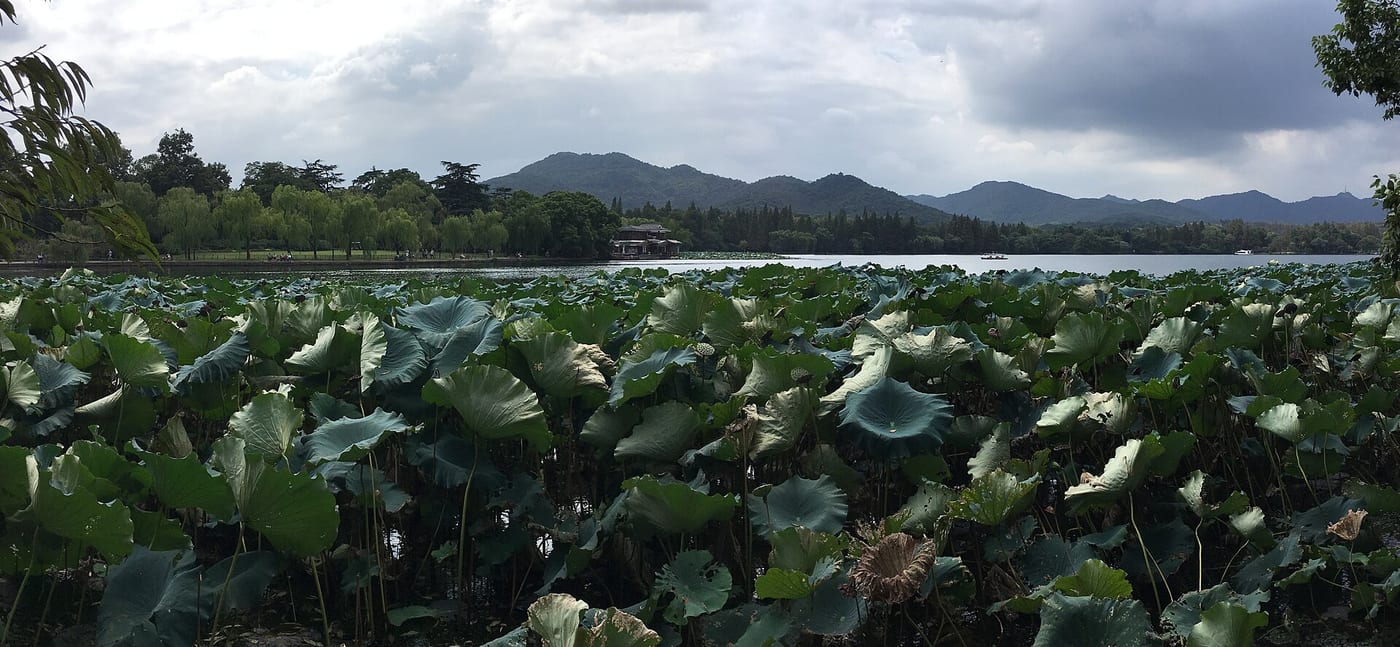
Photo: Fredlyfish4 / CC BY-SA 4.0, via Wikimedia Commons
Days: two. West Lake’s western shore plus a rowing boat one day, Lingyin Temple and Longjing village the other.
Eat:
- Pian’erchuan — a noodle soup with preserved greens, bamboo shoots and shredded pork; a Hangzhou breakfast
- Dongpo pork — one small cube of belly pork braised in soy and rice wine until it falls apart, served with rice
- West Lake vinegar fish — a whole fish under a sweet-and-sour sauce; divisive, try it if you like sweet and sour
- Longjing shrimp — prawns stir-fried with tea leaves, delicate and tea-scented
- Congbaohui (a thin pancake rolled around fried dough and scallion, pressed and griddled) and sheng gao (small pink steamed cakes) from street stalls
Avoid: Lingyin charges twice — once for the Feilaifeng scenic area, once to enter the temple; that is normal. At weekends and on public holidays the scenic roads are restricted, so use buses and the metro rather than taxis.
3. Two routes you can copy directly
Seven days: Beijing and Xi’an
| Day | Where | What |
|---|---|---|
| 1 | Beijing | Land, stay inside the 2nd Ring on a metro line, eat around Wangfujing or Qianmen |
| 2 | Beijing | Tiananmen Square, Forbidden City, Jingshan; Beihai or Shichahai at dusk |
| 3 | Beijing | Badaling or Mutianyu for the full day; Bird’s Nest and Water Cube at night |
| 4 | Beijing | Temple of Heaven, Lama Temple, Guozijian; hutongs in the afternoon |
| 5 | Xi’an | 4.5 hours by rail; city wall in the afternoon, Muslim Quarter at night |
| 6 | Xi’an | Terracotta Army at opening, Huaqing Pool after lunch |
| 7 | Xi’an | Shaanxi History Museum and Big Wild Goose Pagoda, fly out at dusk |
Ten days: Beijing, Xi’an, Chengdu
Same first four days. Day five by rail to Xi’an, day seven 3.5 hours to Chengdu, day eight pandas and People’s Park, day nine Dujiangyan or Sanxingdui, day ten fly out of Chengdu.
Add Shanghai by flying from Chengdu, two more days. Add Chongqing by taking the one-hour train from Chengdu, two more days.
Ten days: Shanghai, Hangzhou, Suzhou
Three days Shanghai (Bund, plane-tree streets, Lujiazui), two in Hangzhou (West Lake, Lingyin), two in Suzhou (gardens, Pingjiang Road), one day spare. All high-speed rail, an hour at most, so you are not constantly repacking.
4. Choose cities by month
| Month | Where it works | Why |
|---|---|---|
| Mar–May | Jiangnan (Shanghai, Hangzhou, Suzhou), Beijing | Mild, spring tea, blossom |
| Jun | North and west | Jiangnan is in its rainy season, humid and grey |
| Jul–Aug | Highlands, northeast, coast | Inland cities pass 35°C; Beijing and Xi’an are brutal |
| Sep–Oct | Everywhere | The best two months; Beijing in autumn especially |
| Nov–Feb | Guangzhou, Shenzhen, Hainan | South China sits around 20°C; the north is dry and cold but heated indoors |
5. Book these ahead
Beijing: Forbidden City seven days ahead, Tiananmen Square as a separate booking, National Museum and Military Museum closed Mondays. Xi’an: Shaanxi History Museum tickets are hard to get; the Xi’an Museum is the fallback. Chengdu: book a morning slot at the panda base, and Sanxingdui needs booking too. Shanghai Museum, the Nanyue King Museum and the Guangdong Museum are all free but timed.
How the booking systems work: which attraction tickets sell out.
6. Two general warnings
Do not overpack the map. The trains are not tiring; checking out, dragging a case and relearning a neighbourhood is. Four cities in ten days means half your trip is in transit. Two bases with day trips beats changing hotels every other night.
Start where you land. Whichever city has the cheap, well-timed flight is the right first city — do not add a flight just to follow a “classic route”. See which city to land in first.
In-depth guides
- Beijing Travel Guide: A 4-Day Plan That Saves Your Knees Who Beijing fits, how many days you need, PEK vs PKX airport rail, 2nd Ring hotels, and why you must never pair the Forbidden City with the Great Wall.
- Chengdu Travel Guide: Giant Pandas, Teahouses & 3 Days Who Chengdu fits, how many days to stay, TFU vs CTU airport distance, Chunxi Road hotels, and why arriving late at the Panda Base ruins the morning.
- Guangzhou Travel Guide: Dim Sum, Arcades & a 3-Day Plan Who Guangzhou fits, how many days to stay, CAN airport metro access, Tianhe vs Yuexiu hotels, and why you should avoid outdoor sightseeing at summer noon.
- First City in China: Comparing 8 Entry Cities Pick your first China city by how far you can walk on jet lag: comparing Shanghai, Beijing, Xi'an, Chengdu, Guangzhou, Shenzhen, Hangzhou, and Chongqing.
- Chongqing Travel Guide: Hills, Monorails & a 3-Day Loop Who Chongqing fits, how many days to stay, CKG airport metro links, where to sleep on flat ground, and why you should never book a hillside Hongyadong hotel.
- Hangzhou Guide: West Lake at Dawn, Tea Hills & 2 Days Who Hangzhou fits, why you should stay overnight instead of day-tripping from Shanghai, HGH airport metro, and how to escape West Lake's afternoon crowds.
- Shenzhen Guide: The Easiest Way In From Hong Kong Who Shenzhen fits, how many days to stay, SZX airport and Hong Kong high-speed rail links, Futian vs Nanshan hotels, and what to see in 2 to 3 days.
- Shanghai Travel Guide: The Easiest First Stop in China Who Shanghai fits, how many days to stay, PVG vs SHA airport trains, which neighbourhoods to sleep in, and why you should skip the evening Bund crush.
- Xi'an Guide: Terracotta Army, City Wall & 3-Day Plan Who Xi'an fits, why a 1-day stop is a mistake, XIY airport metro links, South Gate hotels, and how to reach the Terracotta Army without tourist traps.
- How to split 10 days in China: two bases, not four Ten days gives you about eight usable days. Two bases, one intercity move, and day trips that come home before dinner beat four cities in a blur.
- Two weeks in China: Beijing, Chongqing, Chengdu, Shanghai Four cities in 14 days works only if you count transit days. One order, two- and three-night stops, and when to fly instead of train.
- Which city to skip on a first China trip The city to skip is the one that repeats a city you already have. Cut by transit cost and pace, not by a famous-name ranking.
Questions visitors ask
- How many days do I need for a first trip to China?
- Seven to ten days is comfortable: four days in Beijing plus three in Xi'an, or three in Shanghai plus two each in Hangzhou and Suzhou. With more than ten days you can add a western city. Under four days, stay in one city.
- Beijing or Shanghai, if I can only pick one?
- Beijing if you want the Forbidden City, the Great Wall and the Temple of Heaven. Shanghai if you want the easiest landing, the gentlest jet lag, flat walkable streets and more food choice. Travelling with children or older parents, Shanghai is easier.
- Are Chengdu and Chongqing too similar?
- No, but order matters. Chengdu is flat and slow, with teahouses you can sit in all afternoon. Chongqing is vertical, with steep steps and the best night views. They are about an hour apart by high-speed rail, so two to three days each works well back to back.
- Where should I go to escape winter?
- Guangzhou and Shenzhen from November to March, around 20°C by day with a light jacket. Hainan is warmer but needs its own flights and a separate plan.
- How long are the high-speed trains between these cities?
- Beijing to Xi'an about 4.5 hours, Beijing to Shanghai 4.5 to 5.5 hours, Xi'an to Chengdu 3.5 to 4 hours, Chengdu to Chongqing just over an hour, Shanghai to Hangzhou one hour, Guangzhou to Shenzhen half an hour. Check 12306 for actual trains.