Chongqing Travel Guide: Hills, Monorails & a 3-Day Loop
Chongqing's challenge is not language—it is elevation, where a 'ground floor' plaza sits eleven storeys above the river road below. Give the city 2 to 3 full days, sleep on flat ground near a metro interchange in Jiefangbei or Guanyinqiao, always walk downhill and ride rail back up, and never pay for a 'VIP Hongyadong ticket.'
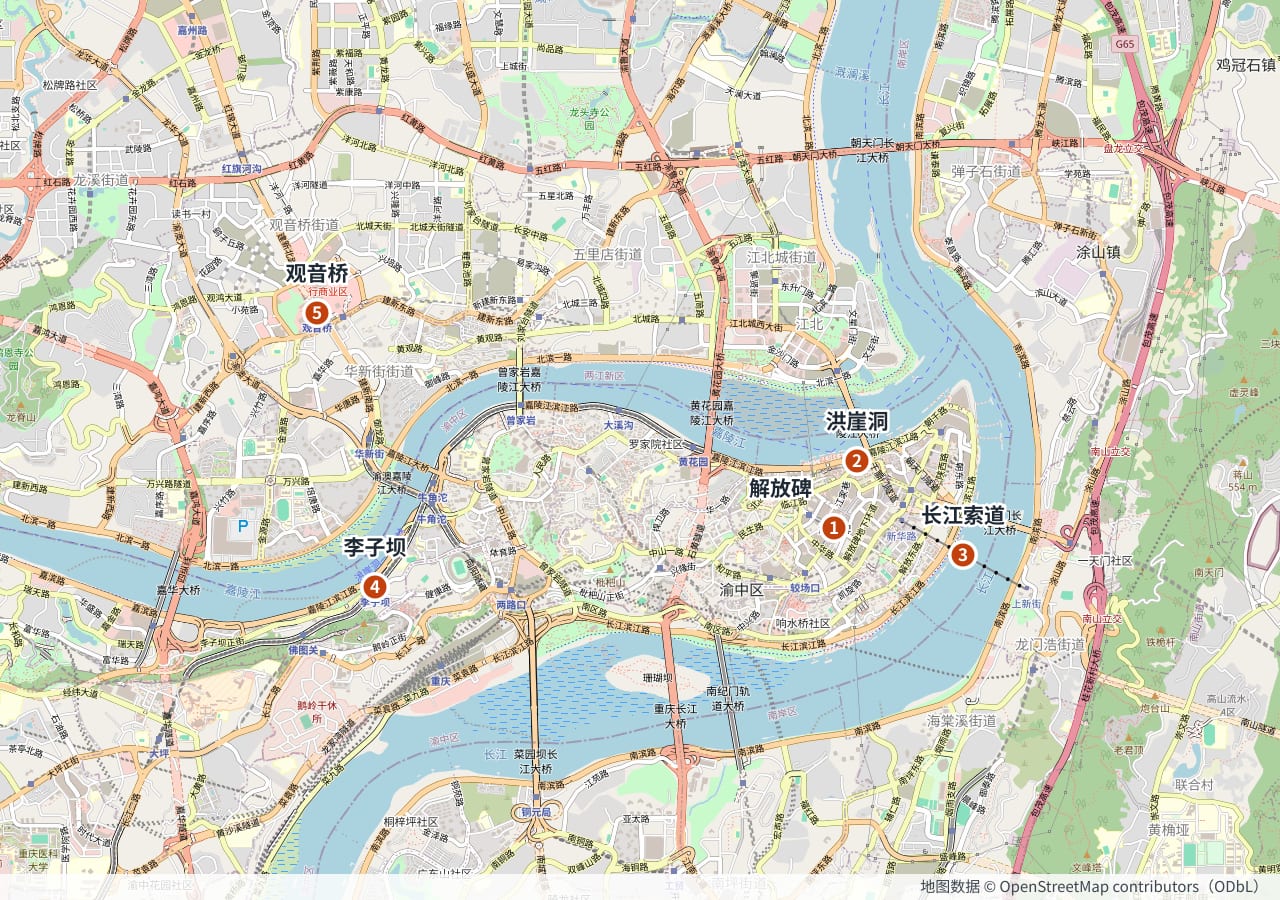
Map: OpenStreetMap. Numbers added by Arrive China — © OpenStreetMap contributors (ODbL)
Getting there: the sights, the nearest station, and how to walk it
-
1 Jiefangbei 12
Jiaochangkou / Linjiangmen
Jiaochangkou, where Lines 1 and 2 interchange, or Linjiangmen on Line 2, then five to eight minutes on foot. One thing to absorb first: Chongqing is a vertical city, and 300 m on a map can be a flight of steps, an outdoor lift, or a footbridge. Follow the signs inside the stations and malls rather than the straight line on the map.
-
2 Hongyadong 16
Xiaoshizi (exit 1, 400 m walk)
Lines 1 and 6 to Xiaoshizi, exit 1, then 400 m on foot. Hongyadong is an eleven-storey stilt-house complex built against a cliff: the top floor opens onto the road on the Jiefangbei side and the bottom floor opens onto the riverbank, so which floor you are on depends on where you walked in — you have not got lost. The lights come on around seven in the evening, and the best full view is from Qiansimen bridge across the water.
-
3 Yangtze cable car 16
Xiaoshizi
Same station as Hongyadong: Lines 1 and 6 to Xiaoshizi, then about five minutes on foot to the north terminal on the Yuzhong side. The cable car crosses the Yangtze in four or five minutes. It began as commuter transport and is now mostly tourists. It is the first thing in Chongqing to sell out, so book on the official channel in advance — and when the queue is long, the ferry across the river gives you much the same view.
-
4 Liziba (monorail through a building) 2
Liziba
Line 2 to Liziba. Here the monorail runs straight through floors six to eight of a nineteen-storey residential block, with the platform inside the building — the single most photographed thing in Chongqing. To photograph a train coming through, go down to the viewing deck outside the block, a few minutes down from the exit following the signs. To experience it, just ride Line 2 through. Open any time during the day, no ticket.
-
5 Guanyinqiao 3
Guanyinqiao
Line 3 to Guanyinqiao; it starts at the exit. This is the Jiangbei district's shopping centre, across the Jialing river from Jiefangbei. Fewer tourists, more locals, cheaper food and hotels than Jiefangbei — and Line 3 runs straight to Jiangbei airport, which is why many people base themselves here.
Jiefangbei, Hongyadong and the cable car are packed into one small patch of the Yuzhong peninsula, all within walking distance of Xiaoshizi and Jiaochangkou. But a ten-minute walk in Chongqing includes stairs and lifts, so it takes longer than in a flat city.
The base map is OpenStreetMap, so it is to scale rather than a schematic. The number in each orange dot matches the list below, and every entry gives the nearest station, which exit to use, how long the walk is, and what to know once you arrive.
Chongqing is built vertically on a mountain peninsula between two rivers: you step into an elevator on “floor 1,” ride up to “floor 11,” and walk out onto another street with buses and noodle shops. Because it sits just over an hour by high-speed rail from Chengdu, the two cities make a natural pair (see how all eight entry hubs compare in which city to visit first in China).
Quick facts
| Item | What to expect |
|---|---|
| Airport to centre | Jiangbei Airport (CKG) Metro Lines 10 or 3 take ~45–60 min to Yuzhong or Guanyinqiao |
| Suggested stay | 3 days (2 days for Yuzhong Peninsula, monorail & river views + 1 day for Guanyinqiao or Dazu) |
| Metro English | Full English signage and announcements across all metro and monorail lines; Alipay QR supported |
| Best months | March–May and October–November (avoid July–August 38°C+ “furnace” heat) |
| Next stop | High-speed rail: 1–1.5 hr to Chengdu or ~2 hr to Guiyang |
Who it fits, who should skip
Who it fits: Travellers drawn to dramatic cyberpunk river skylines, monorails threading through buildings, cliffside walkways, and bubbling beef-tallow hotpot—provided your knees are happy with stairs.
Who should skip: Anyone travelling with a stroller or wheelchair, visitors with bad knees, or travellers who dislike humid heat and spicy food.
How many days you need
Give Chongqing 2 to 3 full days.
Day one covers the Yuzhong Peninsula walking downhill from Jiefangbei to the river; day two rides Monorail Line 2 along the Jialing River and crosses to the south bank or Guanyinqiao. If you have a 4th day, use it for a day trip to the Dazu Rock Carvings (a UNESCO site of 9th–13th century cliff sculptures) or Wulong Karst.
Three days, in order
There is only one ordering rule in Chongqing: walk downhill, and use the metro and escalators to get back up. Do it the other way round and your legs are finished by the end of the day.
Day 1: the downhill line across the Yuzhong peninsula
| Stop | Ticket | To the next stop |
|---|---|---|
| Jiefangbei | free | 10 min on foot |
| Luohan Temple | ¥10 | 15 min on foot |
| Shancheng Trail or the Daijiaxiang cliff walkway | free | 20 min on foot (downhill the whole way) |
| Hongyadong (enter from the top on Cangbai Road) | free | 10 min on foot |
| Qiansimen Bridge walkway for the night view | free | — |
This day costs almost nothing in tickets. Start at Jiefangbei with Luohan Temple right beside it, then follow the Shancheng Trail all the way down to the river — downhill from start to finish. In the evening, walk into Hongyadong from Cangbai Road (the street at the 11th-floor level) and work your way down, then finish on the Qiansimen Bridge walkway with the whole Yuzhong peninsula lit up in front of you.
Hongyadong has no paid entrance. Anyone selling a “fast-track ticket” is a scammer.
Day 2: the monorail and the south bank
| Stop | Ticket | To the next stop |
|---|---|---|
| Rail Transit Line 2 (Jiaochangkou – Liziba – Futuguan) | ¥2–4 | ~20 min ride |
| Futuguan Park hillside trail | free | 15 min by metro |
| Yangtze River Cableway or the Liangjiang ferry | cableway ¥20, ferry around ¥10 | 10 min on foot |
| Danzishi Old Street or Nanbin Road | free | — |
Line 2 is the monorail that runs through a building. Rather than crowding under Liziba station to shoot upwards, ride in the front carriage and go through the residential block yourself; it is a completely different experience. Get off at Futuguan and there is a hillside trail with river views along part of it.
If the cableway queue is over forty minutes, give it up and take the Liangjiang ferry instead: a wider view from the water, and a cheaper ticket.
Day 3: Guanyinqiao or the Dazu Rock Carvings
With another day in the city, you can walk the Guanyinqiao commercial district and the Beicang creative quarter. The ground there is far flatter than Yuzhong, with malls close together and plenty of late-night food.
If you would rather see the real thing, go straight to the Dazu Rock Carvings: Tang and Song cliff sculpture, a World Heritage site, and the Thousand-Hand Guanyin and Reclining Buddha around Baodingshan are worth the dedicated trip. Hire a car for the day there and back, or take the high-speed train to Dazu South and change there.
Airport to the city centre
- Chongqing Jiangbei International Airport (CKG): check whether your flight uses Terminal 2 or Terminal 3. During the day, ride Metro Line 10 (serves both T2 and T3) or Line 3 into the centre in about 50 minutes.
- Chongqing North (
重庆北站) and Chongqing West (重庆西站): both high-speed rail stations connect directly to the metro, with Chongqing North sitting closer to the central Yuzhong Peninsula.
If you arrive late at night or call a DiDi with heavy luggage, confirm that the drop-off pin is on the exact street level of your hotel lobby—being dropped on the lower river road can mean four flights of outdoor stairs.

Photo: Juukeihc at English Wikipedia / CC BY 4.0, via Wikimedia Commons
Where to stay
In Chongqing, a flat street next to a metro exit matters ten times more than a river-view balcony (and always confirm foreign-passport registration first via how to book hotels that accept foreigners):
- Jiefangbei / Jiaochangkou / Xiaoshizi (Best central base): sits on the flat ridge at the top of Yuzhong Peninsula where Lines 1, 2, and 6 meet, surrounded by late-night food, pharmacies, and malls.
- Guanyinqiao (Flatter, great for families): north of the river on Lines 3 and 9, with wide flat plazas, modern shopping centres, and easier walking when it rains.
- Cliffside “river-view” apartments right on Hongyadong’s slope (Avoid): listing photos look stunning, but many sit inside aging mixed-use towers with 20-minute elevator queues and steep stairs between you and breakfast.
Three things worth your time
- A downhill ridge walk on Yuzhong Peninsula + Qiansimen Bridge at dusk: start on top of the ridge at Jiefangbei and Luohan Temple, walk downhill along the Daijiaxiang cliff walkway toward the river, look down at lit-up Hongyadong from the 11th-floor Cangbai Road deck, and walk out onto the pedestrian lane of Qiansimen Bridge for the best free skyline view in the city.
- Ride Monorail Line 2 from Jiaochangkou through Liziba to Fotuguan: instead of just standing in the crowd below Liziba Station looking up, ride in the front car as the train glides straight through the 6th-to-8th floors of the apartment building, then get off at Fotuguan for the hillside park trail.
- Yangtze River Cable Car or the 2-river commuter ferry: if the cable car queue exceeds 40 minutes, skip it and take the public river ferry from Chaotianmen or Danzishi instead (see which attraction tickets need advance booking).

Photo: Yumeto / CC BY-SA 4.0, via Wikimedia Commons
What to eat and how to order
Chongqing cooking is built around fiery chilies, numbing huajiao peppercorn, and rich aromatics:
- Chongqing hotpot (重庆火锅): always order a divided pot (
鸳鸯锅) with clear mushroom or tomato broth in the centre ring. Mix your dipping bowl with sesame oil and minced garlic (香油蒜泥)—it coats your stomach and cools the heat. - Chongqing xiaomian (重庆小面 — street noodles): the city’s breakfast staple. If you want zero spice, ask for clear-broth noodles (
清汤小面,完全免辣) or pork wontons in clear soup (清汤抄手). - Crucial note for vegetarians and Halal diners: authentic Chongqing red hotpot base is made with beef tallow (
牛油), and street noodles often use pork lard (猪油). Show the Chinese food allergy and vegetarian card before ordering.
Getting around locally
Follow one golden rule in Chongqing: walk downhill, and let the metro, monorail, and public escalators carry you back uphill.
Flat 2D maps lie in Chongqing: two pins that touch on your screen can sit 60 vertical metres apart on a bridge deck and the riverbank below. When lost, ask a shopkeeper which elevator or metro exit goes up to the top street rather than trying to follow a compass arrow.

Photo: Chen Hualin / CC BY-SA 4.0, via Wikimedia Commons
Best time to visit
March–May and October–November give you mild 18–24°C days for climbing stairs without soaking through your shirt.
July and August turn Chongqing into one of China’s “Three Furnaces,” with 38°C+ daytime heat where sightseeing only makes sense after sunset. December to February is mild but foggy and damp—check the sky at 16:00 before paying for an evening river cruise. See the month-by-city China packing table.
Common mistakes
- Buying a “VIP fast-track ticket” for Hongyadong: Hongyadong is a free public hillside building; enter from the top road (Cangbai Road) or view it from Qiansimen Bridge for zero RMB.
- Wearing stiff dress shoes or slick soles: wet stone stairs and 15,000 steps of elevation change demand broken-in running or trail shoes.
- Criss-crossing both rivers three times in one day by taxi: group your stops by ridge and riverbank so you do not spend your afternoon stuck on bridge approaches.

Photo: N509FZ / CC BY-SA 4.0, via Wikimedia Commons
Compare China hotels Browse China tickets
Affiliate link. Compare prices on the partner site before you pay.
Questions visitors ask
- Is Chongqing worth visiting, and how many days do I need?
- Yes—if you want to see a vertical mountain metropolis where monorails pass through apartment blocks and bridges span two rivers. Spend 2 to 3 full days in the city, or 4 days if you add the Dazu Rock Carvings.
- Is Chongqing too difficult for a first-time visitor to China?
- The metro and monorail have full English signage, so language is not the hurdle. The hurdle is stairs and hills—sleep right next to a metro exit and wear cushioned running shoes.
- Do I need to book a ticket for Hongyadong?
- No. Hongyadong is a free, open hillside complex. Ignore anyone selling 'VIP fast-track entry' on the pavement; walk across Qiansimen Bridge or look down from the 11th-floor top road for free.