Shenzhen Guide: The Easiest Way In From Hong Kong
Shenzhen is China's youngest, most step-free metropolis and the easiest overland entry point from Hong Kong. Treat it as a 2-to-3-day modern base for bayfront parks, drone-delivery kiosks, and design districts rather than ancient history. Stay in Futian or Nanshan along Metro Line 11, and skip overpriced 1990s miniature theme parks.
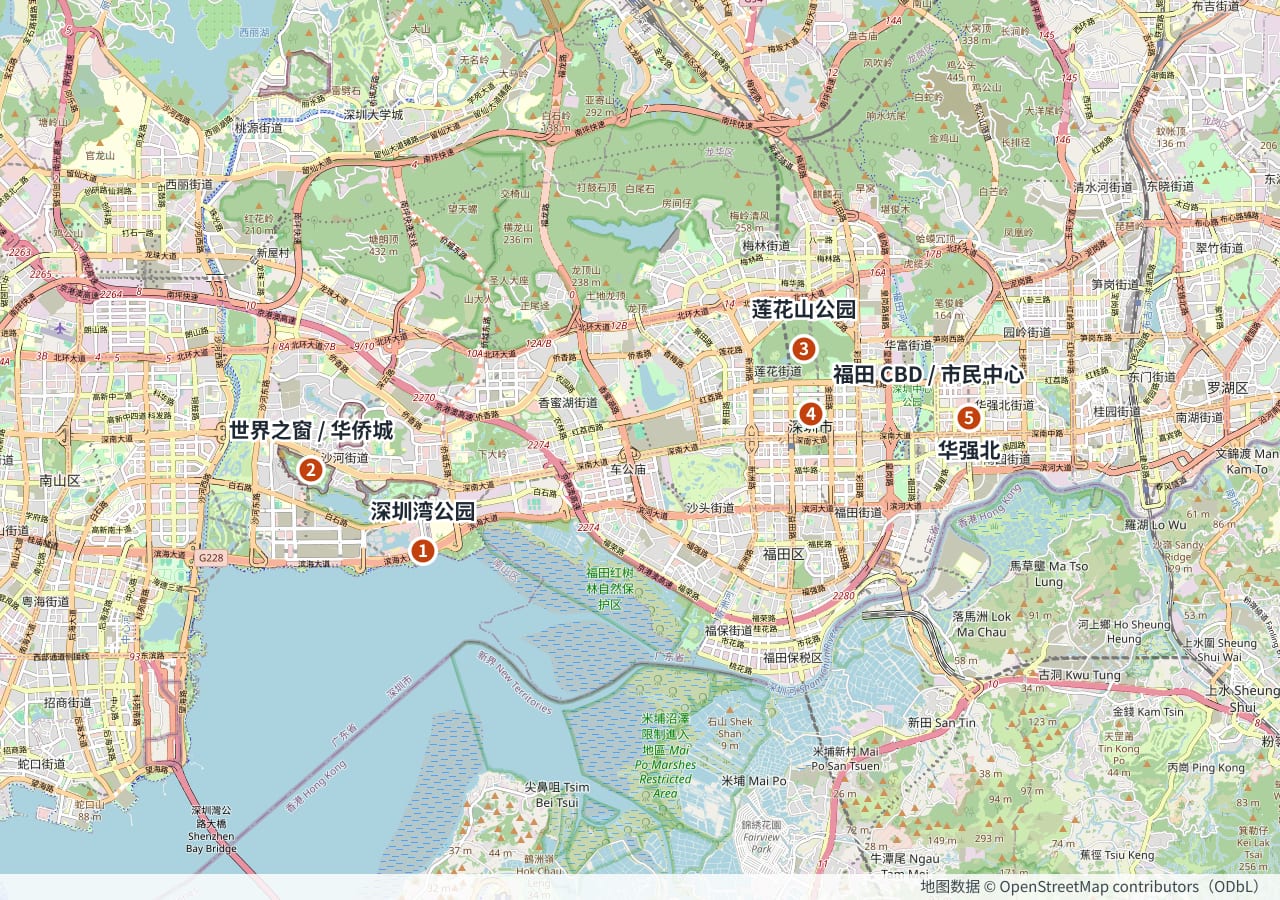
Map: OpenStreetMap. Numbers added by Arrive China — © OpenStreetMap contributors (ODbL)
Getting there: the sights, the nearest station, and how to walk it
-
1 Shenzhen Bay Park 9
Shenzhen Bay Park (exits A / C / D2)
Line 9 to Shenzhen Bay Park; exits A, C or D2 put you on the waterfront. Note that a lot of older guides say Line 1 — that is wrong, Line 1 does not reach it. The park runs for more than ten kilometres along the shore with a dedicated walking and cycling path, and the far side of the water is Hong Kong's New Territories. It fills with locals in the late afternoon, and this is the sunset spot.
-
2 Window of the World / OCT 12
Window of the World
Lines 1 and 2 interchange at Window of the World, right at the exit. Window of the World is a theme park of scaled-down world landmarks standing side by side; it needs a ticket and opinions differ. The better walk is OCT-LOFT next door, a former electronics factory turned into bookshops, cafés and exhibition spaces. It is free, ten minutes away on foot.
-
3 Lianhuashan Park 34
Children's Palace (10 min walk)
Lines 3 and 4 interchange at Children's Palace; walk ten minutes north to the park's south gate. The hill is low, about 20 minutes to the top, and the summit faces the Futian CBD skyline directly — Shenzhen went from fishing villages to that in forty years, and standing there is the clearest way to see it. Free, and full of kite flyers in the evening.
-
4 Futian CBD / Civic Center 24
Civic Center
Lines 2 and 4 interchange at Civic Center. The Civic Center is the government building with a roof shaped like a bird's spread wings, and the Shenzhen Museum is inside it — free, with a reservation. This is the administrative and financial core: office workers by day, empty at night.
-
5 Huaqiangbei 27
Huaqiangbei
Lines 2 and 7 interchange at Huaqiangbei, and the exit opens onto the electronics market strip. Each building has a theme: phone parts, chips, cameras, second-hand gear, repairs. If your phone breaks, you forgot an adapter, or you want gadgets you cannot find elsewhere, this is the answer. Haggling is normal — check two stalls before you buy.
Shenzhen's sights are spread out and the metro is what links them: Shenzhen Bay Park is only on Line 9, OCT is on Line 1, and the Futian CBD and Lianhuashan are on Lines 2, 3 and 4. Line 1 runs the long east–west axis; Line 2 covers the centre.
The base map is OpenStreetMap, so it is to scale rather than a schematic. The number in each orange dot matches the list below, and every entry gives the nearest station, which exit to use, how long the walk is, and what to know once you arrive.
Do not come to Shenzhen looking for Ming Dynasty temples—forty-five years ago this coastline was fishing villages and rice paddies. Come to Shenzhen as the cleanest, flattest, most futuristic soft landing into mainland China, especially when crossing over from Hong Kong (compare all eight entry hubs in which city to visit first in China).
Quick facts
| Item | What to expect |
|---|---|
| Airport to centre | Bao’an Airport (SZX) Metro Line 11 takes ~30–40 min to Nanshan (Houhai) or Futian |
| Suggested stay | 2–3 days (1.5 days for Shenzhen Bay & OCT-LOFT + 1 day for Huaqiangbei or museums) |
| Metro English | Crisp bilingual signage and announcements on every line; Alipay QR supported |
| Best months | Late October–March (sunny, mild 18–25°C winters; May–September is hot, humid, and stormy) |
| Next stop | High-speed rail: 14 min to Hong Kong West Kowloon, 30 min to Guangzhou, ~3 hr to Guilin |
Who it fits, who should skip
Who it fits: Travellers crossing into mainland China from Hong Kong who want an easy first night to test Alipay and eSIM data; fans of modern architecture, electronics markets, drone delivery, design parks, and flat coastal boardwalks.
Who should skip: Visitors looking for ancient palaces, historic alleys, or centuries-old teahouses—ride the 30-minute high-speed train to Guangzhou for traditional Cantonese heritage instead.
How many days you need
Give Shenzhen 2 to 3 full days.
Shenzhen works best when you treat it as a relaxed urban break rather than a monument checklist: spend a morning at the OCT-LOFT creative park, walk the Shenzhen Bay waterfront at sunset, and eat coconut chicken hotpot or Chaoshan beef hotpot for dinner. On day three, catch a high-speed train from Shenzhen North Station (深圳北站) into the interior.
Three days, in order
Shenzhen has no ancient monuments. What there is to see is the modern city itself, so the route runs “the bay → the creative parks → the old markets”.
Day 1: Shenzhen Bay and OCT
| Stop | Ticket | To the next stop |
|---|---|---|
| Shenzhen Bay Park (around Talent Park) | free | 20 min on foot |
| OCT-LOFT creative culture park | free | 15 min by metro |
| Window of the World or Happy Valley (with children) | Window of the World about ¥220 | — |
Shenzhen Bay Park is the most pleasant stretch of this coastline. Rent a shared bike and ride the greenway, with the hills of Hong Kong on the other side. It gets windy in the evening, and it is the best place for sunset.
OCT-LOFT is a creative park converted from old factory buildings, with cafés, bookshops and exhibitions in one place, and quiet on weekdays. Window of the World is an artificial miniature-landmark park; the ticket is not cheap, so skip it if your schedule is tight.
Day 2: Futian and Lianhuashan
| Stop | Ticket | To the next stop |
|---|---|---|
| Lianhuashan Park (for the Futian skyline) | free | 15 min on foot |
| Shenzhen Museum or the Museum of Contemporary Art and Urban Planning | free, booking required | 10 min by metro |
| Shopping Park and the convention centre area | free | 15 min by metro |
| Free Sky observation deck, Ping An Finance Centre | about ¥200 | — |
The top of Lianhuashan is the classic vantage point over the Futian CBD. Twenty minutes to climb, and free. The planning museum’s own architecture is worth a look, and that is free too.
For the observation deck, watch the weather. If visibility is poor, do not spend the money.
Day 3: Huaqiangbei and Shekou
| Stop | Ticket | To the next stop |
|---|---|---|
| Huaqiangbei electronics market | free | 20 min by metro |
| Shekou Sea World | free | 15 min on foot |
| Shekou Old Street or Nantou Ancient City | free | — |
Huaqiangbei is a market for electronic components. You go for the atmosphere; do not casually buy things unless you know the trade. Nantou Ancient City is one of the few districts in Shenzhen with real history, and a number of small shops have opened there since it was redeveloped.
With only two days, swap day three for Chimelong or the beaches of the Dapeng Peninsula, or simply take the 14-minute high-speed train to Hong Kong.
Airport to the city centre
- Shenzhen Bao’an International Airport (SZX): follow the ground transport signs straight onto Metro Line 11, which reaches Nanshan (Houhai) in 30 minutes and central Futian in 40 minutes.
- Entering from Hong Kong: the smoothest route is the high-speed train from Hong Kong West Kowloon Station to Futian Station (
福田站) in 14 minutes or Shenzhen North (深圳北站) in 18 minutes. You can also take the Hong Kong MTR East Rail Line to Lok Ma Chau (Futian Checkpoint) or Lo Wu and walk across the border bridge.
For late-night airport arrivals, head to the official DiDi pickup garage.
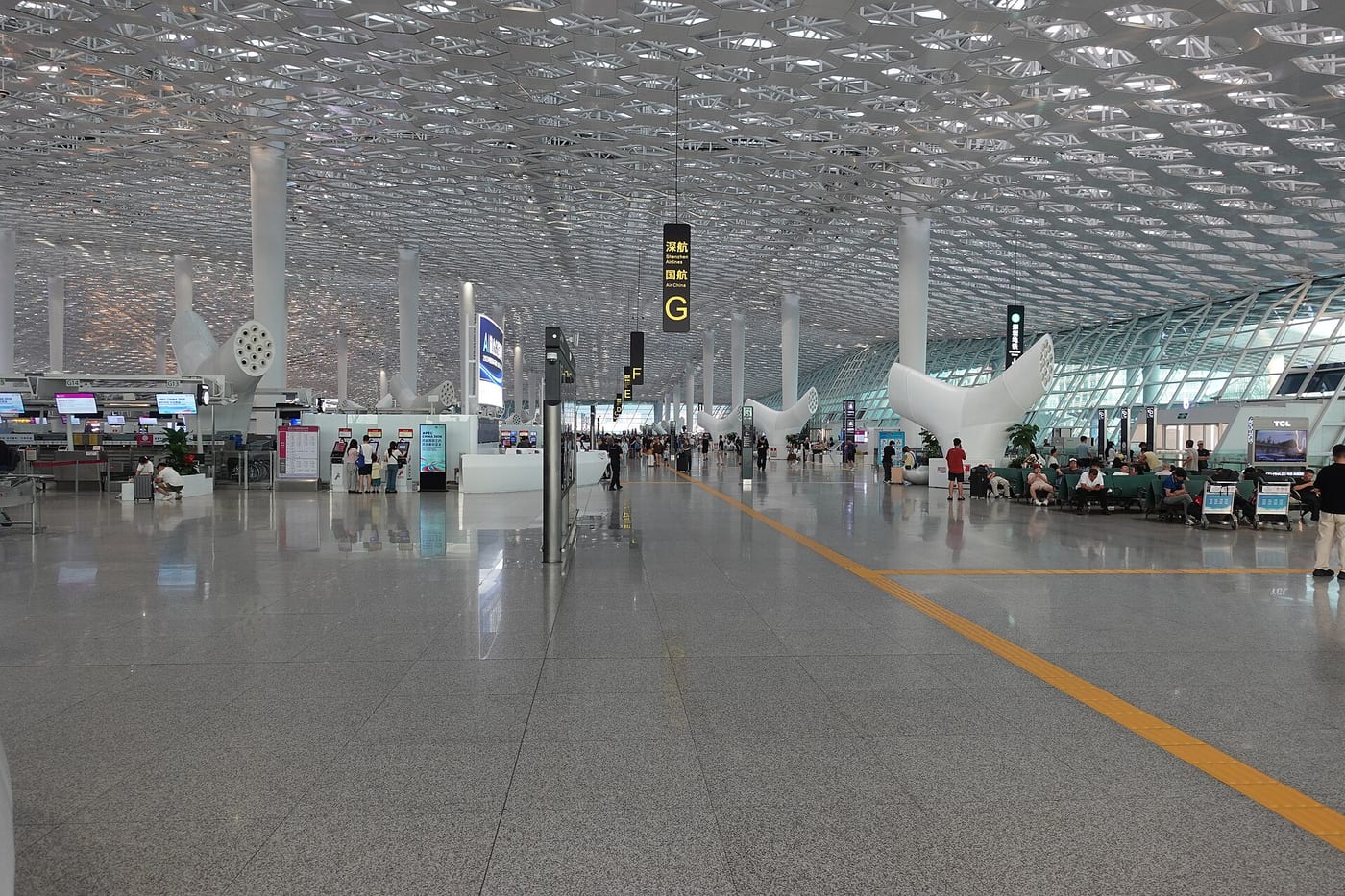
Photo: 颐园居 / CC BY-SA 4.0, via Wikimedia Commons
Where to stay
Shenzhen stretches east–west along the bay; sleep in Futian or Nanshan along Metro Lines 1 and 11 (and confirm foreign-passport registration first via how to book hotels that accept foreigners):
- Futian CBD (Convention Center / Coco Park / Futian Station — Best hub): direct rail from both SZX Airport and Hong Kong West Kowloon, packed with international hotel chains, wide pavements, and late dining.
- Nanshan Houhai / Shenzhen Bay / OCT (Bayfront & creative base): modern waterfront towers next to Talent Park, Shenzhen Bay MixC, and the leafy OCT-LOFT art district.
- Old towers right next to Luohu Checkpoint (Think twice): convenient for the Lo Wu footbridge, but older, louder, and far from Shenzhen’s best parks and museums.
Three things worth your time
- Late-afternoon walk from Shenzhen Bay Park to Talent Park (plus a drone delivery): completely free. Walk the coastal promenade toward the bamboo-shoot skyscraper at sunset, and order a coffee or juice to one of the Meituan drone drop-off kiosks inside the park to watch a quadcopter deliver your cup from a nearby mall roof.
- OCT-LOFT Creative Culture Park (
华侨城创意文化园): a shaded former factory district turned into independent bookshops, galleries, specialty coffee roasters, and design studios. - Huaqiangbei Electronics Market + Museum of Contemporary Art & Urban Planning (MOCAUP): spend an hour browsing the multi-storey gadget halls of Huaqiangbei, then take the metro to Civic Center for MOCAUP’s futuristic steel-and-glass interior (free timed entry—see which attraction tickets need booking).
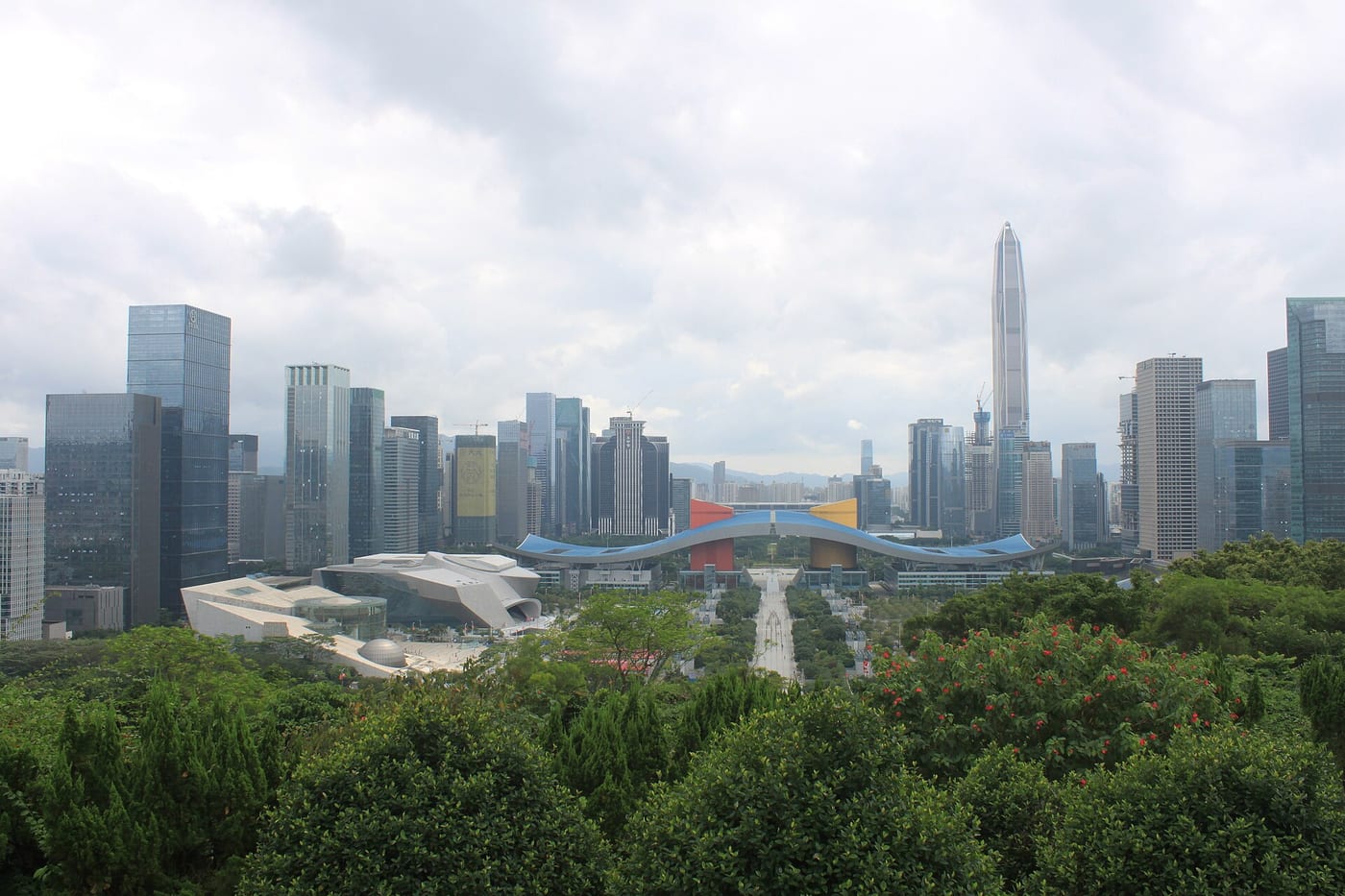
Photo: Huangdan2060 / CC BY 3.0, via Wikimedia Commons
What to eat and how to order
Because migrants from all over China built Shenzhen, you can eat every regional cuisine here, led by two non-spicy southern hotpot styles:
- Hainan coconut chicken hotpot (
椰子鸡): tender chicken poached for five minutes in pure fresh coconut water with coconut strips, dipped in soy, lime, and sand ginger. Mild, fragrant, and zero chili. - Chaoshan hand-sliced beef hotpot (
潮汕牛肉火锅): fresh beef cuts swished for 8 seconds in clear bone broth. Allergy warning: the standard dipping sauce is shacha paste (沙茶酱), which contains peanuts and dried shrimp/fish—use plain soy sauce, garlic, and cilantro if you have a peanut or shellfish allergy. - Cantonese dim sum and roast goose: widely available across Futian and Nanshan.
Show the Chinese food allergy and vegetarian card before ordering if you have dietary restrictions.
Getting around locally
Shenzhen has some of the widest pavements and cleanest metro stations in Asia. Activate the Shenzhen Metro QR code inside Alipay to tap through any turnstile.
Watch out for one detail on Metro Line 11: two cars at one end of the train are designated Business Class (商务车厢) and cost roughly triple the standard fare. Stand by the standard platform doors unless you deliberately tap the yellow Business Class validator on the platform first.
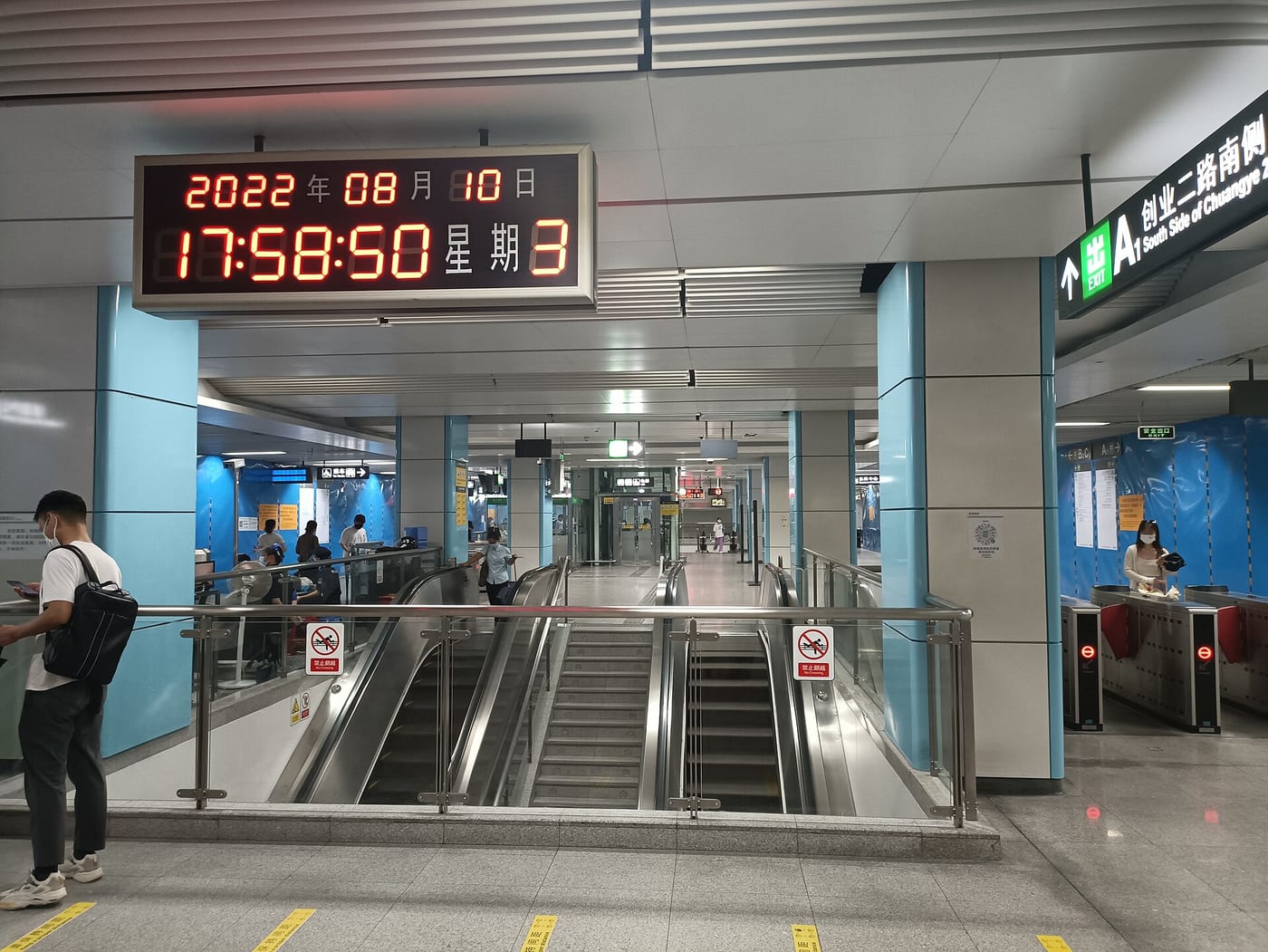
Photo: Bob Wehn / CC BY-SA 4.0, via Wikimedia Commons
Best time to visit
Late October through March brings sunny, dry 18–25°C weather ideal for coastal walks.
May through September is hot, humid, and subject to sudden tropical downpours or occasional typhoons (when coastal parks temporarily close). Check the month-by-city China packing table.
Common mistakes
- Treating Shenzhen as a traditional sightseeing city and paying 220 RMB for “Window of the World”: unless you are entertaining young kids with miniature Eiffel Towers, spend your time in the free bayfront parks and OCT-LOFT instead.
- Walking into the Metro Line 11 Business Class car without tapping the Business validator: staff check tickets inside those cars; use the standard cars for normal metro fares.
- Crossing back into Hong Kong on a single-entry Chinese visa: Hong Kong is a separate immigration territory—stepping across the border uses up a single-entry mainland visa (verify your entry rule in the China entry checklist).
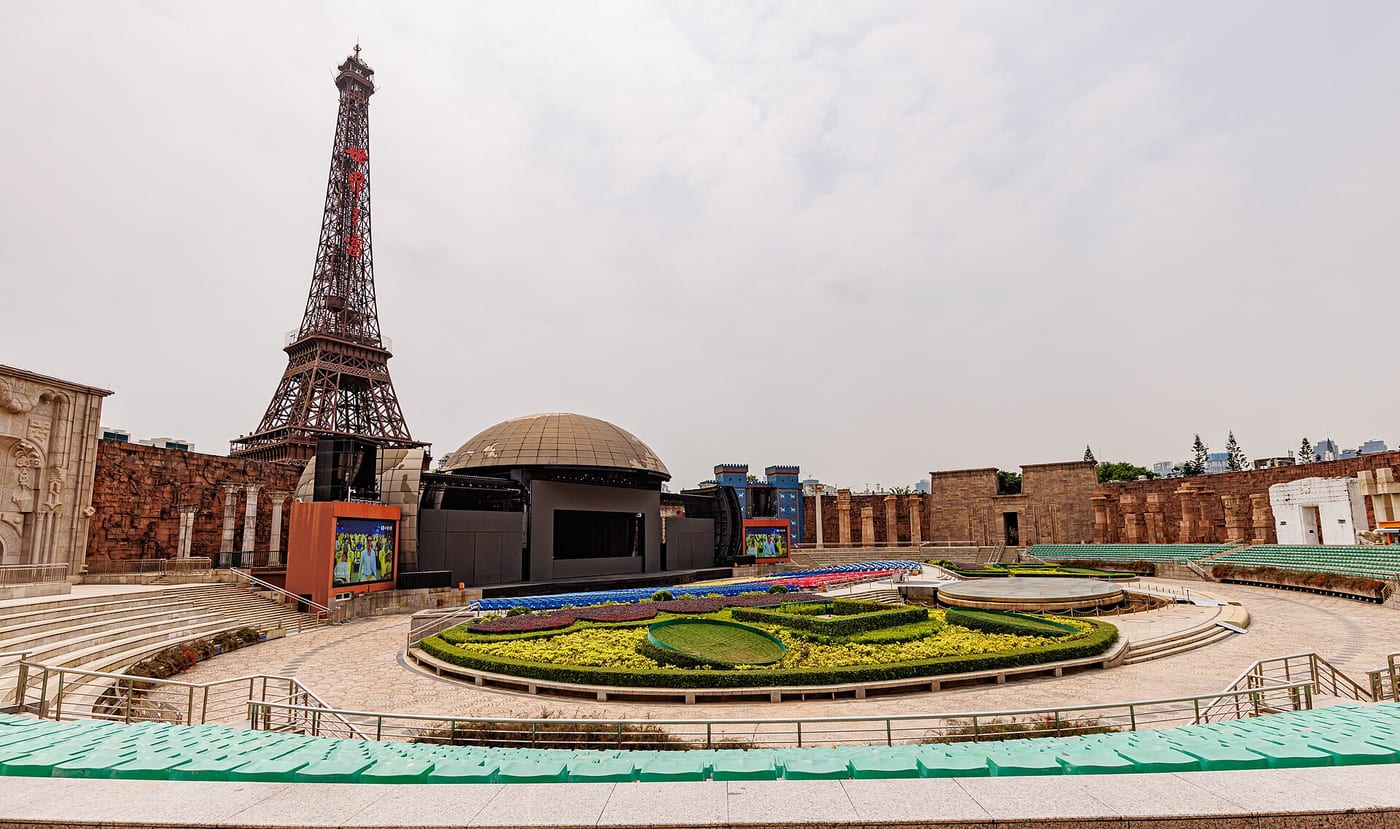
Photo: Dinkun Chen / CC BY-SA 4.0, via Wikimedia Commons
Compare China hotels Browse China tickets
Affiliate link. Compare prices on the partner site before you pay.
Questions visitors ask
- Is Shenzhen worth visiting, and how many days do I need?
- Yes—if you are entering mainland China from Hong Kong, want a warm winter stop, or enjoy modern architecture, bayfront parks, and tech markets. Two to three days is plenty before continuing by high-speed rail to Guangzhou or Guilin.
- What is the easiest way to enter Shenzhen from Hong Kong?
- Ride the high-speed train from Hong Kong West Kowloon Station, which clears both borders inside the terminal and reaches Shenzhen Futian Station in 14 minutes or Shenzhen North in 18 minutes.
- Is Shenzhen easy for first-time foreign visitors?
- Extremely easy. Because the entire city was built in recent decades, metro signage is bilingual, pavements are wide and step-free, and younger staff in malls and cafés speak basic English.