Xi'an Guide: Terracotta Army, City Wall & 3-Day Plan
Xi'an packs two thousand years of imperial history into a flat, grid-patterned walled city that makes an ideal second stop after Beijing or Chengdu. Give it 2 to 3 full days, stay near Yongningmen (South Gate) on Metro Line 2, visit the Terracotta Army at 08:30 opening, and ride the Ming City Wall at sunset—never try to rush Xi'an as a one-day stop.
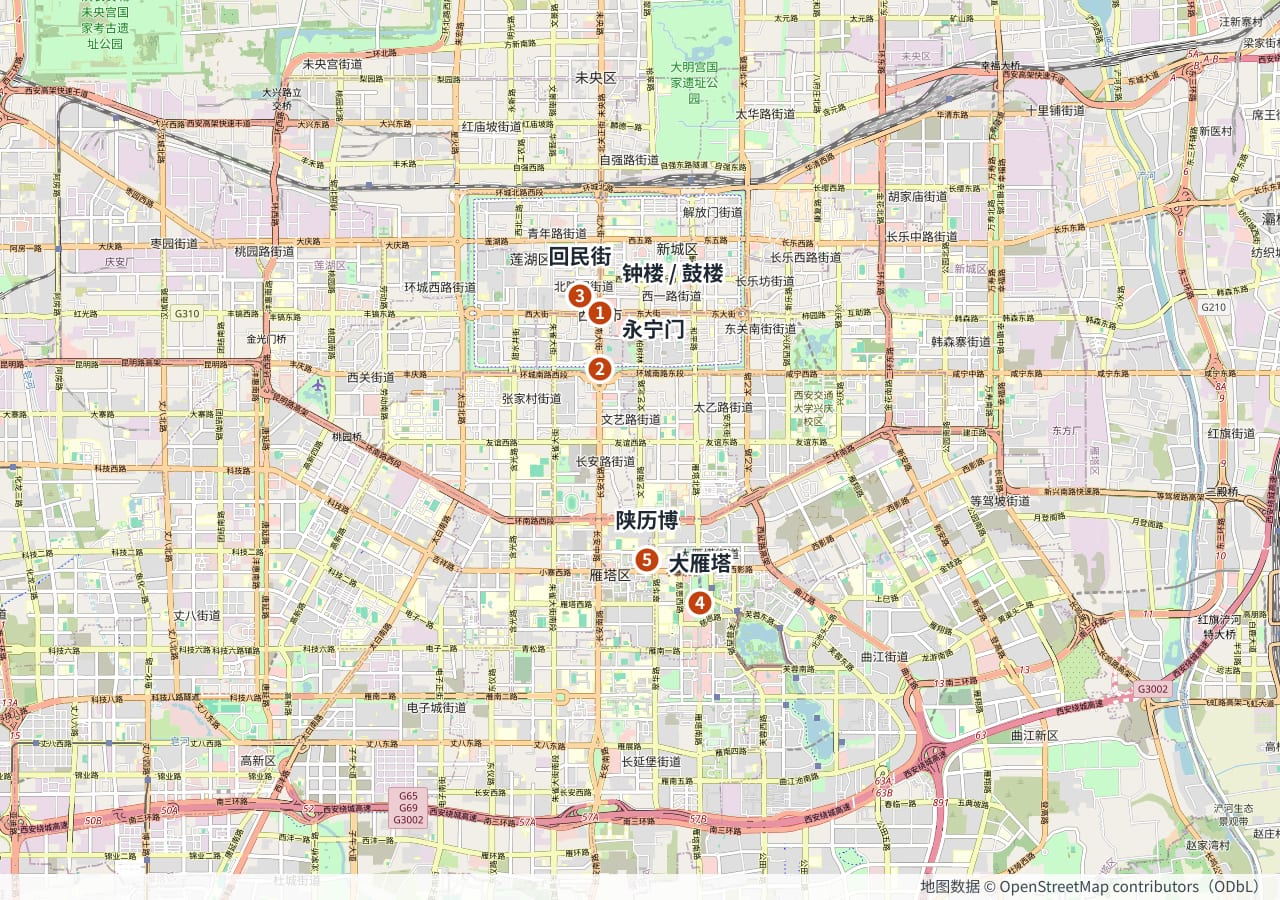
Map: OpenStreetMap. Numbers added by Arrive China — © OpenStreetMap contributors (ODbL)
Getting there: the sights, the nearest station, and how to walk it
-
1 Bell Tower / Drum Tower 12
Bell Tower
Lines 1 and 2 interchange at Bell Tower. The tower itself stands in the middle of a traffic roundabout you cannot cross at street level, so you use the underpass — and the metro station's passage leads straight to the base of the tower. The Drum Tower is at the north-west corner, three minutes from the same underpass.
-
2 City Wall · Yongningmen 2
Yongningmen
Line 2 to Yongningmen, and the south gate of the wall is right at the exit. This is a complete 14th-century city wall, 13.7 km around, and the top is wide enough to cycle on — renting a bike and riding the full loop takes about two hours and is the single best use of time in Xi'an. For a shorter version, just walk a stretch: the south gate to Wenchangmen and back is half an hour.
-
3 Muslim Quarter 12
Bell Tower (10 min walk)
No station of its own. From Bell Tower station, walk ten minutes north-west and through the arch under the Drum Tower. These are the food streets of Xi'an's Hui Muslim quarter: lamb soup with torn flatbread, meat in a bun, persimmon cakes. Evenings are packed; daytime is quieter but with fewer stalls open. Further in is the Great Mosque, a mosque laid out like a Chinese courtyard temple, with a ticket.
-
4 Big Wild Goose Pagoda 34
Dayanta
Lines 3 and 4 interchange at Dayanta; five minutes on foot to the north square. The pagoda was built in the 7th century to house Buddhist scriptures brought back from India. One ticket gets you into Da Ci'en Temple, a second one gets you up the pagoda. The fountain show on the north square runs at fixed times each day, and the evening one draws the biggest crowd.
-
5 Shaanxi History Museum 23
Xiaozhai (10 min walk)
Lines 2 and 3 interchange at Xiaozhai; walk ten minutes north-east. This is the main collection of everything excavated in Shaanxi, and seeing it before the Terracotta Army makes the army make far more sense. Entry is free but requires an advance reservation in the official mini-program; slots are released daily and go fast. Foreign passports can book, and you verify at the staffed window. Closed Mondays.
Off this map
-
Terracotta Army 9
Huaqingchi exit C → bus 613 / 602
Not on this map: out at Lintong, about 40 km east of Xi'an, with no direct metro. Take Line 1 to Fangzhicheng, change to Line 9, get off at Huaqingchi exit C and take bus 613 or 602. Alternatively ride Line 9 to Qinlingxi and take bus 617. Either way it is about 1.5 hours each way. A second option is the 306 (You 5) bus straight from the east square of Xi'an railway station, about an hour. Book the ticket on the official channel in advance and enter by scanning your passport.
The Bell Tower, Yongningmen and the Muslim Quarter are all inside the walled old city and link up on foot. The Big Wild Goose Pagoda and the history museum are to the south, ten-odd minutes on Line 2 or 3. The Terracotta Army is 40 km out and needs a whole morning.
The base map is OpenStreetMap, so it is to scale rather than a schematic. The number in each orange dot matches the list below, and every entry gives the nearest station, which exit to use, how long the walk is, and what to know once you arrive.
Xi’an compresses the Qin, Han, and Tang dynasties inside a Ming Dynasty stone wall you can cycle around in an evening. It works best as your second base connected by high-speed rail from Beijing or Chengdu (see how all eight entry hubs compare in which city to visit first in China).
Quick facts
| Item | What to expect |
|---|---|
| Airport to centre | Xianyang Airport (XIY) Metro Line 14 → Line 2 or 4 takes ~55–70 min into the walled city |
| Suggested stay | 3 days (half-to-full day for Terracotta Army + 2 days for City Wall, museums, and quarters) |
| Metro English | Full English signs and announcements; scan the Alipay Xi’an Metro QR code at turnstiles |
| Best months | March–May and September–November (dry and mild; Jul–Aug is blazing hot, Dec–Feb is cold and dry) |
| Next stop | High-speed rail: ~3.5–4 hr to Chengdu or ~4.5 hr to Beijing |
Who it fits, who should skip
Who it fits: Travellers coming for the Terracotta Army, the intact Ming City Wall, Giant Wild Goose Pagoda, Silk Road history, hand-pulled noodles, and Halal lamb and beef cooking.
Who should skip: Anyone who dislikes museums and historical sites, or travellers with only four days in China who already have a full schedule in one coast city.
How many days you need
Give Xi’an 3 full days (at least 2 nights).
Trying to do Xi’an in a single day is the most common itinerary mistake in China: the Terracotta Army sits 40 kilometres east of the city centre, so a one-day stop means arriving at the pits during the noon crush and leaving before you ever see the City Wall lit up at dusk.
Three days, in order
Xi’an is laid out on a grid, so the best way to plan is by direction: one day on the eastern line, one day inside the city wall, one day in the southern suburbs. Do not cut across the whole city in a single day.
Day 1: the Terracotta Army and Huaqing Pool (eastern line)
| Stop | Ticket | To the next stop |
|---|---|---|
| Emperor Qinshihuang’s Mausoleum Site Museum (Terracotta Army) | ¥120 | 10 min by taxi |
| Huaqing Palace (Huaqing Pool) | ¥120 | ~60 min by taxi |
| Dinner on the Muslim Quarter or Dapiyuan | free | — |
The Terracotta Army opens at 08:30. Be in the first group through the door: Pit 1 first, then Pit 3, Pit 2 and the bronze chariot hall. Hire one of the museum’s own guides or rent an audio guide, because without one you are looking at clay figures and missing eighty per cent of the information. Book tickets on the official site under your passport name.
Huaqing Palace is on the same line as the Terracotta Army, ten minutes away by taxi. It is mainly the Tang-dynasty bathing-pool site and Mount Li, so whether to go in depends on how interested you are in the history.
Come back into the city for dinner. The main street, Beiyuanmen, is aimed at tourists; turn into Dapiyuan or Sajinqiao and you find the halal restaurants locals use.
Day 2: inside the city wall, the Bell and Drum Towers
| Stop | Ticket | To the next stop |
|---|---|---|
| Ming city wall (up at Yongningmen) | ¥54 | 15 min on foot |
| Bell Tower, Drum Tower | ¥35 each, ¥50 combined | 10 min on foot |
| Muslim Quarter, Dapiyuan | free | 10 min on foot |
| Shuyuanmen, Xiangzimiao Street | free | — |
Go up on the wall in the late afternoon. After 17:00 the sun drops and the temperature with it, and cycling or walking both become pleasant. The wall runs 13.7 kilometres with no shade at all on top; half an hour up there at midday in summer will give you heatstroke. Bike rental is charged by the hour, and a full circuit takes a little over an hour.
The Bell Tower and Drum Tower stand facing each other at the exact centre of the walled city, and the combined ticket is better value. Shuyuanmen is a street of calligraphy and scholar’s-supply shops, where you can watch old masters writing on the spot.
Day 3: the Big Wild Goose Pagoda and the museums
| Stop | Ticket | To the next stop |
|---|---|---|
| Shaanxi History Museum | free, booking required | 10 min on foot |
| Big Wild Goose Pagoda (Daci’en Temple) | temple ¥40, climbing the pagoda extra | 10 min on foot |
| Great Tang All Day Mall | free | — |
Tickets for the main Shaanxi History Museum building are extremely hard to get, released at a fixed time. If you miss out, go to the Xi’an Museum (Small Wild Goose Pagoda) or the Qin–Han building of the Shaanxi History Museum instead: equally first-rate Han and Tang material, with far fewer people.
The Big Wild Goose Pagoda stands inside Daci’en Temple, and climbing the pagoda is a separate ticket. Go to the Great Tang All Day Mall in the evening — it is a pedestrian district, good-looking under the lights but crowded; walking towards the south square of the pagoda is quieter.
Airport to the city centre
- Xi’an Xianyang International Airport (XIY): board Metro Line 14 inside the terminal to Xi’an North Railway Station (
西安北站), then transfer on the same concourse to Line 2 (straight to Bell Tower and Yongningmen/South Gate) or Line 4 (to Giant Wild Goose Pagoda). - Xi’an North Railway Station (
西安北站): almost all high-speed trains use Xi’an North, which is 30 minutes from the Bell Tower on Metro Line 2. Do not confuse it with oldXi'an Station(西安站) just outside the north city wall.
For late arrivals or heavy luggage, use the official DiDi pickup zone at the airport.
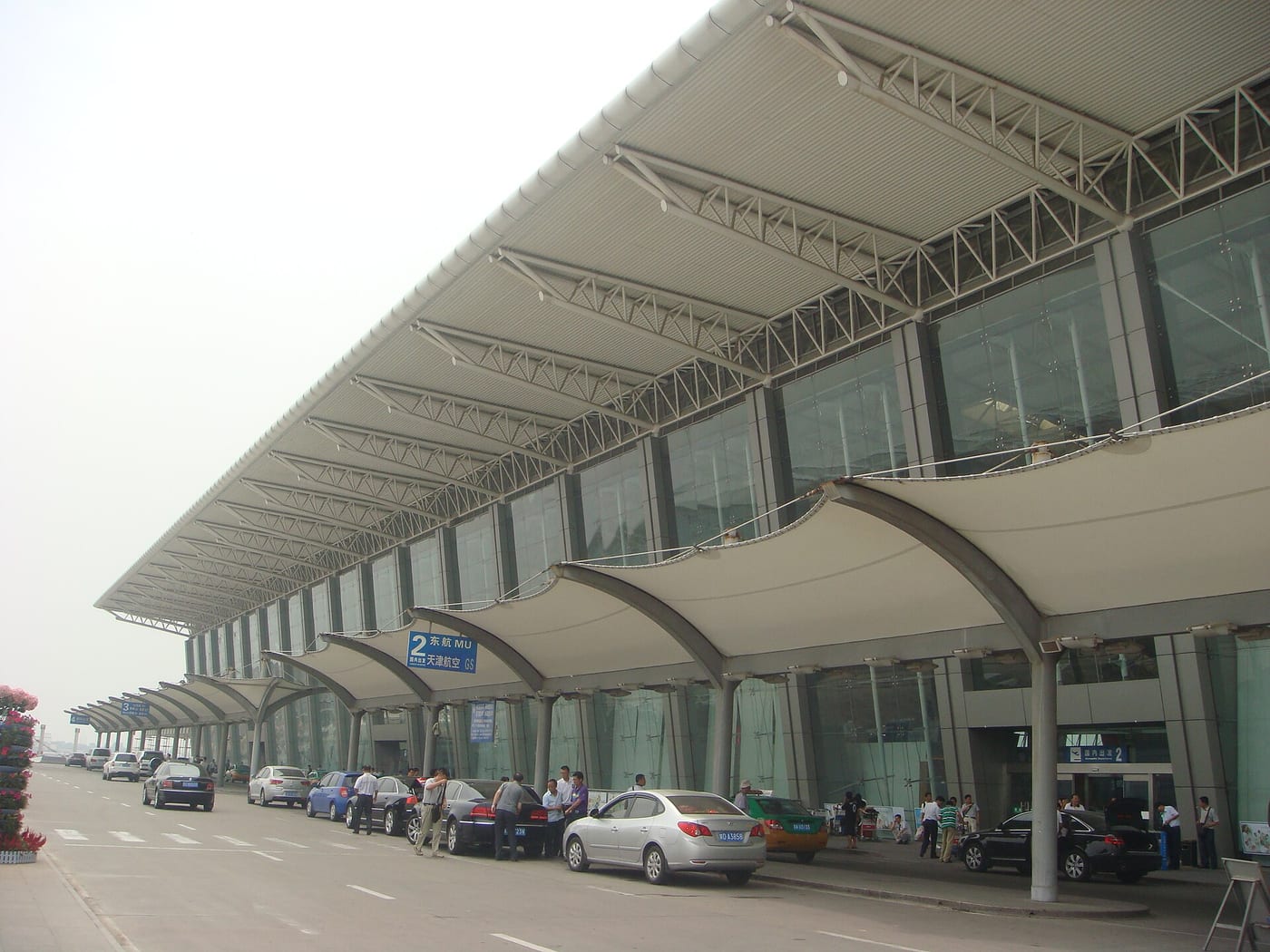
Photo: MNXANL / CC BY-SA 4.0, via Wikimedia Commons
Where to stay
Your choice comes down to sleeping by the Ming City Wall or south near the pagodas (confirm foreign-passport check-in first via how to book hotels that accept foreigners):
- Yongningmen (South Gate) / Bell Tower on Metro Line 2 (Best first base): gives you a one-train ride from Xi’an North Station, puts the City Wall ramp five minutes away on foot, and surrounds you with cafés and restaurants along Shuyuanmen and Xiangzimiao Street.
- Giant Wild Goose Pagoda / Qujiang outer blocks (Modern hotels): wide avenues and newer international chains; pick a hotel two blocks away from the Grand Tang Mall pedestrian spine so evening crowds do not block your taxi.
- Directly above the main Beiyuanmen tourist alley in the Muslim Quarter (Think twice): noisy past midnight, smoky, and inaccessible to cars.
Three things worth your time
- Emperor Qinshihuang’s Mausoleum Site Museum (Terracotta Army) at 08:30 opening: book your passport-linked timed ticket online in advance (see which attraction tickets sell out). Enter at opening, visit Pit 1 first before tour groups arrive, then Pit 3, Pit 2, and the Bronze Chariots hall. Hire an official museum guide at the entrance or rent the audio guide so you understand what you are looking at.
- The Ming City Wall at 17:00: climb up at Yongningmen (South Gate) or Andingmen (West Gate) an hour before sunset to walk or cycle the 13.7-kilometre ramparts as the lanterns come on.
- Shaanxi History Museum (or its Qin & Han Branch) + Small Wild Goose Pagoda: the main Shaanxi History Museum is famous and sells out instantly; if slots are gone, ride the metro to the Qin & Han Branch or visit Xi’an Museum at Small Wild Goose Pagoda.
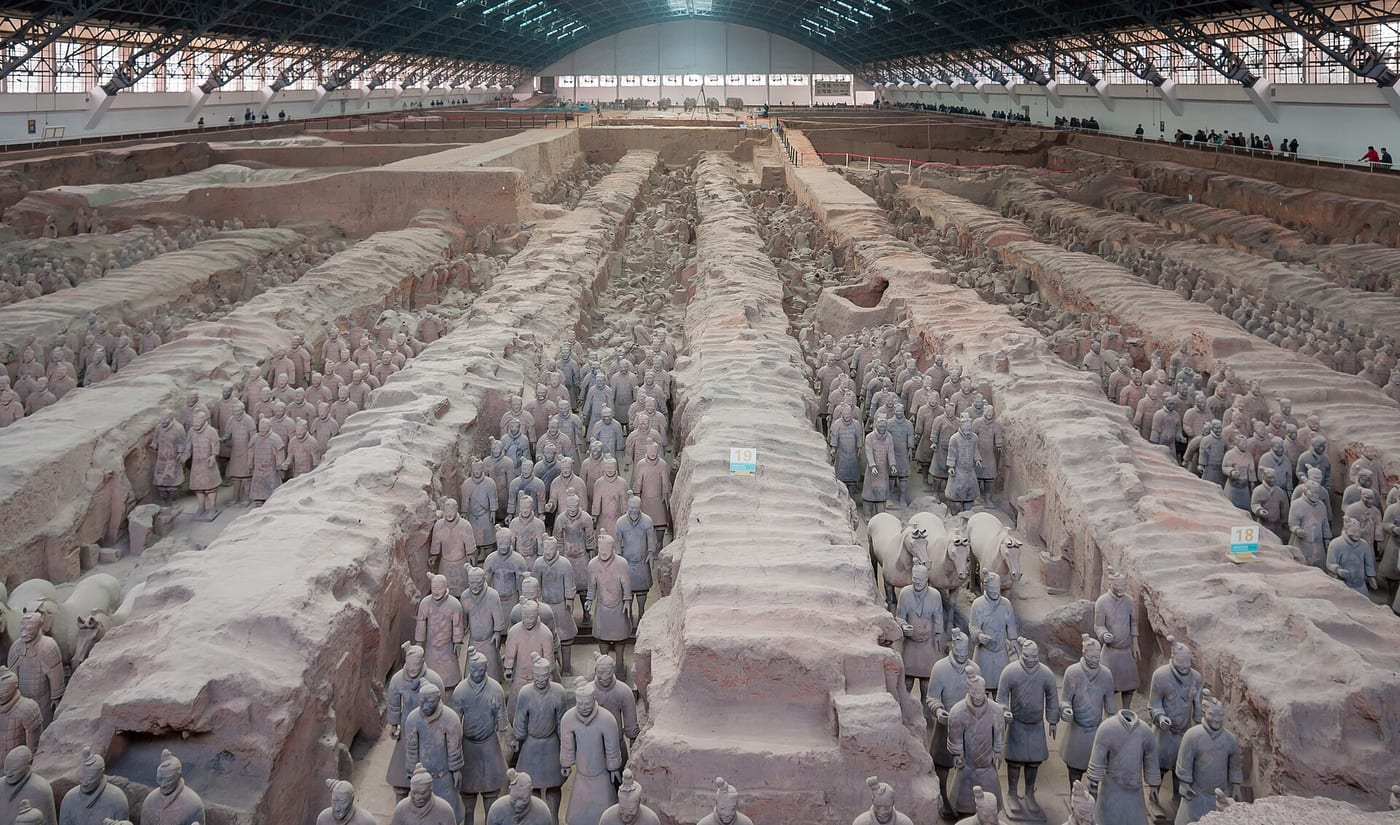
Photo: CEphoto, Uwe Aranas / CC BY-SA 3.0, via Wikimedia Commons
What to eat and how to order
Xi’an is one of the best food cities in China for wheat noodles, flatbreads, and Halal beef and lamb:
- Roujiamo (肉夹馍 — crispy flatbread burger): note that standard Shaanxi lazhi roujiamo is braised pork; if you eat Halal or avoid pork, walk into the Muslim Quarter and order cured beef roujiamo (
腊牛肉夹馍). - Biangbiang noodles, oil-splashed noodles (
油泼面), liangpi (cold skin noodles), and yangrou paomo (lamb stew with hand-torn bread): if you do not want chili oil on your noodles, ask for免辣 / 不要油泼辣子when ordering. - Skip the main Beiyuanmen souvenir strip for meals: turn into the side streets of Dapiyuan (
大皮院), Sajinqiao (洒金桥), and Miaohou Street where locals actually eat.
For allergy, vegan, and Halal cards to show the kitchen, see ordering food in China with allergies or dietary rules.
Getting around locally
Xi’an’s street grid runs straight north–south and east–west, and Metro Lines 1, 2, 3, 4, and 6 reach every major sight. Activate the Xi’an Metro QR code inside Alipay to tap through the gates.
Avoid taking cars around the Bell Tower roundabout and Grand Tang Mall between 18:00 and 22:00—police close lanes for pedestrian flow, and walking one block to a metro entrance is much faster than waiting for a stuck taxi.
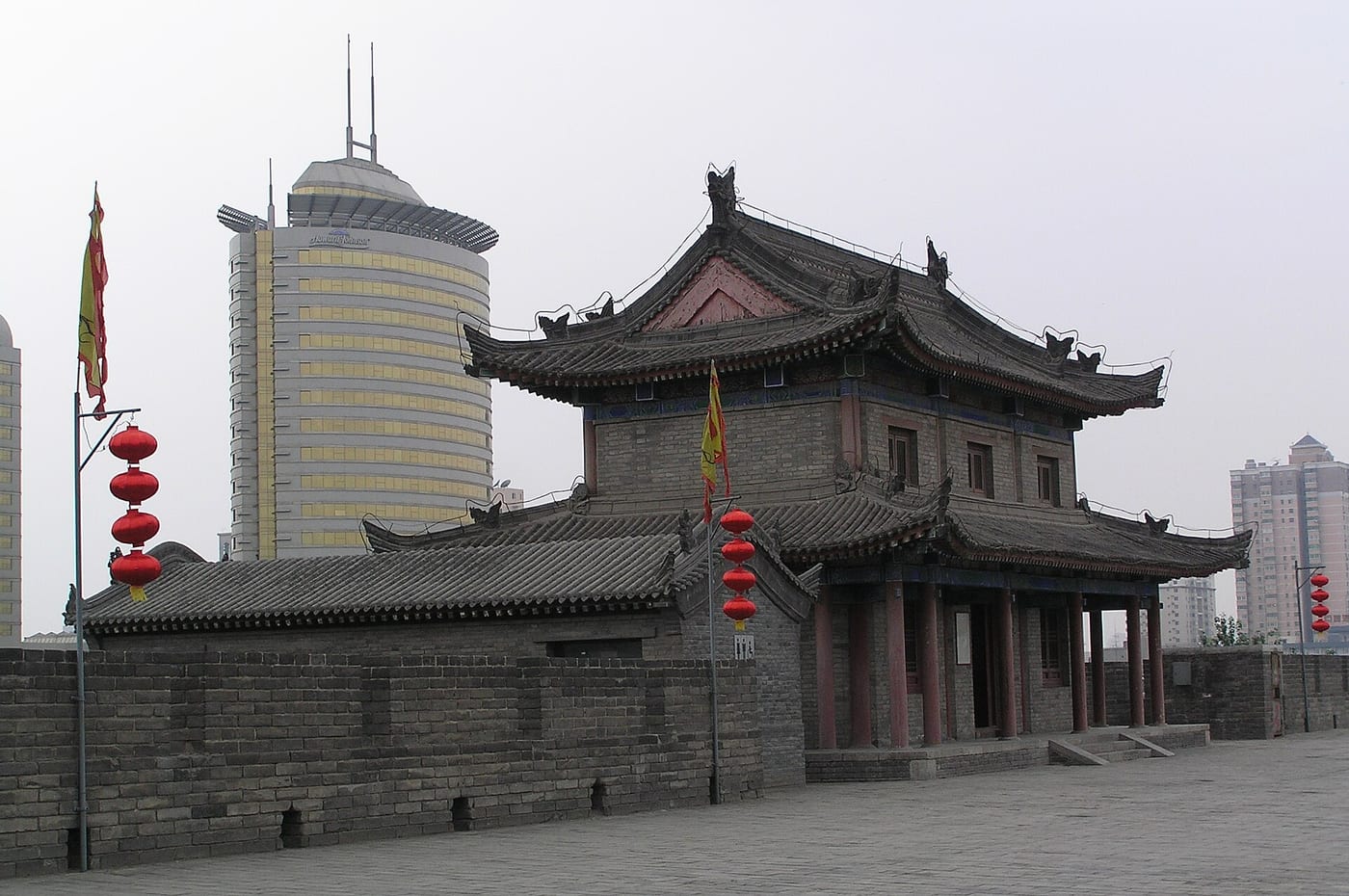
Photo: No machine-readable author provided. Mr. Tickle assumed (based on copyright claims). / CC BY-SA 3.0, via Wikimedia Commons
Best time to visit
April–May and September–October give you dry, comfortable days for walking the pits and cycling the wall.
July and August regularly top 36°C with fierce sun and zero shade on top of the City Wall. December to February is cold and dry outdoors but well heated indoors. Check the month-by-city China packing table.
Common mistakes
- Treating Xi’an as a 1-day stopover: the 80-kilometre round trip to Lintong for the Terracotta Army eats most of a day, leaving you no time for the walled city itself.
- Following touts outside the train station to fake attractions: only go to the official Emperor Qinshihuang’s Mausoleum Site Museum (
秦始皇帝陵博物院), never to replica “underground palaces” pitched by unofficial drivers. - Cycling the Ming City Wall at noon in summer: there is not a single tree on the stone ramparts; go after 17:00 instead.
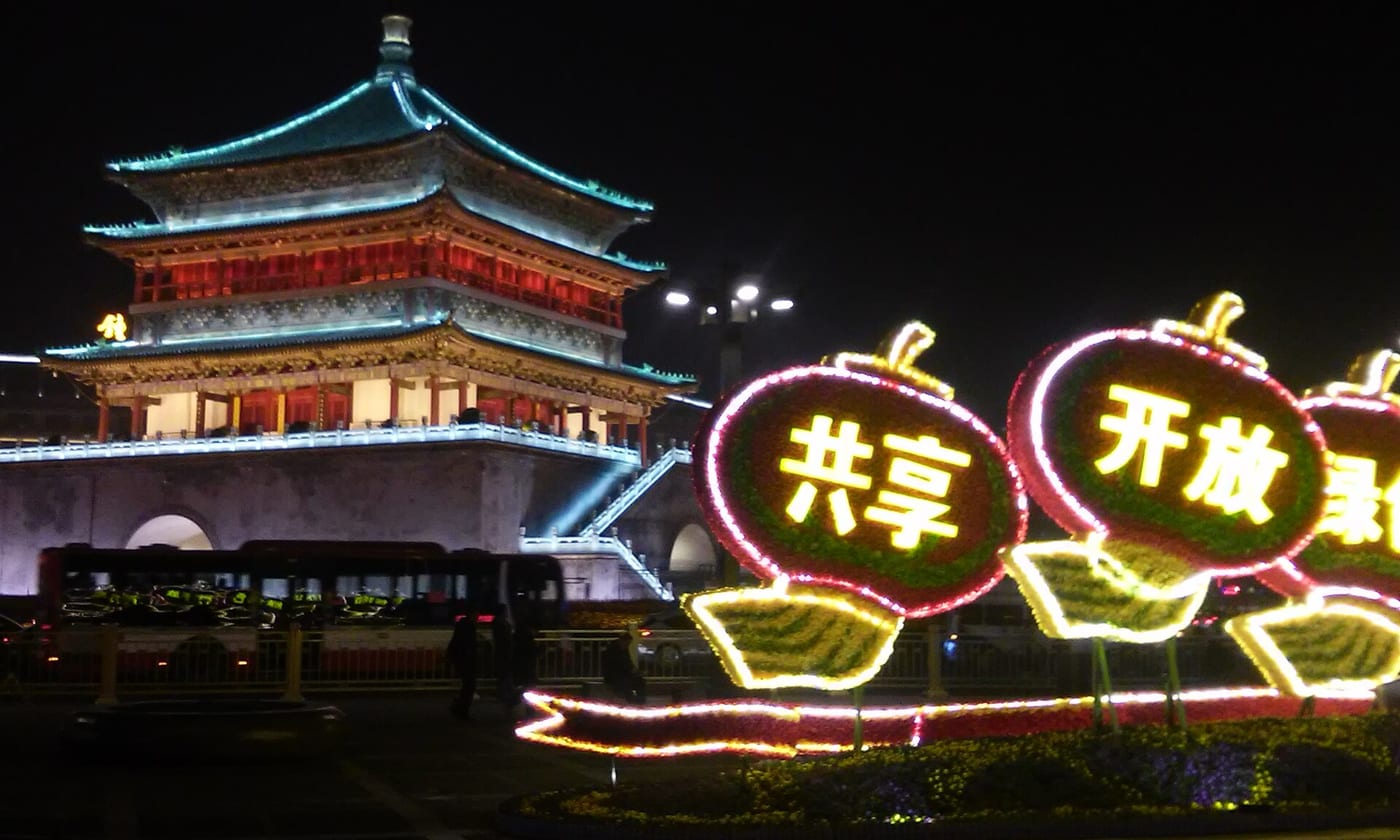
Photo: Tgasrio / CC0, via Wikimedia Commons
Compare China hotels Browse China tickets
Affiliate link. Compare prices on the partner site before you pay.
Questions visitors ask
- Is Xi'an worth visiting, and how many days do I need?
- Yes—if you want to see the Terracotta Army, cycle a complete Ming Dynasty city wall, and eat Northwest noodle and Halal dishes. Budget 3 full days (2 to 3 nights); a single day leaves you stuck in afternoon crowds.
- What is the easiest way to get to the Terracotta Army on my own?
- Take the metro to Line 9 (Huaqingchi or Qinlingxi station) and a 15-minute taxi or shuttle bus to the Emperor Qinshihuang's Mausoleum Site Museum, or book an official direct tourist bus or DiDi from your hotel.
- Is Xi'an hard for first-time foreign travellers?
- No. The city is laid out on a compass grid, the metro links the airport and high-speed rail station directly to the centre, and the Muslim Quarter makes Halal dining effortless.